
The global trade ecosystem includes activities performed by various role players operating across the shipping, freight, maritime, logistics, supply chain, and trade industries.. By my estimate, there could easily be more than 150 different role players involved in enabling global trade at one stage or another, depending on how individual roles and functions are classified..
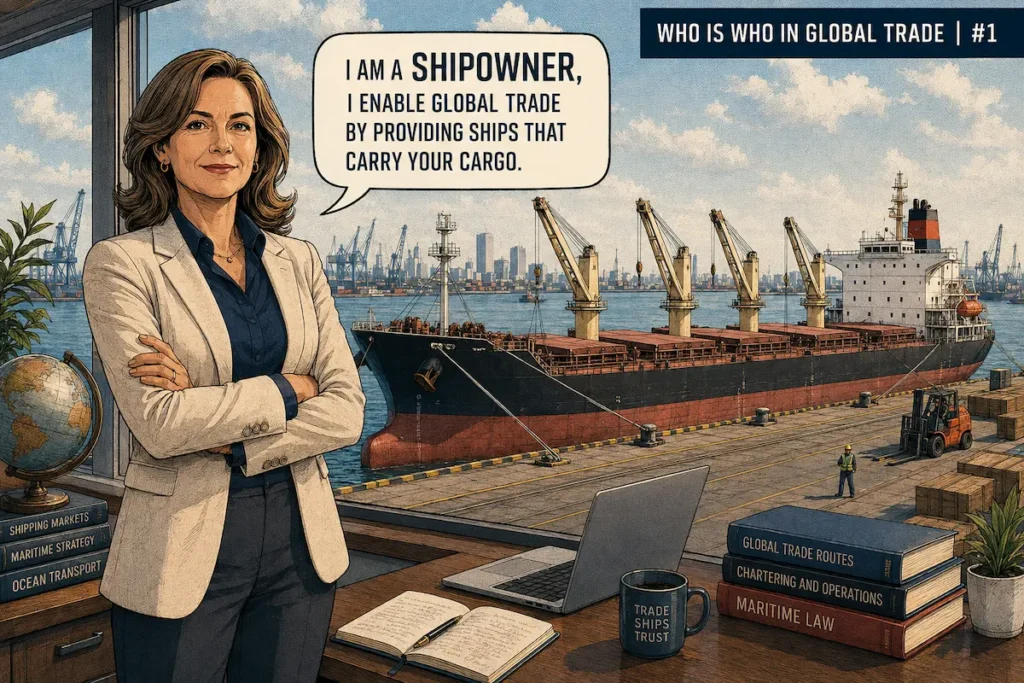
In a new series, “Who is who in global trade”, Shipping and Freight Resource looks at what these entities do and how they contribute to enabling global trade..
In the first article of this series, I look at the shipowner.. Why start there..??
Because according to UN Trade and Development (UNCTAD), around 80% of the volume of international trade in goods is carried by sea.. At the beginning of 2026, the world merchant fleet comprised around 116,000 vessels of at least 100 GT, of which around 62,000 were over 1,000 GT..
Who is a shipowner..??
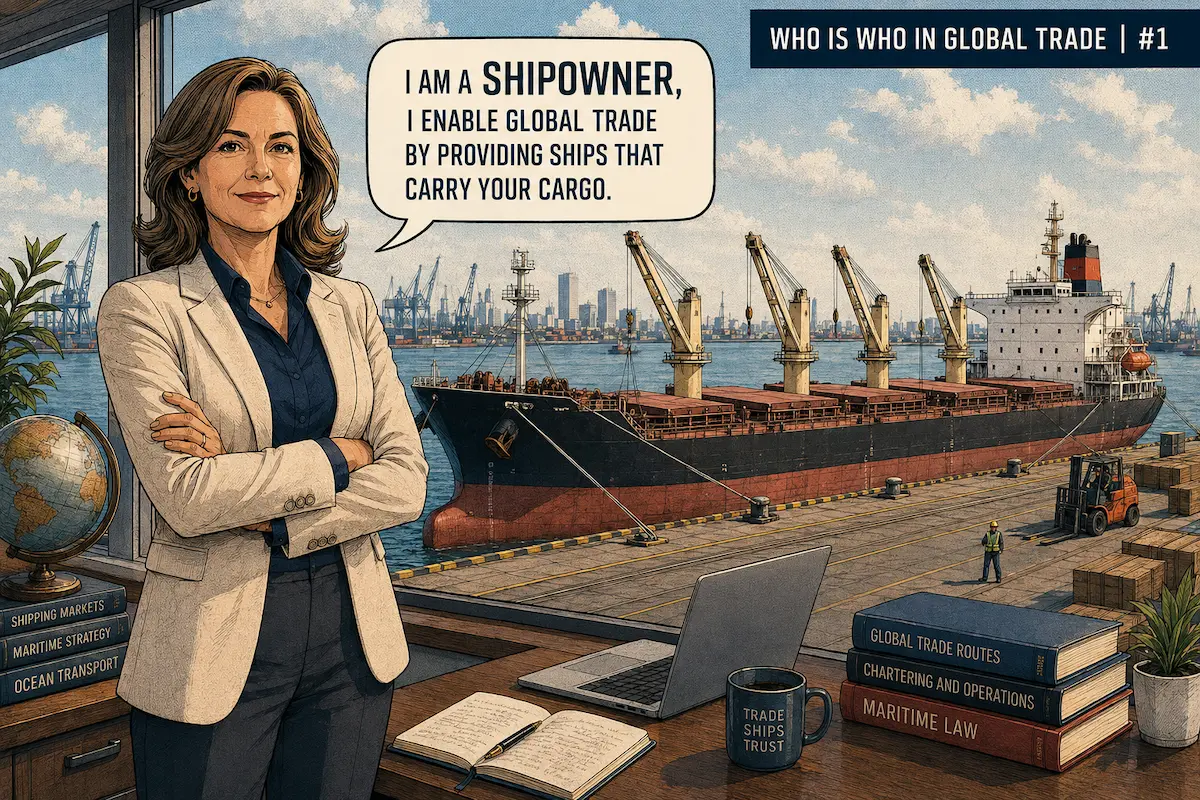
In the simplest sense, a shipowner is a person or company that owns a ship..
Owning a ship comes with some rather large numbers.. A ship may cost tens or even hundreds of millions of dollars, operate for 20-25 years or longer, carry cargo between countries thousands of kilometres apart, and spend most of its working life outside the country where its owner is based..
The shipowner puts capital into acquiring that asset and carries the commercial risks associated with owning it..
The owner decides what type of ship to buy or build, how large it should be, how it will be financed, how it will earn money, when money should be spent on it, and eventually when it should be sold or retired..
And these aren’t small decisions..
Order the right type of ship at the right time, and the owner could have an asset earning revenue for decades.. Order the wrong ship for where the market is heading, and that is an extremely expensive decision to live with..
Who actually owns the ship..??
If you look up a vessel, you will usually find a registered owner.. The IMO defines a registered owner as the owner specified on the ship’s certificate of registry issued by the relevant Administration..
Ships are commonly owned through companies established to hold individual vessels.. So, a shipping group owning 20 ships could have 20 separate companies appearing as the registered owners of those vessels..
You may therefore also hear the term beneficial owner..
The beneficial owner is essentially the person or company behind that registered ownership structure that ultimately owns or controls the commercial interest in the ship.. So, while ABC Vessel Ltd may appear on the ship’s registry as its registered owner, ABC Vessel Ltd could itself be owned or controlled by a much larger shipping group..
UNCTAD uses beneficial ownership for its ship ownership statistics and defines it by the economy where the enterprise having the principal commercial responsibility for the vessel is located..
So, when UNCTAD says Greece is the world’s largest shipowning economy, it doesn’t mean the Greek State owns those ships.. It means the beneficial owners controlling that tonnage are located in Greece..
Where are the world’s shipowners based..??
As of the beginning of 2026, Greece was the world’s largest shipowning economy by carrying capacity, with around 397 million deadweight tons (DWT)..
China followed with around 377 million DWT, while Japan accounted for around 243 million DWT..
According to UNCTAD, companies based in Asia owned around 56% of global carrying capacity, while European companies owned another 34%..
UNCTAD’s underlying regional data puts the combined share owned in Asia and Europe at around 93% of the world’s ship carrying capacity..
That is a remarkable concentration when you consider that these ships trade across virtually every part of the world..
How big can a shipowner be..??
A shipowner can be an individual, a family-controlled shipping group, a publicly listed company, or a state-owned enterprise..
Maria Angelicoussis provides a good example of a major private shipowner.. She leads the Angelicoussis Group, one of the world’s largest privately owned shipping groups, with interests spanning dry bulk, tankers, and LNG shipping..
Companies can own fleets running into hundreds of ships..
Seaspan, for example, describes itself as a leading independent maritime asset owner and operator focused on long-term leases to major shipping lines.. As of 30 June 2026, its fleet consisted of 247 vessels on a pro forma basis including undelivered newbuilds, with approximately 2.5 million TEU of capacity on a fully delivered basis..
In dry bulk, COSCO SHIPPING reported a fleet of 477 dry bulk vessels totalling around 51.2 million DWT at the end of 2025, which it says ranked first globally..
And in RoRo/PCTC shipping, Wallenius Wilhelmsen owned 91 vessels at the end of 2025..
The scale changes.. The basic business of shipowning doesn’t.. Capital has been invested in ships with the expectation that those ships will generate a return over their working lives..
Owning a ship and flagging a ship are 2 different things..
Every ship needs a nationality.. That nationality comes through registration with a flag State, and the ship flies the flag of that State..
The nationality of the shipowner and the flag of the ship can be different..
A Greek shipowner can own a vessel registered in Liberia.. A Japanese owner can have a ship registered in Panama.. The ship remains Greek-owned or Japanese-owned for UNCTAD’s beneficial ownership statistics while sailing under the Liberian or Panamanian flag..
This is why lists of the world’s largest shipowning economies and lists of the world’s largest ship registries look very different..
At the beginning of 2026, Greece, China, and Japan were the three largest economies in terms of beneficially owned carrying capacity.. But the three largest ship registries were Liberia, Panama, and the Marshall Islands..
UNCTAD’s data from the beginning of 2025 illustrates the distinction rather neatly.. 88% of Greek-owned tonnage and 84% of Japanese-owned tonnage was registered under foreign flags..
So, seeing a Liberian flag painted on the stern tells you the nationality of the ship.. It doesn’t necessarily tell you the nationality of the owner..
Why does shipowning matter to a country..??
Shipowning is not a prerequisite for participating in global trade.. A country can be a major exporter or importer without owning the ships carrying its cargo because shipping capacity can be bought from the international market..
But having a significant shipowning sector can give a country something more than access to shipping capacity..
It can create an entire maritime economy around those ships.. Shipowners generate demand for ship finance, marine insurance, shipbroking, maritime law, vessel management, crewing, classification, surveying, ship repair, bunkering, and many other specialist services.. The economic value of shipowning therefore extends well beyond the revenue earned by the ships themselves..
Commercial ships carry the energy, food, raw materials, manufactured goods, machinery, and other commodities on which economies depend.. During wars, geopolitical crises, and other national emergencies, merchant shipping can also become strategically important, with commercial vessels historically used to support military logistics, transport supplies and equipment, and maintain essential supply routes..
Shipowning can therefore contribute to a country’s maritime capability, economic influence, and resilience, although owning ships does not automatically mean that a government can direct or control privately owned vessels whenever it chooses..
And this is where the relationship between the size of a country’s economy, the volume of trade it conducts, and the amount of shipping capacity its companies actually own becomes interesting..
Greece and the USA sit almost at opposite ends of that shipowning spectrum..
Greece does not have the world’s largest economy or the world’s largest merchandise trade volumes, yet Greek beneficial owners control the world’s largest merchant fleet by carrying capacity..
The USA, on the other hand, is the world’s largest economy and one of the world’s largest trading nations, yet US beneficial owners account for only around 1.8% of global merchant fleet carrying capacity, based on UNCTAD’s 2026 data..
Neither position prevents a country from participating extensively in global trade.. But the contrast demonstrates that being a major trading nation and being a major shipowning nation are two very different things..
So now you know the role of a SHIPOWNER in global trade.. Stay tuned for more to follow on the Who is Who in Global Trade Series..