
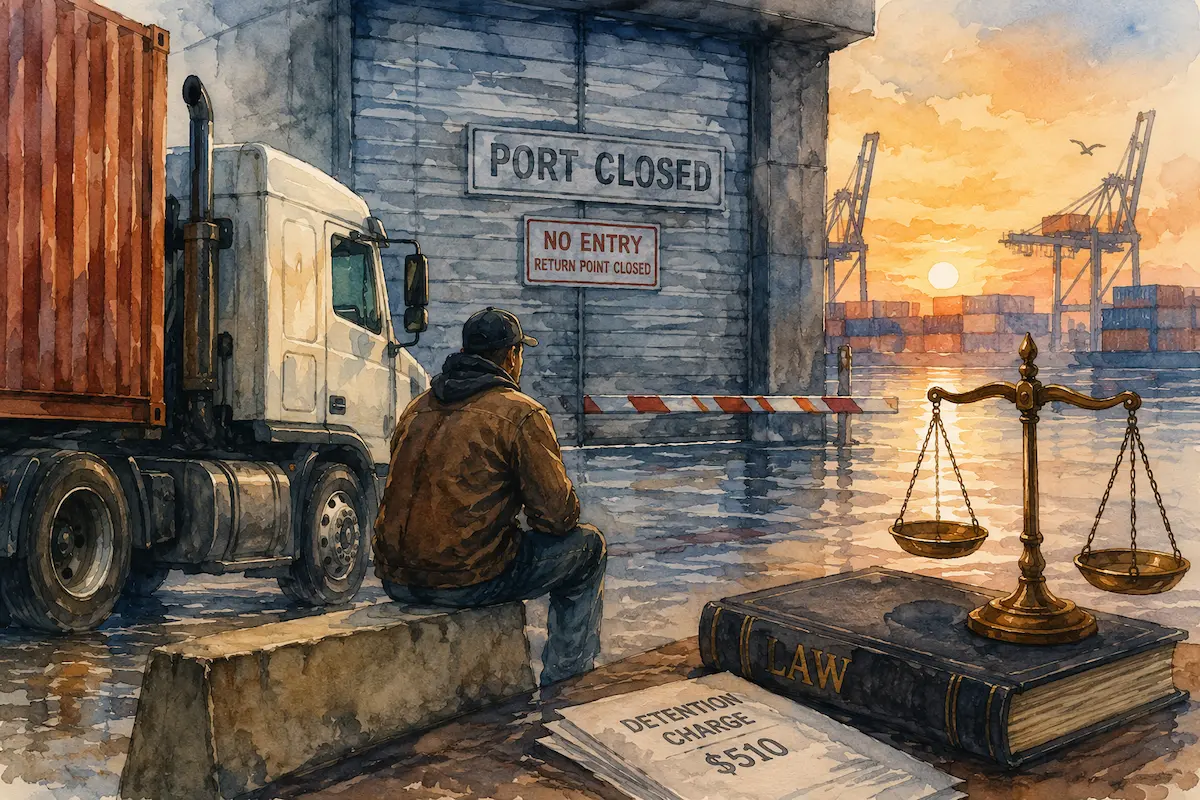
A trucking company collected an import container and chassis from the Port of Savannah.. When the equipment became available for return, the port was closed for 3 days.. The shipping line still charged detention for those days..
The amount in dispute was $510..
Six years, 2 Federal Maritime Commission decisions, and 2 appearances before the United States Court of Appeals later, the trucker won..
On 28 April 2026, the US Court of Appeals for the District of Columbia Circuit upheld the FMC’s decision that Evergreen’s detention charges against TCW were unreasonable..
The Court agreed that TCW should not have been charged for those 3 days because it was impossible to return the equipment while the Port of Savannah was closed..
The FMC uses the term “freight fluidity” to describe the efficient movement of cargo and equipment through the supply chain.. Freight fluidity simply means keeping cargo and equipment moving without unnecessary delays..
As per the FMC, detention charges are intended to encourage the timely return of containers so they can be inspected, repositioned, and reused.. Charging TCW for 3 days when the port gates were closed could not make the container return any faster.. The charge therefore did nothing to improve freight fluidity, which was one of the main reasons the FMC found it unreasonable..
For readers outside the United States, the case raises 2 interesting questions..
Why did the trucking company receive the detention invoice directly from the carrier in the first place, which is uncommon in many countries..??
And if the same dispute happened in your country, who would you ask to review it..??
Why did the trucker receive the invoice..??
Because Evergreen, Yamaha, and TCW were parties to a tripartite equipment agreement.. Under that agreement, TCW took on the trucking activity for the full container and the return of Evergreen’s empty container and chassis within the agreed free time..
TCW received 21 days’ free time for the container and 4 days for the chassis.. Once those periods expired, TCW agreed to pay $150 per day for the container and $20 per day for the chassis..
Evergreen therefore invoiced TCW because the trucking company had accepted direct contractual responsibility for the equipment..
A COVID-related closure at Yamaha’s facility delayed the unloading and release of the container and chassis.. While TCW accepted the detention that had accrued during that period, its objection concerned only the final 3 days, during which the port was closed and the equipment could not be returned..
By 23 May 2020, the container and chassis were available for return.. The Port of Savannah was closed from 23 to 25 May, and TCW returned the equipment on 26 May, immediately after the port reopened..
TCW argued that it should not be charged for a period during which the equipment could not physically be returned.. The FMC agreed, and the Court of Appeals upheld that finding..
Why this may look unusual outside the United States
Readers in many countries will probably pause at one part of this story..
“The trucking company received the detention invoice directly from the shipping line”..
Based on my research across several major trading jurisdictions, direct contractual liability between a shipping line and a trucker appears to be uncommon outside the United States.. While exceptions certainly exist depending on the contracts between the parties, I did not find this to be the predominant commercial model..
In South Africa, detention is normally invoiced to the carrier’s contractual customer, which could be an importer, consignee, or their agent such as a freight forwarder.. The trucker generally performs the inland movement under a separate transport agreement with the cargo interest or freight forwarder..
Where the delay was caused by the trucker, the importer or freight forwarder may recover the detention charge under that inland transport contract.. The shipping line still looks to its own contractual customer for payment..
The position across much of Europe is similar.. The party contracting with the carrier under the bill of lading or service arrangement commonly receives the detention invoice, while the road haulier operates under a separate inland transport contract..
Australia, Singapore, India, parts of the Middle East, and several Latin American markets also appear to operate predominantly under commercial structures where the carrier’s direct billing relationship is with the cargo interest, freight forwarder, or another contracting customer rather than the trucker..
A trucker can become directly liable where it signs an equipment interchange agreement, tripartite agreement, or another contract accepting responsibility for the carrier’s equipment.. That is precisely what happened in the TCW case..
My research did not identify this as the predominant commercial model across the jurisdictions reviewed, although individual carriers, ports, and contracts may differ..
The TCW case therefore reflects a contractual arrangement that is far more familiar in the United States than in South Africa and many other jurisdictions..
Empty container returns also work differently
In South Africa, Europe, Australia, Singapore, and many other markets, empty containers are commonly returned to carrier-nominated private depots, inland container facilities, or off-dock yards.. They do not automatically return to the marine terminal where the full container was collected..
In the United States, empty returns to marine terminals have historically played a larger role, although off-terminal depots are also used.. This creates a closer link between terminal operating hours, appointment availability, empty-return instructions, and detention exposure..
That distinction matters in a case such as TCW’s.. Once the nominated return point is closed, the trucker may have the equipment ready, the driver available, and the transport arranged, but still be unable to complete the return..
The trucker had somewhere to go
The second difference is the protection available to the party being charged..
TCW had somewhere to go and lodge a complaint.. Rather than accepting the invoice or beginning expensive court proceedings, it approached the Federal Maritime Commission..
The Federal Maritime Commission is the independent federal agency responsible for regulating the US international ocean transportation system for the benefit of US exporters, importers, and consumers.. Its mission includes ensuring a competitive and reliable international ocean transportation system and protecting the public from unfair and deceptive practices..
Among its functions is investigating and ruling on complaints relating to the rates, charges, and practices of ocean common carriers, marine terminal operators, and ocean transportation intermediaries under the Shipping Act..
TCW therefore had access to a regulator that understood container detention, equipment returns, terminal closures, and the commercial purpose of the charge..
That is a form of protection many cargo interests and transport providers elsewhere do not have..
Different countries provide different routes
In researching this article, one of the clearest findings was that there is no single international model for dealing with detention disputes.. Commercial practices, contractual arrangements, and regulatory oversight vary between jurisdictions and, in some cases, between carriers operating within the same country..
South Africa has maritime authorities, port regulators, competition bodies, and courts.. None performs the same specialist commercial dispute role as the FMC for an individual detention invoice..
The United Kingdom has the Maritime and Coastguard Agency, whose responsibilities focus mainly on maritime safety, ship standards, pollution prevention, seafarers, and emergency response.. A commercial dispute over a container detention invoice would ordinarily remain a contractual matter between the parties..
Australia has the Australian Competition and Consumer Commission, which can investigate competition and fair-trading concerns.. Its role is broader than the FMC’s and does not provide the same specialist forum for every disputed detention charge..
Singapore has a major maritime and port authority.. India, the Middle East, Latin America, and European countries also have maritime administrations, port authorities, competition regulators, and commercial courts..
Their mandates differ.. A body responsible for port operations, vessel safety, licensing, or competition law may have no authority to decide whether a specific detention charge was reasonable..
In practice, many disputes begin with the shipping line.. The importer, consignee, freight forwarder, or trucker submits supporting records, explains why the container could not be returned, and asks for the charge to be waived or reduced..
If the carrier refuses, the remaining route may be arbitration, litigation, or a commercial settlement.. For a few hundred dollars, the legal route rarely makes financial sense..
Who protects cargo interests where you operate..??
The TCW case shows 2 sides of the US system..
The trucker had accepted direct contractual responsibility for the equipment and was therefore correctly invoiced by Evergreen..
The FMC then protected the trucker’s right to challenge the part of the invoice that arose while the port was closed and return was impossible..
That combination is what makes the case unusual..
This article does not suggest that every country or every shipping contract operates in the same way.. It reflects the predominant commercial and regulatory approaches identified during my research and uses the TCW case to show how different contractual structures and regulatory systems can produce very different outcomes..
Suppose a trucking company, importer, exporter, or freight forwarder in your country receives a detention invoice that it genuinely believes is unreasonable..
- Who reviews the complaint..??
- Who understands the difference between contractual liability and operational impossibility..??
- And where the amount is only a few hundred dollars, is there any realistic route beyond a commercial appeal to the shipping line..??
The United States has the Federal Maritime Commission..