
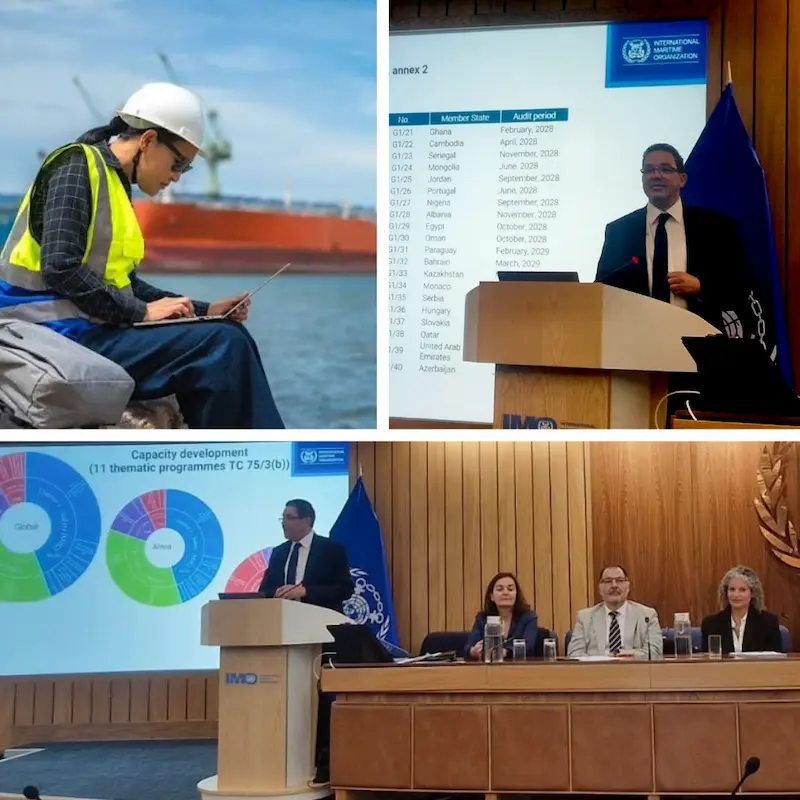
We all know there is no shortage of IMO regulations governing international shipping..
Over the years, the IMO has adopted conventions, codes, resolutions, circulars, and mandatory requirements covering ship safety, pollution prevention, maritime security, seafarer training, casualty investigations, certification, and several other aspects of shipping..
But there has always been an important question.. “How many countries are actually implementing and enforcing these regulations as intended..??”
That question becomes particularly relevant after a maritime disaster.. When there is a collision, grounding, fire, pollution incident, or loss of a vessel, attention eventually turns to whether the applicable IMO requirements were properly implemented and enforced by the Member States responsible..
The International Maritime Organization has now completed the first mandatory audit cycle aimed at assessing exactly that..
What is IMSAS..??
The IMO Member State Audit Scheme, known as IMSAS, assesses how effectively Member States implement and enforce mandatory IMO instruments..
The Scheme audits governments and their maritime administrations.. It assesses how Member States fulfil their obligations as flag States, port States, and coastal States..
A flag State is responsible for ships registered under its flag, including ensuring that these ships comply with the applicable international conventions.. A port State exercises jurisdiction over foreign ships visiting its ports, while a coastal State exercises rights and responsibilities within the maritime zones under its jurisdiction in accordance with international law..
The audits are conducted against the IMO Instruments Implementation Code, commonly known as the III Code.. This provides the framework used to assess how Member States carry out their responsibilities under the mandatory IMO instruments covered by the Scheme..
According to the IMO, IMSAS helps Member States improve how they implement and enforce IMO regulations, contributing to safer, more secure, and more environmentally sustainable shipping..
The first mandatory audit cycle is complete
IMSAS became mandatory in 2016..
Since then, the IMO has audited 168 Member States, covering around 94% of its membership.. The IMO describes this as one of the most extensive collective assessments of global maritime governance ever undertaken..
There were Member State audits before 2016 under the Voluntary IMO Member State Audit Scheme.. The latest announcement therefore relates to the completion of the first audit cycle since the Scheme became mandatory..
The first cycle has produced evidence on how IMO instruments are being implemented around the world.. According to the IMO, audit findings, Corrective Action Plans, and analyses of Consolidated Audit Summary Reports have identified recurring areas requiring attention and the root causes behind them..
IMO, however, does not disclose what those recurring issues are or how individual Member States performed..
Why does the audit matter..??
IMO conventions depend on Member States putting their requirements into practice..
Countries must implement the applicable requirements through their own laws, maritime administrations, procedures, oversight, and enforcement activities.. IMSAS gives the IMO a common process for assessing how effectively those responsibilities are being carried out..
The audit findings also help the IMO determine where technical assistance is needed.. This allows support to be directed towards Member States that need help addressing gaps, implementing corrective actions, and improving the application and enforcement of IMO instruments..
The findings also support the IMO Capacity Development Strategy under Resolution A.1205(34).. That strategy recognises IMSAS outcomes as a basis for shaping capacity development programmes and technical cooperation projects around the needs identified through the audits..
What happens after an audit..??
Audit findings are followed by Corrective Action Plans, commonly referred to as CAPs..
These plans set out how a Member State intends to address the findings raised during its audit.. The combined audit findings also allow the IMO to identify recurring problems and determine where broader technical assistance may be required..
The IMO Member State Audit Scheme webpage also explains that the audit process produces Executive Summary Reports, Corrective Action Plans, Audit Final Reports, and follow-up reports.. Some reports can be made publicly available where the audited Member State authorises their release..
The second mandatory cycle begins in 2027
The second mandatory audit cycle will begin in July 2027 under the revised Framework and Procedures for IMSAS contained in Resolution A.1211(34)..
The revised Scheme introduces the IMSAS Continuous Monitoring Mechanism, known as the ICMM.. According to the IMO, it will use a more risk-based approach, supported by information and data, to assist with continuous monitoring, audit prioritisation, and the use of audit findings in capacity development and technical cooperation activities..
The IMO has also encouraged Member States to continue nominating suitably qualified auditors, particularly women and young professionals, in accordance with Circular Letter No. 5105..
The results still matter
Completing audits of 168 Member States is a substantial administrative achievement.. It gives the IMO a broad body of evidence on how its regulations are being implemented across its membership..
But completing the audit cycle does not, by itself, tell the maritime industry how well countries are performing..
The IMO has confirmed that recurring implementation issues and their root causes were identified.. It has not yet disclosed what those issues were, how widespread they were, or which areas of implementation caused the greatest difficulty..
The real value of the audit cycle will become clearer when the IMO releases more detail on the recurring problems identified, how widespread they were, and whether the corrective actions taken by Member States produced measurable improvement..
Those findings would give the maritime industry a clearer view of where IMO regulations are being implemented effectively and where further work is still required..