
There is no shortage of stories about what is going wrong in South Africa as a whole and specifically its logistics sector.. Port congestion, rail constraints, ageing infrastructure, and rising costs have dominated industry headlines for years..
Those stories matter because they affect businesses, exports, and the economy.. But every now and then, a story comes along that reminds us why it is equally important to recognise what is going right..
One such story emerged during a recent Agri View interview hosted by agricultural economist Wandile Sihlobo, where he spoke with Dr. Boitshoko Ntshabele, CEO of the Citrus Growers Association of Southern Africa (CGA)..
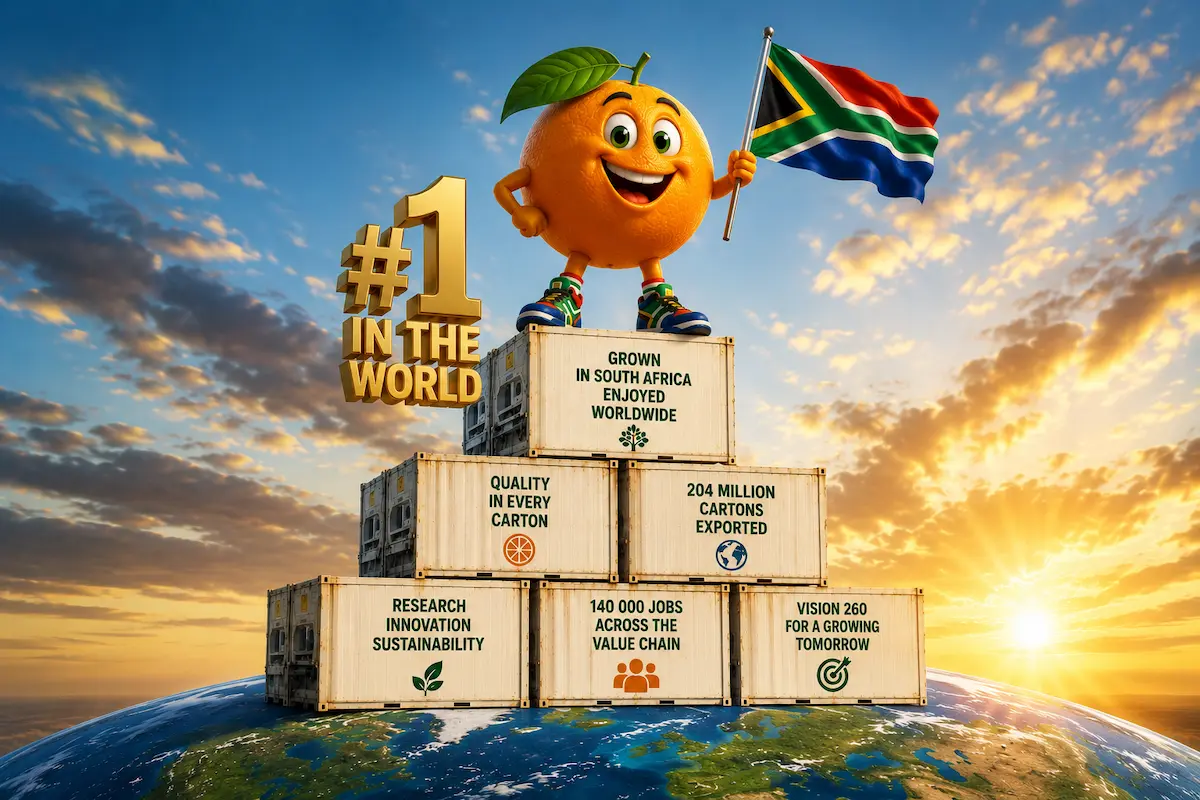
During the discussion, Dr Ntshabele confirmed that South Africa has overtaken Spain to become the world’s largest exporter of citrus by volume, a remarkable achievement that deserves recognition..
As someone who has spent more than three decades working in shipping, freight, and global trade, I found this interview refreshing..
It is easy to focus on operational failures because they are visible when things go wrong.. Success, on the other hand, usually comes from years of consistent investment, planning, and collaboration that rarely make the headlines..
That is good news for South Africa.. It is good news for agriculture.. And for those of us in shipping, freight, logistics, and exports, it is a reminder that cargo does not become an export statistic by accident.. Someone grows it, packs it, cools it, documents it, moves it, ships it, and sells it..
What I found especially useful in the interview was that Dr Ntshabele did not present this as a sudden success story.. He traced it back to decisions made years ago by the industry, especially the decision to invest heavily in research through Citrus Research International..
According to him, around 60% of the citrus levy collected goes mainly into research, covering areas such as cultivars, South African growing conditions, market needs, shipping routes, and fruit quality on arrival..
That matters because South African citrus travels far.. We are at the southern end of Africa, and fruit destined for overseas markets has to hold its quality over distance, time, handling, and temperature changes.. Good fruit on the tree is only the starting point, and export success depends on whether that fruit can arrive in the market in the condition the buyer expects.
The interview also touched directly on logistics, which is where the story becomes even more relevant for this platform..
Dr Ntshabele said the industry had identified clear issues around port efficiencies and had put an engagement model in place with Transnet based on stakeholder relations, core planning, and regular meetings..
He said the CGA continued providing better information to Transnet Port Terminals, which helped them anticipate the flow of fruit, including fruit coming from Zimbabwe on the N1, and plan for empty containers and refrigeration capacity..
He also said last year’s 204 million cartons were processed through the ports.. He described this as a good example of how “cooperation, collaboration, stakeholder management” helped Transnet provide support to the citrus industry at that moment..
That provides another practical industry example to the conversation I recently had with Michelle Phillips, Group Chief Executive of Transnet, in the SFR Executive Insights feature..
This citrus interview also shows the value of strategic collaboration between industry stakeholders and logistics service providers..
Dr Ntshabele was clear that more work remains.. He referred to roads, rail, municipal infrastructure, port efficiency, and the need for more speed in bringing rail capacity into the system..
He also explained that poor road conditions damage fruit quality, and when fruit arrives in overseas markets in poorer condition, the grower carries the loss..
That is the part of logistics that people outside the industry sometimes miss.. A delay is rarely just a delay.. A poor road is rarely just a poor road.. In a perishable export chain, time, temperature, road quality, container availability, and port planning all land in the final value of the cargo..
The longer-term ambition is also significant. Dr Ntshabele spoke about the CGA’s Vision 260, the industry’s target of exporting 260 million cartons.. He said the industry supports around 140,000 jobs across the value chain, and linked further growth to rural livelihoods, port efficiency, roads, infrastructure, rail, and market access..
South Africa becoming the world’s leading citrus exporter is an achievement for its agriculture, its exports and its logistics capabilities..
It is also a reminder that when industry invests in research, shares information, plans properly, and works with the transport system instead of only shouting at it from the outside, measurable progress is possible..
So yes, our glass is indeed half full..
But keeping it that way will need continued investment, better infrastructure, more reliable rail, stronger port performance, and more market access..
The citrus industry has shown what long-term thinking can produce.. The next test is whether South Africa’s logistics system can keep pace with that ambition..
Credit to Wandile Sihlobo and Agri View for bringing this conversation to the surface, and to the Citrus Growers’ Association of Southern Africa for telling a good news story that South Africa’s export sector should welcome..