
South Africa faces the loss of preferential US market access under the African Growth and Opportunity Act from 1 January 2027.. The US announcement raises questions about tariffs, export competitiveness, and employment.. Diplomatic negotiations and alternative trading arrangements remain possible, although affected exporters must prepare for higher duties if the decision proceeds..
Why is South Africa being removed from AGOA..??
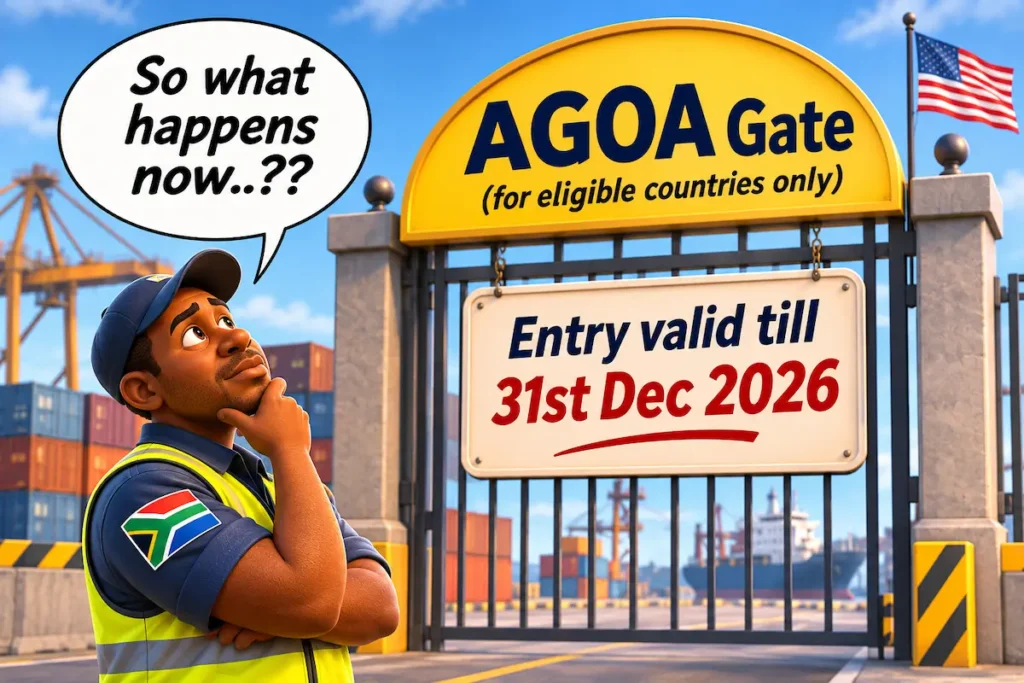
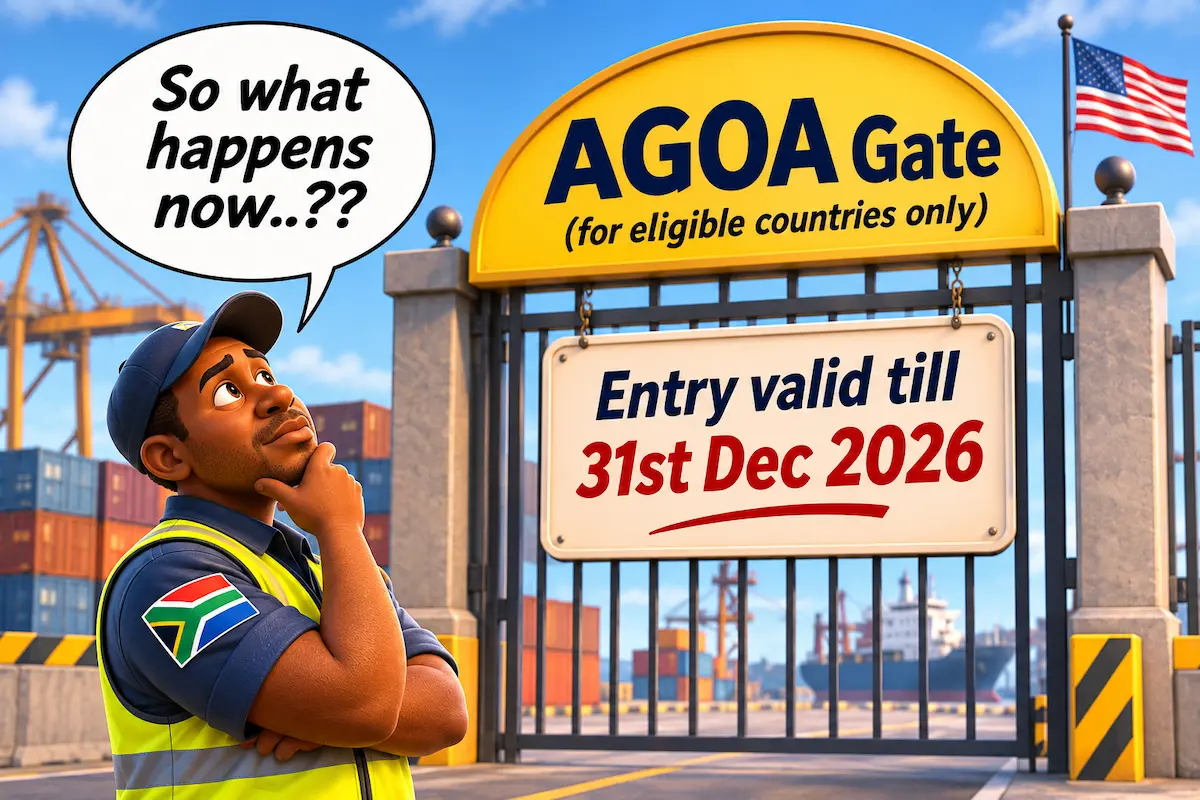
On 2 November 2026, the Office of the United States Trade Representative (USTR) announced President Donald Trump’s intention to terminate South Africa’s and Rwanda’s eligibility under the African Growth and Opportunity Act (AGOA) from 1 January 2027.. Congress and both governments have been notified..
Introduced in 2000, AGOA allows eligible sub-Saharan African countries to export qualifying products to the United States duty-free.. Participating countries must satisfy requirements relating to trade, investment, governance, and other conditions established under US law..
US Trade Representative Jamieson Greer cited barriers to American trade and investment, corruption, and concerns involving US national security and foreign policy interests.. These are the US administration’s stated reasons, although the announcement did not provide detailed findings supporting each allegation against South Africa..
South Africa’s Minister of Trade, Industry and Competition, Parks Tau, has disputed the decision.. According to statements reported by Daily Maverick on 3 November 2026, Tau said South Africa had responded constructively to American concerns and offered additional trade concessions.. The government intends to continue diplomatic engagement and support affected businesses..
AGOA itself under potential threat
There is a separate development affecting ALL countries benefiting from AGOA..
On 3 February 2026, President Trump signed legislation extending AGOA through 31 December 2026.. Unless Congress approves another extension, the programme’s preferential trade benefits will expire at the end of the year..
The US administration has expressed support for extending AGOA while seeking changes to the programme, including greater market access for American businesses..
South Africa therefore faces 2 uncertainties.. The first concerns the US government’s intention to terminate its AGOA eligibility from 1 January 2027.. The second concerns whether Congress will extend AGOA beyond December 2026 and what conditions might apply..
Even if Congress extends AGOA, South Africa could remain excluded unless the US changes its eligibility decision..
What does AGOA exclusion mean for South African exporters..??
South African exporters would lose preferential duty-free treatment for products currently qualifying under AGOA.. Those products would face their otherwise applicable US import duties, including additional tariffs where relevant..
The actual increase depends on each product’s classification under the Harmonized Tariff Schedule of the United States (HTSUS) and the tariff measures applicable when the goods enter the country..
According to figures reported in the public domain as provided by Minister Tau, South Africa’s AGOA exports declined from approximately US$4 billion in 2024 to US$1.7 billion in 2025.. The share of South African exports to the US entering under AGOA fell from 28% to 10% over the same period..
AGOA exports accounted for approximately 1% of South Africa’s total global exports in 2025, according to Tau.. However, the relatively small national share offers limited comfort to businesses whose export programmes depend on the preference.. For individual producers, additional duties could determine whether American customers continue buying South African products or switch suppliers..
South Africa’s citrus industry is particularly concerned.. Gerrit van der Merwe, chairperson of the Citrus Growers’ Association, warned that removing AGOA benefits could threaten jobs in the Western and Northern Cape, including communities such as Citrusdal.. Redirecting established citrus exports involves phytosanitary requirements, customer relationships, and transport arrangements..
Some processed food products face substantial exposure.. Economist Eckart Naumann identified edible ice and sorbets in the Daily Maverick report of 3 November 2026, stating that South African exports in this category exceeded US$33 million in 2025.. He estimated that withdrawing AGOA would expose qualifying products to a 17% standard tariff previously waived under the programme..
Economist Wandile Sihlobo offered a broader perspective in his analysis published on 2 November 2026.. He estimated that losing AGOA could add an average Most Favoured Nation (MFN) tariff of approximately 3.4 percentage points to affected South African products.. His example shows a tariff increasing from 12.5% to 15.9%, although the actual increase depends on the product..
The commercial impact will depend on the product and the exporter’s ability to absorb or pass on additional duties..
Is AGOA exclusion really that bad..??
South African businesses can continue exporting to the US even if AGOA preferences are withdrawn, subject to applicable tariffs and import requirements.. The commercial challenge is whether individual products remain competitive after duties, freight costs, insurance, distribution expenses, and other import-related charges are considered..
Alternative export markets offer another option, particularly through South Africa’s existing trade relationships with the European Union, United Kingdom, and African trading partners.. Exporters must consider market access conditions, product specifications, customer demand, and logistics costs.. For agricultural products, phytosanitary approvals and seasonal supply arrangements can make rapid diversification particularly difficult..
The basic SWOT assessment below considers South Africa’s position following the US announcement, including the options that remain available..
| SWOT | Assessment |
|---|---|
| Strengths | Established US commercial relationships, diversified exports, and access to other international markets.. Approximately 90% of South Africa’s US exports did not enter under AGOA in 2025.. |
| Weaknesses | Dependence on AGOA preferences in certain agricultural and manufactured products.. Some exporters have limited scope to redirect production or absorb additional tariffs quickly.. |
| Opportunities | Further diplomatic negotiations, possible future restoration of eligibility, development of alternative export markets, and examination of longer-term trade arrangements with the US.. |
| Threats | Higher import duties, reduced competitiveness, lost US orders, employment pressures, and uncertainty over AGOA’s continuation beyond December 2026.. |
What exporters could potentially prepare for
Exporters should review which products currently benefit from AGOA and work with their US importers or customs brokers to calculate the duties that could apply from January 2027..
Existing commercial contracts also require attention.. Where a US importer pays the import duties, higher tariffs may lead to requests for price reductions or changes to future orders.. Where a South African exporter has agreed to deliver goods under Delivered Duty Paid (DDP) terms, additional import duties may directly affect the exporter’s costs, subject to the contractual arrangements..
For shipments scheduled around 1 January 2027, exporters and freight forwarders should monitor official instructions from US Customs and Border Protection (CBP).. The date appearing on a bill of lading does not automatically determine the customs duty applicable to imported goods.. The relevant customs entry rules and any transitional provisions will determine the treatment of affected shipments..
With negotiations still possible and AGOA’s future uncertain, South African exporters have some difficult commercial decisions to make before January 2027..
My Take
I think South Africa should pursue every reasonable opportunity to retain its AGOA eligibility.. The potential consequences for established exporters and the communities that depend on them deserve serious attention..
Businesses also need to prepare for the possibility that negotiations will fail.. For industries such as citrus, where production and shipping programmes are planned months in advance, waiting until January 2027 could be costly..
Government and industry should already be identifying the most exposed products and examining what support or alternative market opportunities are realistically available.. Preserving established trade relationships deserves serious attention..
Article FAQ
What documents are needed to claim AGOA preferences..??
Importers must establish that their goods meet AGOA’s applicable origin and product eligibility requirements.. Supporting records may include production information, commercial invoices, and origin documentation.. Certain textile and apparel products have additional requirements.. US importers and customs brokers should confirm the documentation required for each product under the applicable customs rules..
Will South African exports automatically become more expensive in the US after AGOA exclusion..??
Products losing AGOA preferences may face higher US import duties, depending on their tariff classification and other applicable measures.. The effect on the selling price depends on commercial agreements and whether the exporter, importer, or another party absorbs the additional cost.. Importers should establish the revised duty before agreeing to future prices..
How can a South African exporter establish whether its products currently benefit from AGOA..??
The exporter should obtain the US tariff classification from its importer or customs broker and confirm whether AGOA preferential treatment has been claimed on previous entries.. Reviewing customs entry records and the applicable origin requirements will help establish the existing preference and calculate the potential additional duty if eligibility ends..
Can goods shipped before 1 January 2027 still qualify for AGOA preferences if they arrive afterwards..??
Shipment before 1 January 2027 does not automatically preserve AGOA eligibility.. US customs entry requirements and any transitional provisions will determine the applicable treatment.. As of 3 November 2026, the USTR announcement does not specify transitional arrangements for cargo already in transit.. Importers should obtain confirmation from US Customs and Border Protection..
*** END OF ARTICLE ***