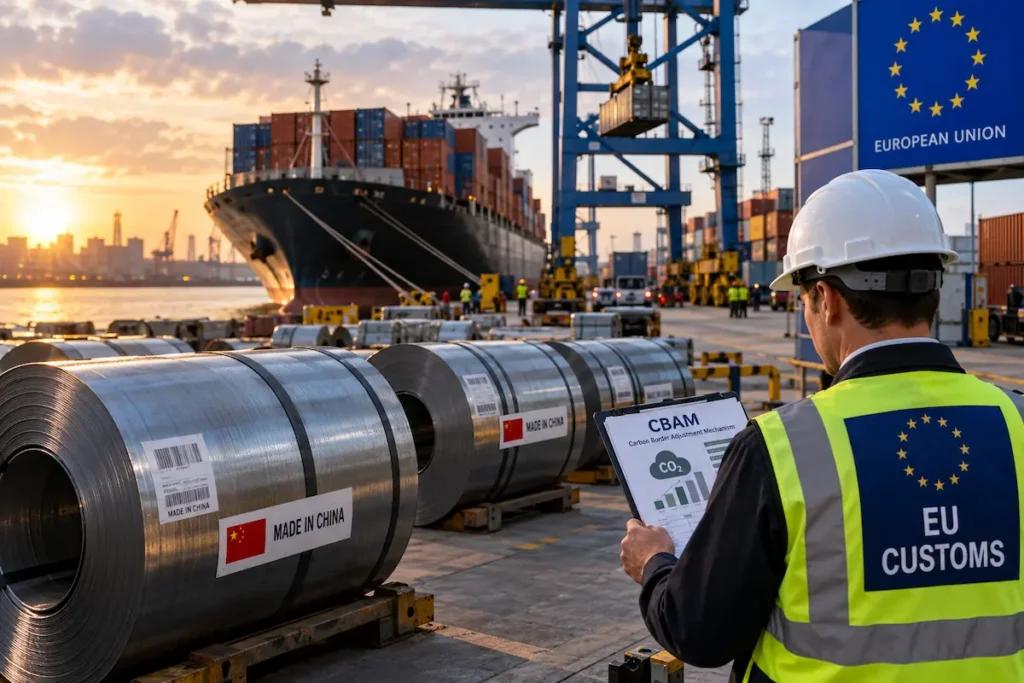

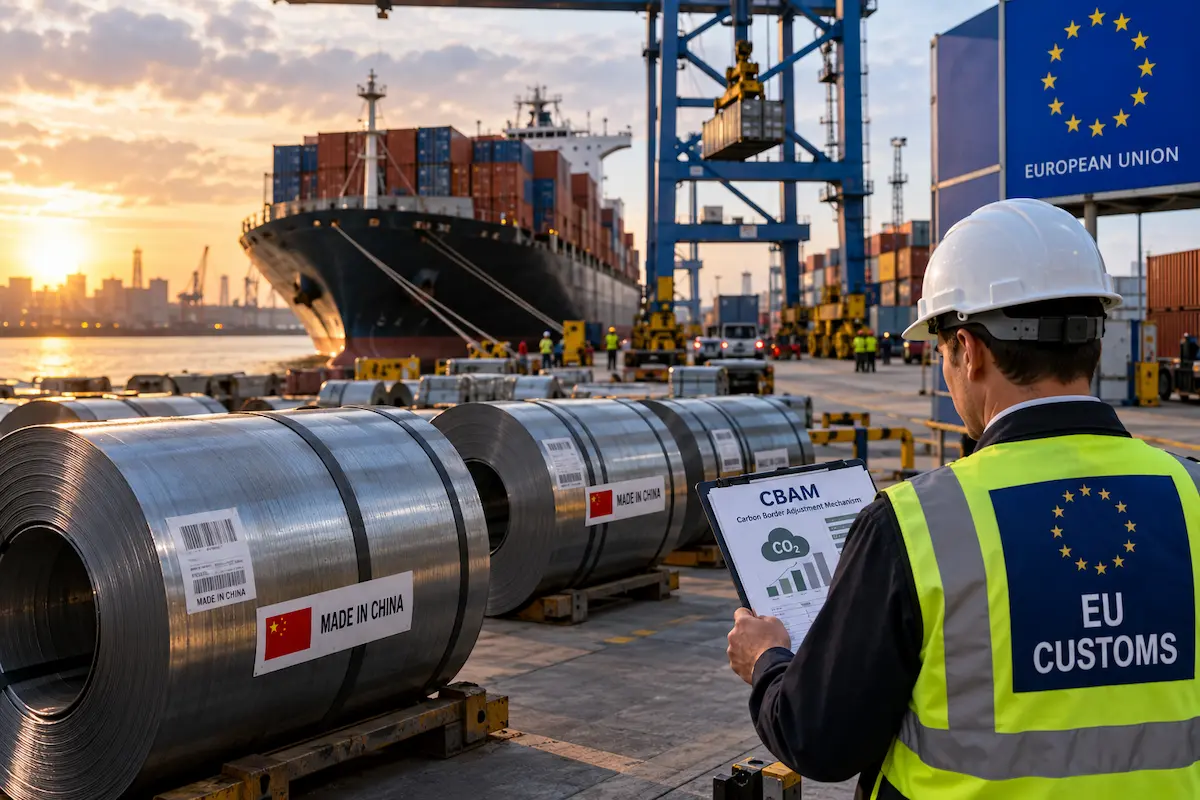
EU importers of steel, aluminium, cement, fertilisers, electricity, and hydrogen are required to pay Carbon Border Adjustment Mechanism (CBAM) costs on qualifying 2026 imports, through certificates sold from February 2027.. These additional supplier emissions cost will now shape landed cost of goods in EU..
Manufacturers producing goods within the EU may have to pay for carbon emissions under the EU Emissions Trading System (EU ETS), while an overseas manufacturer producing similar goods in their country may face lower carbon costs, depending on the manufacturing process and the carbon pricing rules applicable in that country..
This creates a potential cost advantage for imported products, putting local EU producers at a disadvantage..
The European Union introduced the Carbon Border Adjustment Mechanism (CBAM) in May 2023, with a reporting-only phase starting in October 2023..
The CBAM was introduced to address differences in carbon costs for goods like iron and steel, aluminium, cement, fertilisers, electricity, and hydrogen manufactured within the EU and similar goods manufactured outside it..
CBAM entered its definitive phase on 1 January 2026, but the certificates required to settle these carbon-related obligations for 2026 imports will only be available for purchase in 2027..
So basically, businesses importing these goods into the EU in 2026 must account for potential carbon costs, which they will pay in 2027..
How does CBAM actually work..??
Consider a German company importing steel from a Chinese manufacturer.. The German importer, acting as the authorised CBAM declarant, gets the steel’s emissions data from the manufacturer and uses it to work out how many CBAM certificates to buy and surrender, each covering 1 tonne of CO2 equivalent at a price that tracks EU ETS allowances..
The free allocation adjustment cuts that number, mirroring the free allowances EU producers still receive.. Under Implementing Regulation (EU) 2025/2620, it uses EU benchmarks and a CBAM factor of 97.5% for 2026, falling to zero by 2034.. A deduction for carbon prices paid abroad also exists, but as of mid-October 2026 its rules were still in draft, so do NOT count on it for 2026..
Certificates for 2026 imports go on sale in February 2027 and must be surrendered by 30 September 2027.. So the financial exposure arises from imports made in 2026, even though the certificates are bought and surrendered in 2027..
A practical example: Two Chinese steel manufacturers supplying Germany
A German importer can buy the same steel from 2 Chinese manufacturers, both quoting €10,000.. Manufacturer A uses a lower-emission process, Manufacturer B a more carbon-intensive one, and the CBAM calculations come to €400 and €1,600 respectively..

Same steel, same price, €1,200 apart.. The importer can pick Manufacturer A, push Manufacturer B on price, or ask Manufacturer B to cut its emissions..
Is a gap that size realistic in 2026..?? It can be.. The free allocation adjustment follows EU benchmarks set by the most efficient EU producers, so a manufacturer well above the benchmark pays for most of that excess straight away, and the gap widens every year..
Who is actually affected by CBAM..??
- EU importers carry the legal and financial responsibility.. If the carbon cost isn’t in their selling price, it comes straight out of their margin..
- Overseas manufacturers don’t buy certificates, but their emissions decide the importer’s bill, so at the same price the lower-emission mill wins..
- Exporters and traders must get emissions data from the factory that made the goods, because the emissions belong to that factory, whoever sells the steel..
- EU manufacturers using imported steel or aluminium face CBAM on those materials, raising input costs they must absorb, pass on, or source around..
- Freight forwarders and customs representatives aren’t automatically liable, but an indirect customs representative acting as declarant takes on the CBAM obligations.. Classification matters because CBAM applies to specific EU Combined Nomenclature (CN) codes, and the EU is negotiating an extension to between 180 and 457 downstream steel and aluminium products from 1 January 2028..
Does CBAM apply to every shipment..??
No.. Since 1 January 2026, Regulation (EU) 2025/2083 exempts importers whose combined imports of iron and steel, aluminium, cement, and fertilisers stay within 50 tonnes net mass per calendar year.. The sectors count together, so 30 tonnes of steel plus 25 tonnes of aluminium is over..
Once over, CBAM applies to every covered import that year, including earlier shipments, and customs won’t release the goods without authorised declarant status.. Importers who applied by 31 March 2026 can keep importing while they wait, but later applicants need the authorisation BEFORE the shipment that crosses 50 tonnes..
What happens if the exporter cannot provide emissions data..??
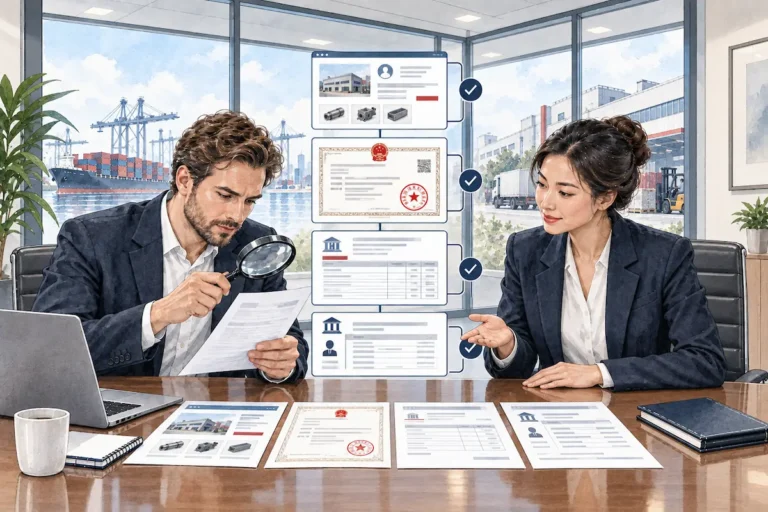
The importer uses default values, set by product and country of origin.. Actual emissions data can replace them only after an accredited verifier has checked it..
Default values are set high on purpose.. Under Implementing Regulation (EU) 2025/2621, most carry a mark-up of 10% for 2026 imports, 20% in 2027, and 30% from 2028, and Implementing Regulation (EU) 2026/1740 corrected a batch of them in July 2026, backdated to 1 January.. A supplier with a sharp price but no verified data quickly becomes the more expensive supplier..
Does the Incoterm determine who pays CBAM..??
No.. Incoterms split delivery, costs, and risk between buyer and seller, but they don’t override EU CBAM law.. Under FOB, the EU importer carries the CBAM obligation as declarant..
DDP is where sellers get caught out.. Declarant status is only for importers established in the EU, so an overseas DDP seller needs an EU-based indirect customs representative to act as declarant.. The sales contract should spell out who provides emissions data and who pays CBAM, especially on all-inclusive prices..
What should businesses be doing now..??
EU importers should build CBAM into supplier evaluation and landed cost now, because the numbers are no longer guesswork.. The European Commission has published 3 of the 4 CBAM certificate prices for 2026: €75.36 for Q1, €75.28 for Q2, and €82.32 for Q3, each applying only to that quarter’s imports.. The Q4 price is due on 4 January 2027..
From 2027, declarants must also hold certificates covering at least 50% of embedded emissions at the end of every quarter, while still settling the 2026 bill.. And don’t over-buy for 2026, because unused 2026 certificates are cancelled on 1 November 2027..
The question for businesses affected by CBAM is whether they have correctly accounted for the carbon costs associated with their 2026 imports and are financially prepared to settle those obligations in 2027..
For those that haven’t, the additional costs could affect margins on goods that have already been purchased, imported, or sold..
My Take
Too many importers still treat CBAM as a flat surcharge per tonne, and I think that’s where the money leaks.. The real cost sits in the gap between a supplier’s actual emissions and the EU benchmark, and for Q3 2026 imports, every tonne of CO2 in that gap costs €82.32.. Two overseas mills quoting the same price for the same coil can land in Hamburg with very different carbon bills.. If I were buying CBAM goods today, I’d ask every supplier for verified emissions data BEFORE asking for their best price.. A supplier who can’t provide it is giving you half a quote..
Article FAQ
What is an authorised CBAM declarant..??
An authorised CBAM declarant is the EU-established importer, or its indirect customs representative, that holds the status needed to import CBAM goods and to buy and surrender CBAM certificates.. National competent authorities grant the status, and since 1 January 2026 one authorisation covers imports into every EU member state..
Why is CBAM charged on emissions and not on the value of the goods..??
CBAM puts a price on carbon, so the bill depends on the tonnes of CO2 embedded in the goods, whatever their invoice value.. One CBAM certificate covers 1 tonne of CO2 equivalent, and the European Commission set the Q3 2026 price at €82.32, so a cheap steel coil with high emissions can cost more than a dearer, cleaner one..
How does a non-EU manufacturer get its CBAM emissions data verified..??
A non-EU manufacturer gets its installation’s emissions report checked by a verifier accredited for CBAM, then sends the verified report to its EU customer.. The European Commission published 10 guidance documents for non-EU operators on 14 August 2026 and guidance for CBAM verifiers on 24 August 2026, both on its CBAM legislation and guidance page..
Critical Note: Can a customs broker or freight forwarder file the CBAM declaration for the importer..??
Yes, a customs broker or freight forwarder can submit the CBAM declaration on the importer’s behalf, but the authorised CBAM declarant stays legally responsible for its accuracy.. Regulation (EU) 2025/2083 introduced this delegation option, so importers should check the broker’s emissions figures before the first declaration falls due on 30 September 2027..
Official sources
Last reviewed and updated by Hariesh Manaadiar: October 2026..
*** END OF ARTICLE ***