
If you thought cargo theft was still about opportunistic break-ins at truck stops or the stolen containers, the latest cargo theft intelligence from BSI Consulting and TT Club paints a very different picture..
2025 showed that cargo crime is becoming more organised, more technology-driven, more violent in some regions, and far more adaptive to changing market conditions than many in the industry may realise..
The latest report highlights how criminal groups are no longer just targeting “cargo” in general..
They are targeting supply chain vulnerabilities, operational blind spots, weak verification processes, digital freight platforms, and commodities whose market value suddenly spikes due to shortages, tariffs, geopolitical pressures, or supply disruptions.
And perhaps the most important takeaway from the report is this..
Cargo theft is no longer just a security issue..
It is now a supply chain resilience issue, an operational risk issue, a technology risk issue, and increasingly, a business continuity issue..
Global hotspots and theft risks are escalating everywhere
According to the report, Brazil, Mexico, India, the United States, Indonesia, Chile, China, Germany, and South Africa remained among the countries with the highest recorded cargo theft incidents in 2025.. Ecuador also experienced one of the sharpest increases in theft activity as organised criminal violence intensified around coastal logistics corridors..
Food and beverage products once again topped the list of stolen commodities globally, followed by agriculture, electronics, automotive parts, construction materials, and metals..
But the more interesting trend is not what criminals stole..
It is how quickly they changed what they targeted..
The report highlights emerging theft activity involving pharmaceuticals in India and rare earth minerals in China, showing how organised groups are closely watching global market conditions, supply shortages, export controls, and commodity pricing..
In other words, criminals are increasingly behaving like opportunistic commodity traders..
When market value rises, theft risk follows..
Trucks still dominate theft statistics, but rail theft is becoming a major concern
Road transport remained the most exposed cargo modality globally, accounting for around 70% of all recorded cargo theft incidents in 2025..
However, one of the most significant developments in the report is the rapid increase in rail cargo theft, especially in the United States..
Organised groups reportedly carried out highly coordinated attacks on freight trains across California and Arizona, targeting electronics, footwear, appliances, and consumer goods.. Some operations involved deliberate sabotage of rail infrastructure, cutting brake lines, damaging signals, and using armed lookouts during theft operations..
This is not random criminality anymore..
This is organised supply chain crime operating with planning, intelligence, logistics coordination, and operational discipline..
The report also notes growing concerns about insider involvement, particularly where specific containers or cargo types appear to be repeatedly targeted, suggesting access to operational shipment information.
Cargo theft is becoming increasingly digital
One of the most concerning sections of the report focuses on load boards and modern freight brokerage..
For years, load boards were primarily viewed as operational tools designed to improve trucking efficiency and reduce empty miles.. Today, according to the report, they are also becoming attractive hunting grounds for organised cargo criminals..
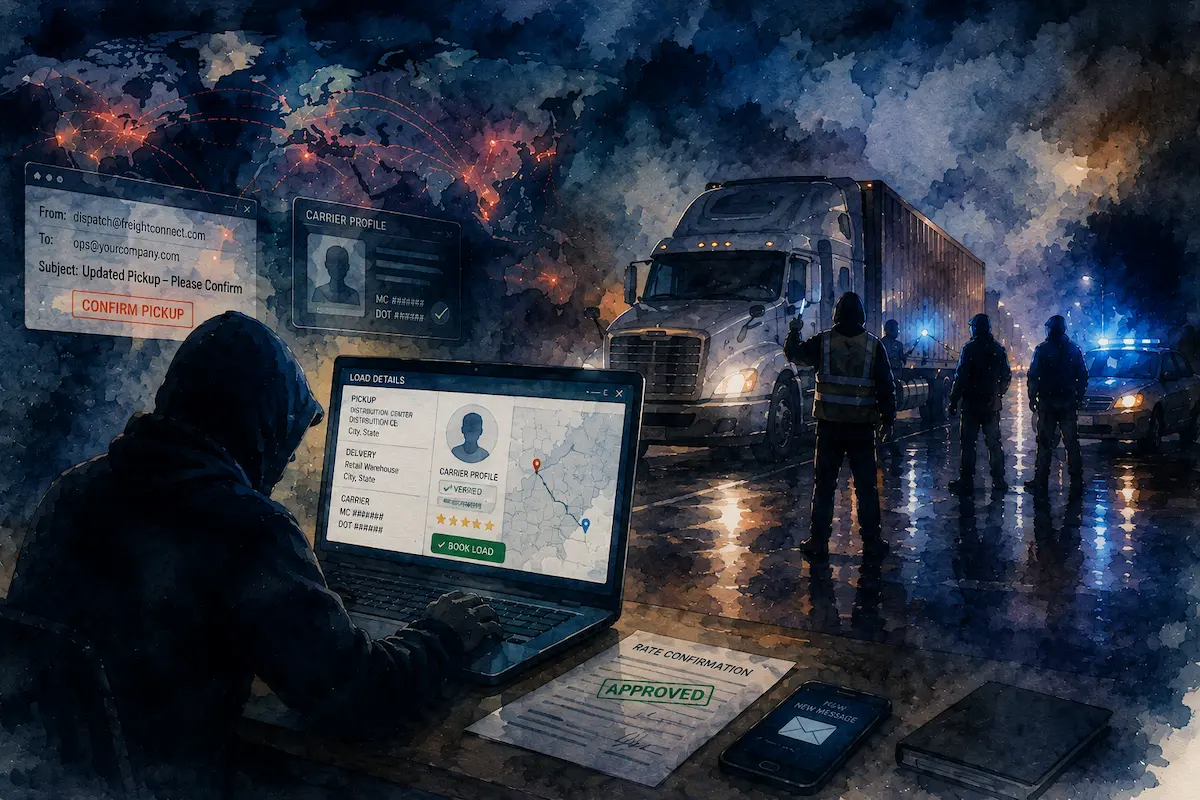
Criminals are reportedly using data scraping tools, fake carrier identities, artificial intelligence, fraudulent documentation, and impersonation tactics to intercept shipments through fictitious pickups, double brokering schemes, and fraudulent carrier accounts..
In several cases highlighted in the report, criminals created fake freight company profiles, spoofed legitimate motor carrier identifiers, and collected cargo before disappearing within hours..
This changes the entire risk profile of freight brokerage..
It means cybersecurity, identity verification, and operational communication controls are now directly linked to cargo security..
And many supply chains are still not prepared for that reality..
Europe continues to battle organised and strategic cargo theft
Across Europe, Germany, Italy, the United Kingdom, France, and Spain recorded the highest number of theft incidents in 2025..
The report highlights increasing use of fictitious pickups and impersonation schemes, including criminals posing as legitimate transport operators or freight forwarders to intercept cargo..
One particularly interesting point is the continued vulnerability linked to unsecured truck parking..
In the UK alone, the shortage of secure truck parking infrastructure reportedly continues to expose drivers and cargo to theft risks at laybys, rest areas, and unsecured transit locations..
This is an issue many in the industry have spoken about for years..
Yet despite advances in visibility platforms, tracking systems and transport management technologies, the basic operational problem of safe truck parking remains unresolved in many markets..
And criminals know it..
Asia’s cargo theft landscape looks very different
Unlike many Western markets where truck-related theft dominates, Asia’s theft exposure is heavily facility-centric..
According to the report, around half of all incidents in Asia occurred at warehouses and production facilities, while only 36% involved trucks..
Insider involvement also remains particularly high across India, China, and Indonesia, often involving gradual pilferage supported by weak inventory controls and internal collusion..
The report also highlights growing multimodal vulnerabilities involving inland waterways, ports, rail transfers, and cross-border logistics operations..
One example referenced is a high-value electronics theft during a sea-to-rail transfer between Guangdong and Kazakhstan, exposing how custody transfer points continue to create operational blind spots within complex international supply chains..
And then there is piracy..
The report states that piracy incidents across Asian waters rose sharply in 2025, with incidents in the Strait of Malacca and Singapore increasing dramatically year-on-year..
Even though many of these incidents involved theft of ship stores and equipment rather than entire cargoes, it still reflects broader instability across maritime trade routes..
South Africa remains firmly on the cargo theft radar
South Africa once again appeared among the countries with significant cargo theft activity in 2025..
The report specifically highlights in-transit thefts, hijackings, insider involvement, and the continued threat posed by sophisticated criminal groups, including so-called “blue light gangs” using impersonation and deception tactics..
For local transporters, freight forwarders, insurers, and cargo owners, this is not new information..
But what is changing is the sophistication, coordination, and speed with which these operations are being executed..
The industry can no longer manage cargo theft using static risk models
Perhaps the most valuable insight in the report is the idea that cargo theft risk is dynamic, not static..
Criminals are following economic opportunity..
That means risk profiles can change rapidly depending on commodity pricing, shortages, sanctions, tariffs, export controls, geopolitical tensions, or sudden shifts in consumer demand..
Copper was highlighted as a clear example..
As copper prices remain elevated globally due to electrification demand and infrastructure investment, theft exposure involving copper coils, cables, cathodes, and scrap has also increased significantly..
This means cargo security can no longer operate separately from market intelligence..
Risk management teams need to understand not only where cargo is moving, but also why certain commodities are suddenly becoming attractive targets..
Final thoughts
The 2025 cargo theft landscape confirms something many operators across shipping, freight and logistics have already sensed for some time..
Cargo crime is evolving faster than traditional security controls..
The modern cargo thief may not always arrive with bolt cutters and a weapon..
Sometimes they arrive with a fake carrier profile, compromised email account, AI-generated identity, fraudulent pickup reference, or access to insider operational information..
And in many cases, the theft is only discovered long after the cargo has disappeared into a secondary market..
The challenge for the industry going into 2026 is not simply improving physical security..
It is building smarter operational controls, tighter verification procedures, better data governance, stronger collaboration between stakeholders, and more dynamic risk management models that evolve as quickly as the threats themselves..
Because the criminals already are..