
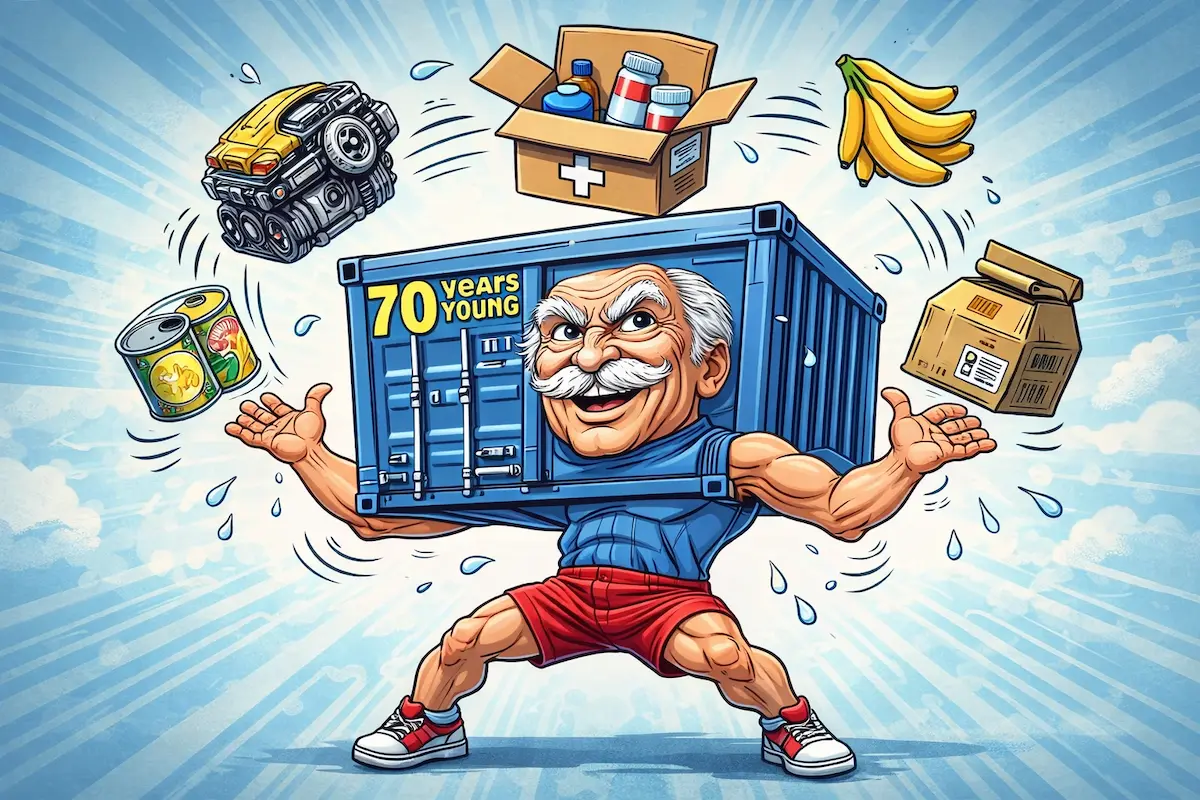
Ten years ago, I wrote a little birthday tribute to the container.. It was a moment to pause and appreciate just how far this humble steel box had come since Malcom McLean and Keith Tantlinger put 58 of them on the SS Ideal X on 26th April 1956..
Well, here we are in 2026.. Ten more years have passed, and the ubiquitous container turns 70..
A lot has happened in these ten years..
- A global pandemic caused one of only two instances in history where global container throughput actually declined
- Global congestion, with hundreds of ships queuing outside Los Angeles, Rotterdam, and Singapore
- Spiking spot rates above $9,000 per TEU on some routes
- A blocked canal and a dry canal
- A Red Sea crisis that continues Houthi attacks on the Bab-el-Mandeb rerouted over 2,000 vessels around the Cape of Good Hope, adding up to 10 days to voyage times and
- Tariff wars
- Blockades of crucial shipping straits
Through all of it, the container kept going.. Today, we take stock of what 70 years of containerisation actually looks like in numbers and in reality..
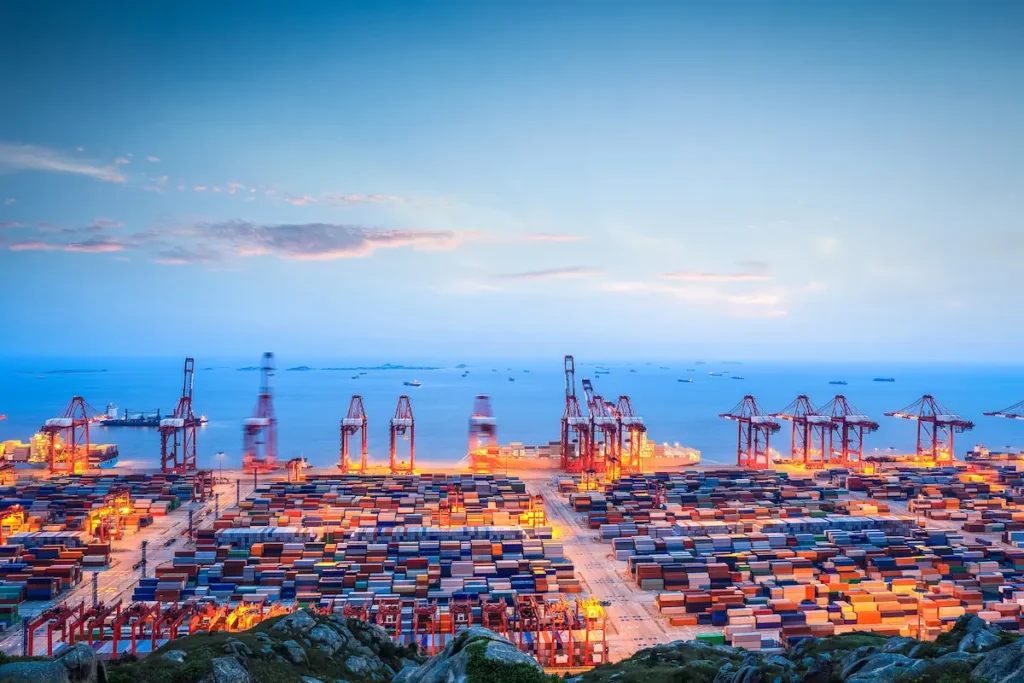
From 58 boxes to nearly a billion moves a year
Here is a picture of how global container volumes have grown over the decades both in terms of container throughput and TEU volumes..

Port Throughput – counts every time a container is handled at a port, including transshipment moves..

TEU Liftings – counts the actual number of containers picked up and shipped, which is what CTS tracks..
To put that in perspective:
Global container throughput increased from 36 million TEU in 1980 to an estimated 1 billion TEUs in 2025, a growth of roughly 28 times over 45 years..
On the CTS liftings side, the jump from 172.1 million TEU in 2022 to 192.9 million TEU in 2025 in just three years is equally remarkable, and 2025 closed as the strongest year on record..
January 2026 already opened at 16.03 million TEUs, 4% ahead of January 2025 and nearly 10% ahead of January 2024, so the momentum is not letting up..
As per CTS, what made 2025 particularly standout was the consistency of those volumes.. 8 out of 12 months in 2025 exceeded 16 million TEUs, a threshold that was only crossed 3 times in the whole of 2024..
New monthly records were set in March, May, August, and December, with December closing at 16.97 million TEUs, narrowly missing the 17 million mark.. Q3 2025 alone, at 49.23 million TEUs, was the highest quarterly total ever recorded in the CTS database..
The numbers have been telling the same story for 70 years now: the world keeps needing more boxes, and the industry keeps delivering..
Ships got bigger, a lot bigger
In 2016, we were marvelling at ships capable of carrying 19,000+ TEU.. By 2026, the largest container ships in the water can carry more than 24,000 TEU on a single voyage..
The global fleet has expanded at a pace that is almost difficult to keep up with.. As of April 2026, the total operational container fleet stands at 7,525 ships, including 6,710 fully cellular containerships with a combined capacity of 33.99 million TEU, according to Alphaliner..
In 2025 alone, the fleet grew 7.3%, adding 2.27 million TEU of new capacity in a single year.. To put that in context, that is more than double the roughly 1 million TEU that was being added annually between 2003 and 2023.. New container ship orders in 2025 hit a record 645 vessels, representing over 5.1 million TEU of capacity, making it the second-highest ordering year on record..
At the time of writing, the global orderbook stands at over 1,165 vessels totalling approximately 11.3 million TEU, equivalent to 33.5% of the entire active fleet..
The challenges of the next 10 years are real
Tariffs and trade uncertainty are back with a vengeance in 2025 and 2026.. The global trade landscape has become more fragmented, with tariff regimes shifting rapidly and supply chains being restructured around geopolitical realities rather than purely economic logic.. This does not kill containerisation, but it does change the trade flows and the volume patterns in ways that are difficult to predict..
Automation and digitalisation are reshaping both the ships and the ports.. Automated container terminals, AI-driven stowage planning, and the slow but steady movement toward paperless trade documentation are all changing how the container moves through the supply chain.. Smart containers with real-time sensor data on temperature, humidity, location, and condition are becoming more common, particularly for high-value and perishable cargo..
Misdeclaration leading to ship fires remains a serious and growing concern, with the Allianz Safety and Shipping Review 2025 recording 250 fire and explosion incidents in 2024, a 20% increase and the highest in a decade.. While the World Shipping Council’s new Cargo Safety Program and the IMO’s mandatory loss reporting from January 2026 are now directly targeting this, in 70 years, what goes INSIDE the box still demands as much attention as the box itself..
70 Years, and the box is still the backbone
That is what is truly remarkable about this milestone.. The world has changed almost beyond recognition since 1956.. Technology, geopolitics, trade patterns, consumer behaviour, manufacturing geography.. All of it has shifted dramatically.. And yet the steel boxes at the heart of it all are essentially the same standard that ISO locked in during the late 1960s..
Malcom McLean‘s simple question: “Why are we doing this the hard way?” produced an answer that has lasted 70 years and shows absolutely no sign of being replaced..
Happy 70th Birthday, dear container.. You have earned it..
What do YOU think has been the single biggest change to containerisation between the 60th and 70th birthday..?? And what do you think the 80th birthday will look like..??
Drop your thoughts in the comments below..