
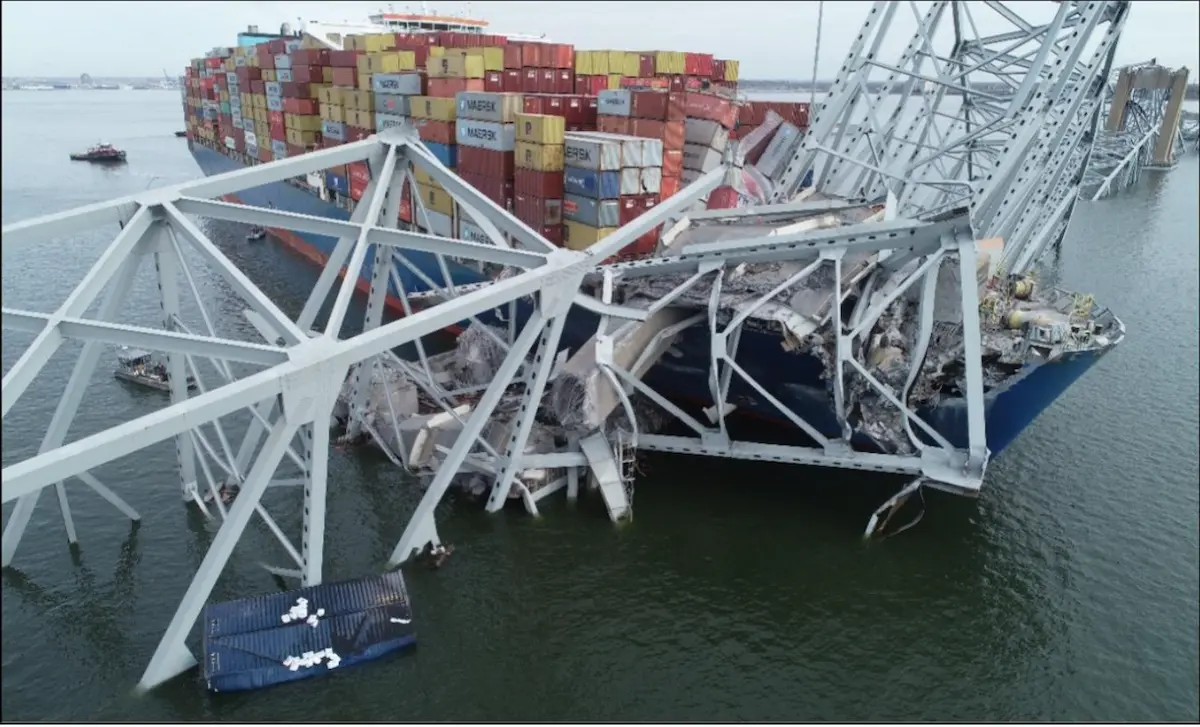
Federal prosecutors in the United States have filed criminal charges against the operator of the cargo ship Dali, two years after the vessel struck Baltimore’s Francis Scott Key Bridge, causing its collapse and killing six people..
The crash, which happened on 26 March 2024, has already been viewed as one of the most serious maritime infrastructure incidents in recent U.S. history.. But the indictment now gives the case another dimension..
It is no longer only about a ship losing power and hitting a bridge.. It is now also about whether the vessel was properly managed, whether known hazards were reported, whether safety records reflected reality, and whether investigators were misled after the incident..
According to the U.S. Department of Justice, Synergy Marine Pte Ltd of Singapore, Synergy Maritime Pte Ltd of Chennai, India, and Radhakrishnan Karthik Nair, the Dali’s technical superintendent, have been charged with conspiracy, failure to immediately inform the U.S. Coast Guard of a known hazardous condition, obstruction of an agency proceeding, and false statements..
The two Synergy companies also face environmental misdemeanor charges linked to pollutants released into the Patapsco River, including containers, cargo contents, oil, and debris from the bridge itself..
The BBC reports that Synergy Marine, the company that operated the ship, said it would defend against the allegations “with vigor”, citing the New York Times..
What prosecutors allege happened
The DOJ says the Dali lost power twice in a four-minute period while navigating out of the Port of Baltimore..
The first power loss was allegedly caused by a loose wire in a high-voltage switchboard.. Prosecutors say the ship then lost power again because it was relying on a flushing pump to supply fuel to two of its four generators..
That flushing pump, according to prosecutors, was not designed to restart automatically after a blackout.. Without fuel supply, the generators could not operate, leading to the second blackout..
Prosecutors allege that if the proper fuel supply pumps had been used, the vessel would have regained power in time to safely navigate under the bridge..
The BBC article also notes that the National Transportation Safety Board identified several factors, including electrical power loss from a faulty cable, fuel pump problems, and a lack of countermeasures to reduce the bridge’s vulnerability..
Why is this now a maritime safety case..??
For the shipping industry, the key point is not only that the vessel lost power..
The bigger question is whether the vessel’s technical condition, operating configuration, and safety reporting reflected the actual risk before departure..
That is what makes this a maritime safety case..
Ships do not operate safely because they have certificates alone.. They operate safely because their systems are maintained, defects are escalated, temporary workarounds are controlled, and shore-side management understands the real condition of the vessel..
If a vessel is being operated differently from how its systems were designed to function, that is not a minor technical detail.. It may become a safety-critical issue..
Why the technical superintendent angle matters
The inclusion of the Dali’s technical superintendent is significant..
Technical superintendents are part of the shore-side structure responsible for vessel condition, maintenance follow-up, defect management, technical decisions, and communication between the vessel and management..
They may not be on the bridge when an incident happens, but their decisions can influence whether a ship is safe and resilient enough to sail..
This is why the indictment will be closely watched by ship managers and technical departments..
It places the shore-side technical management function under direct legal scrutiny..
Reporting is not just paperwork
One of the charges relates to the alleged failure to immediately inform the U.S. Coast Guard of a known hazardous condition..
In a port environment, a hazardous condition on board a ship is not the ship’s problem alone.. It can affect pilots, tugs, terminals, bridges, port authorities, other vessels, workers, cargo interests, and the public..
Timely reporting gives authorities the opportunity to manage the risk before the movement becomes dangerous..
That could mean delaying departure, arranging additional tug support, applying traffic controls, or requiring further checks..
In other words, reporting is part of the safety chain..
The investigation issue
The DOJ also alleges that Synergy and Nair obstructed the NTSB investigation and provided false statements and documents.. One allegation relates to statements that Nair was unaware that the Dali was using the flushing pump to provide fuel to the generators..
This matters because after a major casualty, records, statements, emails, logs, and technical explanations become central to the investigation and what a company says after an incident can become as important as what it did before the incident..
If investigators are misled, the industry may also lose the opportunity to learn the right safety lessons..
A legal caution
The DOJ states that all defendants are presumed innocent unless proven guilty beyond a reasonable doubt in court.. But the indictment still sends a clear message to the shipping industry..
- Safety management must reflect the actual condition of the vessel, not only what is written in the system..
- Technical workarounds must be understood and controlled..
- Known hazards must be reported, and
- Shore-side decisions can carry serious consequences when a vessel casualty becomes a public disaster..