
Freight volatility hasn’t gone away in 2026; it’s just changed shape. U.S. business logistics costs came in at $2.4 trillion last year, or 7.8% of GDP, according to the 37th Annual State of Logistics Report from Kearney and Penske Logistics.
That’s actually down from $2.6 trillion the year before, but don’t mistake lower spend for a calmer market. Capacity is still tight in pockets, labor is harder to find in warehouses and behind the wheel, and shippers who got comfortable during the freight recession are now scrambling to rebuild resilience.
Two strategies keep coming up in conversations with shipping and freight professionals trying to navigate this.
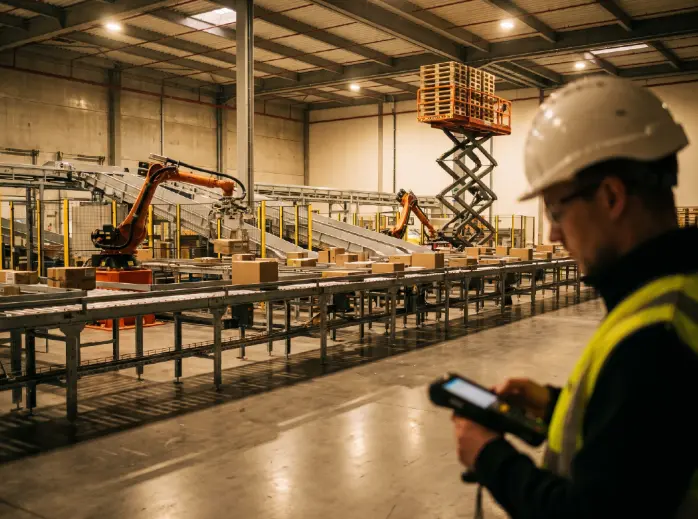
The first is bringing automation into internal operations, from sortation robotics to real-time visibility software. The second is leaning on third-party logistics partners who already have the infrastructure built.
Neither approach is a silver bullet on its own. Together, they’re how a lot of mid-size shippers are actually closing the gap between what their networks can handle and what 2026’s market demands.
The Capacity Squeeze Driving Automation Adoption

Labor scarcity is the piece of this puzzle that rarely gets solved by posting more jobs. Warehouse turnover remains stubbornly high, and truckload capacity has tightened in specific lanes even as overall freight demand normalized. Supply chain leaders have noticed.
According to the MHI/Deloitte 2026 Annual Industry Report, 48% of supply chain leaders now rate AI’s impact on their operations as significant or greater, a 25-point jump in a single year. Robotics and automation aren’t far behind, with 39% saying the same, up 16 points year over year. More than half of executives report they’re already deploying AI agents to automate day-to-day workflows.
The money is following the sentiment. Roughly 60% of warehouses plan to raise their automation budgets by 20% in 2026, and 72% of logistics firms are shifting toward Robotics-as-a-Service contracts, specifically so mid-tier shippers who couldn’t stomach a large capital outlay can finally get in the game.
That shift matters. A few years ago, automation was mostly a large-enterprise play. Now it’s accessible to a distribution center running a few hundred thousand square feet, not a few million.
This gap is closing, too. A Trigent Report survey of 86 industry executives across carriers, 3PLs, freight tech firms, and shippers found that 88% of carriers rank AI as a top priority for fleet optimization and route planning.
Yet 61% of companies admitted they’re still running on outdated or patched-together systems that limit visibility and add operational risk. That’s the exact gap that platforms offering supply chain automation solutions are built to close, replacing disconnected spreadsheets and legacy WMS bolt-ons with a system that actually talks to the rest of the operation.
For a warehouse manager watching order volumes climb while headcount stays flat, that kind of visibility isn’t a nice-to-have anymore.
Where Automation Alone Falls Short
Automation solves a lot, but it doesn’t solve everything, and it’s worth saying that plainly. Robotics and software still need a building to sit in, a footprint to scale into new regions, and capital to expand when order volume spikes seasonally.
A mid-size shipper adding a new fulfillment node in a second time zone doesn’t usually want to lease a warehouse, hire a crew, and stand up automation from scratch for a market they’re still testing.
This is where outsourcing warehouse operations to a specialist provider tends to enter the conversation. Instead of building infrastructure everywhere demand shows up, shippers can plug into a network that already exists, already has trained staff, and already runs at scale.
The Association for Supply Chain Management flags exactly this shift in its Top 10 Supply Chain Trends for 2026, pointing to flexible, outsourced capacity as one of the clearer paths to resilience when demand and disruption are both unpredictable. Automation handles the parts of the operation you control directly. Outsourcing handles the parts you’d rather not build from the ground up.
The Role of Third-Party Logistics in a Volatile Market

The numbers behind third-party logistics growth are hard to ignore. The global 3PL market was worth roughly $1.6 trillion in 2025 and is projected to hit $1.8 trillion in 2026, according to Global Market Insights, with a longer-term climb toward $4.3 trillion by 2035 at a 10.1% compound annual growth rate.
In the U.S. alone, 3PL net revenue grew 5.1% to $138 billion in 2025, with gross revenue up 5% to $323.4 billion, as reported by Transport Topics. Capacity tightened, the freight recession eased, and shippers responded by handing more of the physical work to partners built for it.
More than 60% of companies now use 3PL providers to streamline logistics and control costs, and it’s not hard to see why. Building a second or third fulfillment center takes months of lease negotiation, hiring, and setup before a single order ships. Working with third party logistics services skips most of that runway.
A shipper can be live in a new region in weeks instead of quarters, without carrying the fixed overhead of a facility that might sit half-empty during slower months. For e-commerce brands specifically, that flexibility matters even more, since order volumes can swing hard around promotions and seasonal peaks that a rigid in-house network struggles to absorb.
Choosing the Right Mix of Automation and Outsourcing

Neither path is universally right, and picking between them (or blending them) comes down to a few practical questions. Order volume is the first one. A shipper moving a few hundred orders a week rarely needs its own robotics investment, but a facility processing tens of thousands might.
SKU complexity matters too. Highly variable inventory with lots of kitting or customization tends to favor in-house automation, where you can tune the process precisely. Cross-border fulfillment tilts the other way, toward 3PL partners with compliance and customs experience baked into their networks.
Clarifying your logistics needs before selecting a provider saves a lot of wasted evaluation time. Some shippers run a hybrid model by design: automated systems handling the core domestic fulfillment engine, while a 3PL partner absorbs international orders or seasonal overflow.
Transport Topics’ coverage of 2025’s 3PL market volatility noted that tighter truckload markets and more favorable spot pricing are both expected through 2026, which makes the outsourcing math even more attractive for shippers who don’t want to carry that pricing risk on their own books.
What This Means for Shipping and Freight Professionals in 2026
For carriers, forwarders, and beneficial cargo owners managing freight relationships day to day, these trends aren’t abstract. Connectivity and AI reshaping fleet and freight operations means the partners you work with are increasingly expected to plug into shared data systems, not operate as black boxes.
A 3PL that can’t share real-time inventory or shipment status with your automation stack creates the same blind spots that manual, spreadsheet-driven operations used to cause.
Carriers who understand that their shipper customers are running hybrid automation-and-outsourcing models will have an easier time aligning capacity, scheduling, and pricing conversations around what those shippers actually need.
Conclusion
Automation and third-party logistics aren’t competing strategies fighting for the same budget line. They’re two levers that work better pulled together. Automation tightens control over the parts of the operation a shipper wants to own directly.
Outsourcing extends reach into markets and volumes that would be expensive or slow to build alone.
Through the rest of 2026’s freight volatility, the shippers coming out ahead won’t be the ones who bet everything on one approach. They’ll be the ones who figured out which parts of their network to automate and which parts to hand off, then actually did both.