
In my previous article on Document of Title not equalling Ownership of Goods, I made the point that holding a Document of Title does not automatically make you the owner of the goods..
This article takes that conversation a step further..
Because there is another distinction that gets mixed up constantly in trade finance discussions, in digital trade conversations, and even in some industry publications: how to distinguish between a Bearer Bill of Lading and a Blank Endorsed Bill of Lading.
Let us examine it..
What is a Bearer Bill of Lading..??
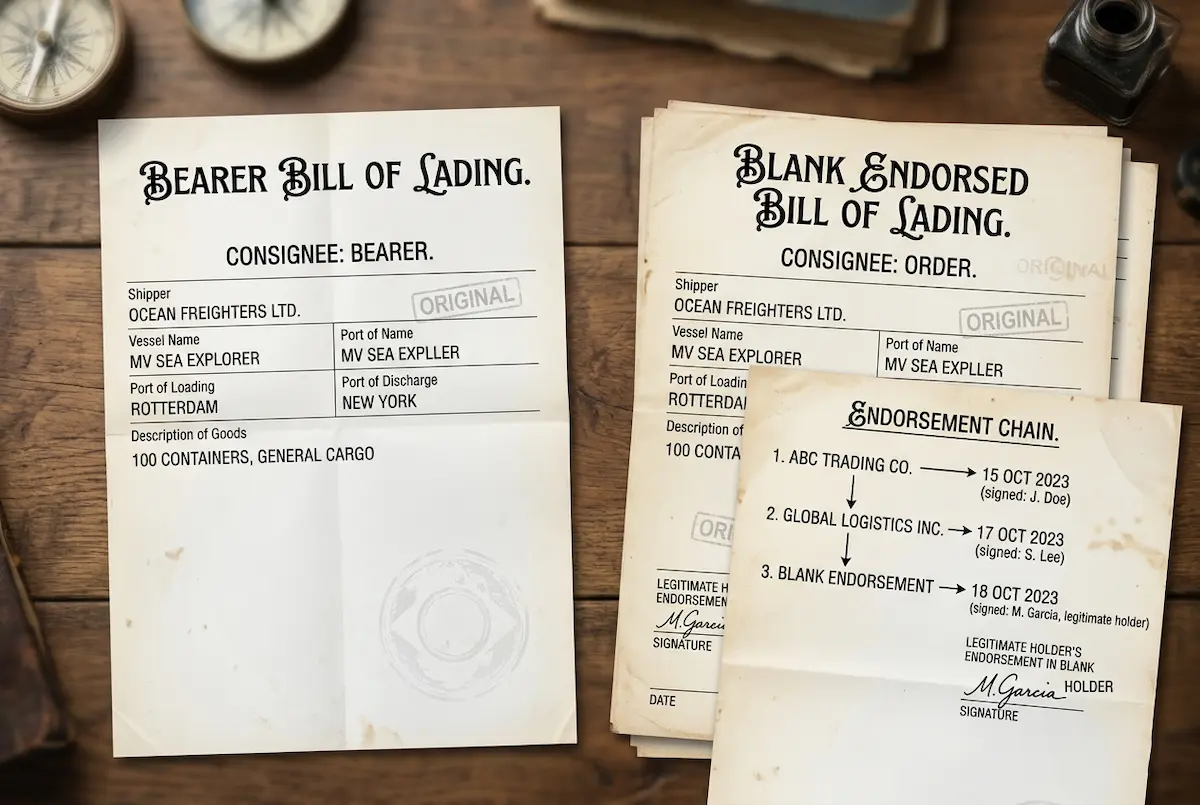
A Bearer Bill of Lading is one where the consignee field on the face of the document literally reads “To Bearer” or is left completely blank at the point of issuance by the carrier..
There is no named party.. There is no “To Order of ABC Company” or “To Order of XYZ Bank”.. Just “To Bearer”, or nothing at all..
This means whoever physically holds that document has the right to claim the goods from the carrier.. No endorsement required.. No identity verification.. No questions asked.. You hold it, you claim it..
It is issued as a bearer instrument FROM THE START.. That is the key point..
A Bearer Bill of Lading is EXTREMELY rare in modern trade.. Most major shipping lines either prohibit them entirely or require special approval before they will issue one..
The reason is simple, from the carrier’s perspective, a Bearer BL is a liability nightmare.. There is no named consignee to trace, no endorsement chain to follow, and no way to verify who the legitimate claimant is if something goes wrong..
Personally, I have NEVER signed a “bearer bill of lading” in all the time I have been signing bills of lading..
What is a Blank Endorsed Bill of Lading..??
A Blank Endorsed Bill of Lading is a completely different animal..
It starts life as an Order Bill of Lading, a properly issued negotiable bill made out “To Order” or “To Order of XXX” of a named shipper, bank, or consignee.. It has a named party after the To Order.. It has a chain of title.. It is a standard instrument used in international trade every day..
What makes it “blank endorsed” is what happens DOWNSTREAM..
When the holder of that Order Bill signs the back of the document WITHOUT specifying who the next holder should be, that act of signing transforms the document into a bearer instrument at that point in the chain..
The endorsement is blank, no name, just a signature, and from that moment, whoever holds the document can claim the goods..
So the blank endorsement is not a starting condition.. It is an action taken later by an authorised party who already held the document legitimately..
So what is the actual difference..??
Here is the simplest way to put it..
- A Bearer BL is born as a bearer instrument.. It has no prior chain of title, no named party, no history.. Whoever holds it from the moment it is issued can claim the cargo..
- A Blank Endorsed BL starts as an Order BL with a clear chain of title, and BECOMES a bearer instrument when a legitimate holder endorses it in blank.. It has a history.. You can trace who held it, who signed it, and when..
Why does this distinction matter in trade and trade finance..??
This matters because the two are sometimes conflated, including in conversations about electronic Bills of Lading and digital trade..
When banks talk about needing “blank endorsement” capability in eBL platforms, they are talking about the ability to take an Order BL and endorse it in blank to hold as security or transfer into secondary markets.. They are NOT asking for Bearer Bills of Lading to be issued..
The blank endorsed eBL gives a bank control over the goods because they hold the document, they control delivery, and they can transfer that control without needing to name the next holder.. That is the liquidity function that banks value..
But even in that state, the document still has a traceable prior chain.. The carrier knows who the original shipper was.. The bank knows how they came to hold it.. That chain matters enormously if something goes wrong..
A true Bearer BL has none of that.. And that is exactly why carriers are so reluctant to issue them..
And does possession of either one mean you OWN the goods..??
NO.. And this is where we come back to the core point from my earlier article.. The document does not answer that question.. The underlying transaction does..
Holding a Bearer BL, or a Blank Endorsed BL, or any bill of lading for that matter, ONLY gives you CONTROL OF ACCESS to the goods.. You do not become the legal owner of the goods by virtue of holding the document.. You become the legal owner by virtue of the payment transaction underlying it..
The carrier will release the goods to whoever presents the document, because that is their obligation under the contract of carriage.. They do not ask for payment receipts.. They do not verify the sales contract.. They verify the DOCUMENT.. But the carrier’s decision to release the goods does not transfer legal title.. It transfers physical possession..
Now here is the nuance that most people miss..
While a true owner of goods could also be holding the bill of lading, the opposite is equally possible.. Someone could be holding a bill of lading and NOT be the legal owner of the goods at all..
It entirely depends on HOW they came to be in possession of that document..
- Did they receive it because they paid for the goods..??
- Did they receive it through an incorrect endorsement, or through theft, or through fraud..??
- Did the previous holder pledge or hypothecate the document as collateral to raise financing against it, even though that previous holder may not have been the legal owner of the goods themselves..??
In that last scenario, you have a situation where neither the party who pledged the document NOR the party now holding it as security is the legal owner of the goods..
Yet the carrier will still release the cargo to whoever presents it.. That is how powerful and how dangerous this document can be when it moves through the wrong hands..
Presumption of ownership
In the case of a Bearer BL specifically, there is an added layer.. In some jurisdictions, the law presumes that the holder obtained the document legitimately, and the carrier acts on that presumption when releasing the goods..
But this is NOT a universal principle, as the strength of that presumption varies significantly depending on the governing law of the transaction and the country where the goods are being claimed..
And even where that presumption exists, it is NOT a legal fact.. It can be challenged.. If a Bearer BL was stolen, forged, or obtained by fraud, the original owner’s legal title to the goods does not automatically disappear, even after the carrier releases the cargo to the holder.. What disappears is the practical ability to recover those goods without expensive legal action..
Ownership of the goods is established by PAYMENT and governed by the underlying sales contract.. The document controls ACCESS.. These are separate things.. Conflating them leads to real commercial and legal consequences for everyone in the chain..
So what is the takeaway here..??
Three things are worth remembering from this article..
- A Bearer BL and a Blank Endorsed BL are NOT the same instrument.. One is born as a bearer document.. The other becomes one through a downstream endorsement act.. The legal origin, the chain of title, and the risk profile are different..
- Possession of either document gives you control of access to the goods, and in the case of a Bearer BL, a legal presumption of entitlement.. But it does NOT give you automatic legal ownership.. Ownership travels on a separate track, governed by the sales contract and the point of payment..
- The carrier’s job is to verify the DOCUMENT, not to investigate ownership.. They will release the goods to whoever presents the correct document in good order.. That is where their responsibility begins and ends..
Mixing up these concepts, or assuming that holding the document equals owning the goods, can lead to serious disputes, cargo losses, and legal exposure for everyone in the chain..
The document of title and ownership of goods may be separate things depending on the sales contract..
Have you come across situations where a Bearer BL or a Blank Endorsed BL was misunderstood or misused in a transaction..?? Share your experience in the comments below..