
The Strait of Hormuz has always been in the background of every conversation about global energy security.. Most people in shipping and freight know it as a chokepoint, the kind where roughly 20% of the world’s oil and LNG passes through every single day..
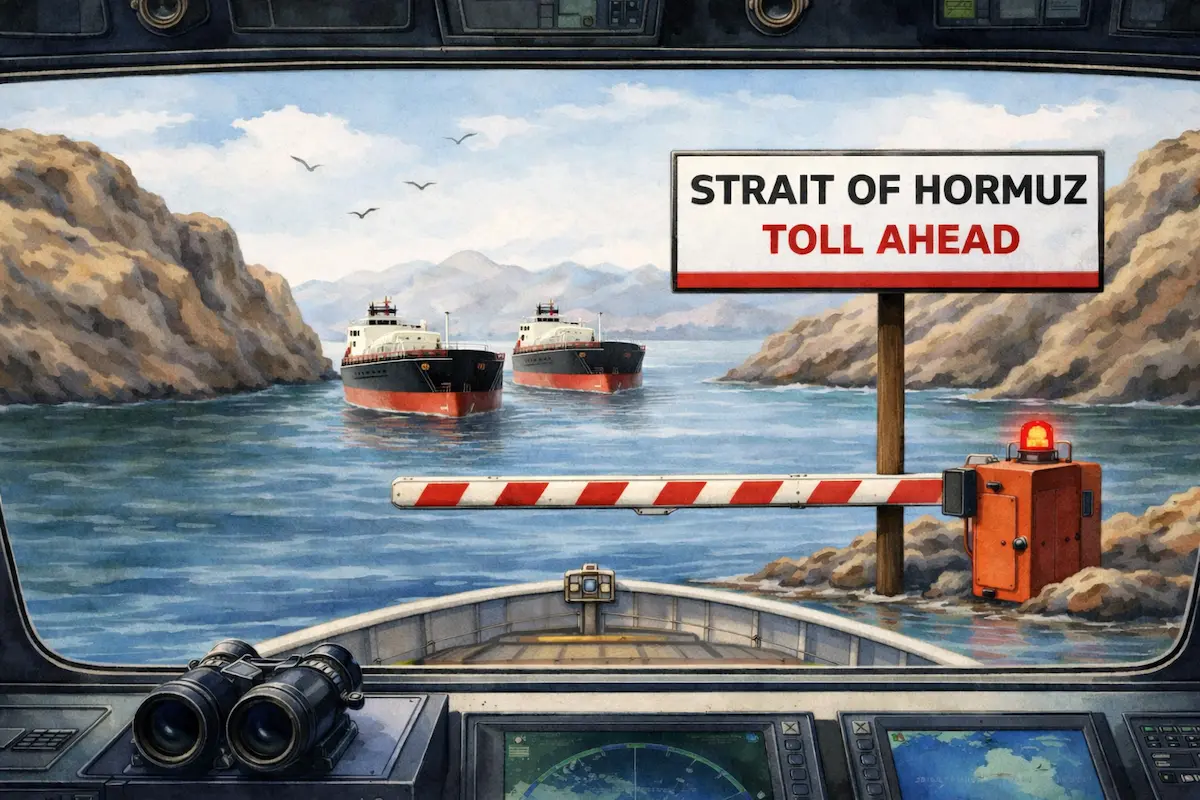
But it has now moved very much to the front of that conversation into a veritable toll booth..
It has been reported that the Iranian Parliament approved a plan to collect tolls on ships travelling through the Strait of Hormuz, according to Iranian state media..
The proposal, which was brought before parliament earlier this month, would require agreement from other countries on either side of the strait. While the report did not specify how much the tolls would be, it made it clear that ships associated with the US, Israel, and countries that sanctioned Iran would not be able to pass under the new plan..
Iran has effectively closed the waterway to Western shipping since the start of the conflict.. The toll plan now seeks to formalise that control..
Don’t other countries share the strait too..??
This is a question that came to mind immediately because the Strait of Hormuz has TWO coastlines.. Iran sits on the northern bank.. On the southern bank sits the Musandam Peninsula, shared between the UAE and Oman’s Musandam Governorate..
As per UNCLOS Section 2 Art.3, each coastal state controls up to 12 nautical miles from its shoreline.. The strait at its narrowest point is only about 21 miles wide, which means Iranian and Omani territorial waters overlap and cover the entire width of the strait.. Both countries have a legal stake in it..
So why does Iran get to run a toll booth on it..??
The answer is geography combined with military positioning.. Iran controls the entire northern shoreline and key islands right at the mouth of the strait, including Qeshm, Hormuz, Hengam, and Larak.. This gives Tehran surveillance dominance and the ability to monitor and disrupt traffic in ways that Oman, on the southern bank, simply cannot match..
Oman has maintained neutral diplomatic ties throughout the conflict and has given no public indication that it endorses Iran’s toll plan.. The plan mentions cooperation with Oman in establishing a legal framework for the strait, according to Iranian state media IRIB.. Whether it gets it is a very different question..
What does international law say and reactions..??
Under the UN Convention on the Law of the Sea (UNCLOS), the Strait of Hormuz is an international strait, which means all ships have the right of transit passage, free of charge and free of prior approval..
Reactions have been varied and critical as can be expected..
Iran’s counter-position is that it passed its own national maritime law in 1993, which does not recognise the strait as an international passage and therefore does not consider itself bound by UNCLOS transit passage rules..
What is already happening on the water..??
As we have seen, the IRGC has not been waiting around for the law to be approved.. As reported, a de facto toll booth regime imposed by the IRGC has been underway since around mid-March 2026, requiring ships to submit cargo details, ownership, destination, and crew lists to approved IRGC intermediaries before being escorted through..
While traffic through the strait has fallen by roughly 90% since the start of the conflict, ships from China, Russia, India, Iraq, and Pakistan have been allowed to transit freely while everyone else seems to have to negotiate.. At least two ships have already paid for passage, with payment settled in Chinese Yuan..
The international response has been firm.. US Secretary of State Marco Rubio called the plan “illegal, unacceptable and dangerous to the world..” G7 foreign ministers called for the restoration of safe and toll-free freedom of navigation.. UN Security Council Resolution 2817, adopted on 11 March 2026, already condemned Iran’s actions and framed any attempt to impede transit passage as a serious threat to international peace and security..
What does this mean for shipping and freight..??
The Strait of Hormuz is no longer just a geography question on a trade lane.. It is now a political and financial variable in every cargo calculation involving the Persian Gulf.. The toll plan, combined with the IRGC’s already operational vetting system, has made passage through the Strait of Hormuz a toll based passed much like the Suez Canal and Panama Canal, but with a side of discrimination.. It is a negotiation in which Iran will ask for more..
For freight forwarders and shippers, the question is no longer simply “can my cargo pass through..??” The question now is “at what cost, under what conditions, and who decides..??”