
Global shipping today is no longer just about freight rates, port calls, and vessel schedules..
Regulators that were once seen as technical oversight bodies now find themselves navigating a much broader environment where maritime logistics intersects with international relations, economic competitiveness, and supply chain stability..
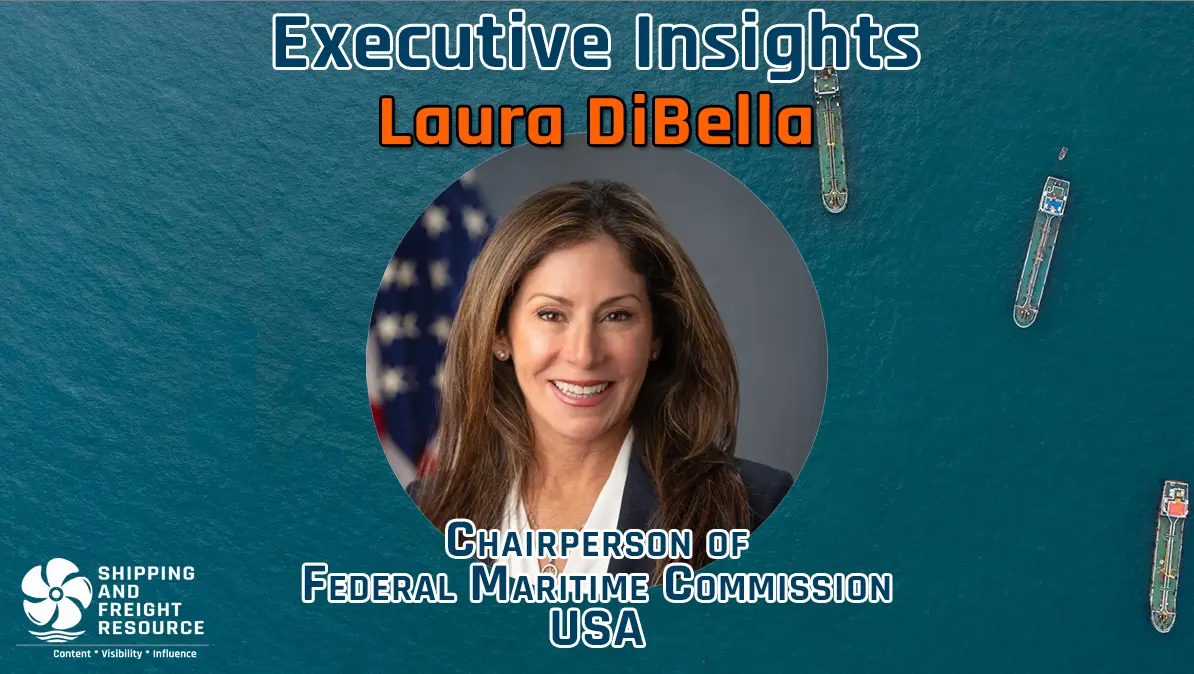
In this edition of Executive Insights, Shipping and Freight Resource speaks with Laura DiBella, Chairperson of the Federal Maritime Commission, about the evolving role of maritime regulators, the lessons learned from recent supply chain disruptions, and how the FMC is adapting to a rapidly changing global trade environment..
HM : When you took over as the Chair of the FMC, what did you believe most urgently needed to change at the FMC..??
LDB: I would not necessarily say something needed to change. What needed to be reinforced was the global perspective of the Commission.
COVID really changed the game for everyone in the supply chain world, including regulators. We realised very clearly that we are not operating on an island in the United States. What happens halfway around the world can have a very real impact on the U.S. economy and on American importers and exporters.
So, it is important for us not only to focus on what is happening in our immediate environment but also to pay close attention to global developments.
HM: You have described the FMC as evolving into something closer to a consumer protection agency.. What does that mean in practical terms for shippers and freight buyers..??
LDB : At its core, our role is about protecting the U.S. importer and exporter.
Sometimes people view regulators purely as enforcement bodies that issue penalties or judgments. But our mission goes beyond that.
We are there to ensure that the marketplace operates fairly and efficiently so that businesses, large or small, can compete on a level playing field.
Whether the shipper is a large multinational company or a small exporter entering global trade for the first time, our responsibility is the same. We want to ensure they can do business in an environment that is fair, efficient, and economically viable.
HM: Regulators are usually reactive by design. Yet you have spoken about making the FMC more proactive.. How do you shift that mindset without overstepping regulatory boundaries..??
LDB: I encourage our teams to look for patterns, signals, and emerging risks.
One of the most important tools we have is investigation. Investigations allow us to unpack not only issues that have already occurred, but also those that may arise in the future.
Currently, we have several investigations underway, including work around maritime chokepoints, flags of convenience, and other structural issues within the global shipping system.
These investigations help us understand potential vulnerabilities and ensure that we are prepared if disruptions occur.
HM: You mentioned investigations into maritime chokepoints, which are mostly geopolitical issues.. What influence can the FMC realistically have in such situations..??
LDB: In many cases, our role is not to lead geopolitical decision-making but to serve as a trusted source of expertise.
Agencies such as the State Department or Homeland Security may lead on the geopolitical front.
What the FMC provides is deep maritime knowledge. We understand the operational realities of the shipping industry, and we can provide valuable insight that helps inform decision-making.
There is a lot of misinformation in the maritime space, and our job is to ensure that policymakers have accurate, expert information when they are making critical decisions.
HM: When the FMC investigates foreign governments or port access issues, where is the line between regulation and foreign policy..??
LDB: That line can sometimes be blurred.
However, we remain very clear about the role we play.
Strong communication with partner agencies is essential. We ensure that we operate within the regulatory responsibilities assigned to us while supporting broader government priorities through information sharing and collaboration.
HM: Two years after the Ocean Shipping Reform Act, have things genuinely improved for shippers. And what still needs fixing..??
LDB: Overall, I do believe things have improved.
There were many lessons learned from the disruptions during the pandemic. Today we are better prepared should a similar shock occur.
At the same time, shipping has evolved. Trade lanes have changed, supply chains have reorganised and new operational challenges have emerged.
In many ways, we are dealing with an entirely new set of dynamics compared to a few years ago.
So while improvements have been made, the work is ongoing. Supply chains are constantly evolving and regulators must evolve with them.
HM: Having completed six World Marathon Majors and holding the record for the most overall female wins in the Seven Mile Bridge Run in the Florida Keys, what has distance running taught you about leading through complex challenges..??
LDB: Distance running is a powerful metaphor for life and leadership.
It teaches you that progress comes from consistent effort over time.
Not every day is perfect. Some days require more effort than others. But if you remain focused on the long-term goal and continue to put in the work, the results will follow.
You cannot expect to run a marathon without preparation. The same applies to leadership and to complex challenges in the maritime world.
Ultimately, what you put into the effort is what you will get out of it.
Shipping and Freight Resource wishes FMC Chair Laura DiBella, all of the very best in her new role..
You can view the full interview below..