
Is the extension of South Africa’s status in the AGOA really a victory lap for the country..??
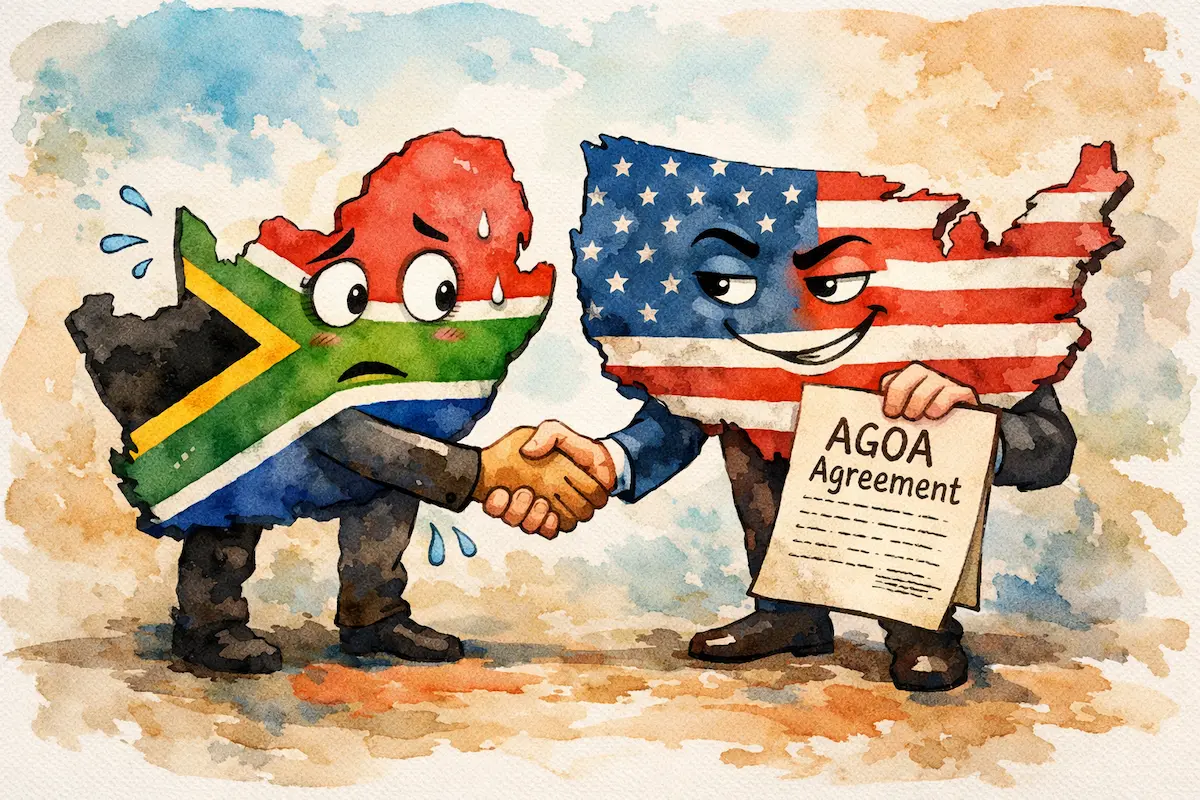
On the 3rd of Feb 2026, U.S. President Donald Trump signed a law extending South Africa’s participation in the African Growth and Opportunity Act until the end of 2026..
AGOA, which came into being in 2000, offers duty-free and quota-free access to the U.S. market from 32 eligible African nations covering thousands of products..
Welcoming the extension, Department of Trade, Industry and Competition (DTIC) Minister Parks Tau said, “The renewal of AGOA will complement and support the implementation of the Africa Continental Free Trade Area and creation of regional value chains, as well as support American businesses that depend on inputs and products imported into the US market under AGOA. This will provide certainty and predictability for African and American businesses that rely on the programme,” the department said.
Work to be done, but not much time
The numbers show why this matters.. South Africa currently enjoys duty-free access for around 6,500 product lines under AGOA.. According to the US Trade Representative, “South Africa is eligible for preferential trade benefits under the African Growth and Opportunity Act and is eligible for textile and apparel benefits.“.. But eligibility and certainty are two different things..
Consider what a one-year extension actually means for business.. Companies that export to the US need to plan production runs that stretch across seasons, negotiate contracts that span multiple quarters, and make capital investment decisions that pay off over years, not months..
A twelve-month extension doesn’t provide that kind of runway.. It creates an environment where businesses think twice before expanding, hiring, or committing to long-term contracts..
South Africa’s relationship with the US has experienced friction over various issues, from the country’s stance on international conflicts to concerns about governance and economic policy.. AGOA exists within this broader political context..
It’s not just about tariffs and trade volumes, it’s about how Washington views its relationship with Pretoria..
Here’s what should be concerning for South African policymakers: the country has significant exposure to a single partner whose decision-making has become increasingly unpredictable..
When trade preferences can shift year by year based on political considerations, that’s not a foundation for long-term economic planning.. South Africa is making decisions the US doesn’t like, and the current US administration has shown it’s willing to act quickly and unpredictably on trade issues..
Should South Africa look elsewhere..??
This is the question topmost in many of the exporters’ minds.. What happened in the last year with AGOA, the tariff fiasco, etc., makes the case for alternatives compelling..
Whether it is strengthening African Continental Free Trade Area relationships, deepening ties with the EU and/or BRICS, or exploring new markets in Asia, reducing dependence on US market access looks less like pessimism and more like prudent planning..
Not because AGOA will definitely end, but because relying entirely on year-by-year extensions isn’t a sustainable trade strategy..
Local businesses are caught in this uncertainty.. They’ve built supply chains and employed workers based on AGOA access.. The textile and apparel sector has invested heavily in AGOA-enabled exports and created jobs in communities that need them.. These industries operate on longer planning cycles than twelve months.. They need predictability to justify expansion or even to maintain current operations with confidence..
Looking ahead
What happens in the next twelve months will matter.. South Africa needs to demonstrate it’s serious about meeting AGOA’s eligibility criteria, addressing US concerns, and showing why the partnership has value.. But at the same time, the country would be wise to pursue diversification aggressively.. Not as a backup plan, but as a parallel strategy..
The costs of losing AGOA are real.. Higher tariffs, lost competitiveness, and job losses in sectors that can’t easily absorb either.. But the costs of depending entirely on an uncertain arrangement might be just as high, even if they’re less obvious..
The extension provides breathing room.. What South Africa does with that room, both in terms of the US relationship and building alternatives, will determine whether this year is remembered as an opportunity seized or a warning ignored..