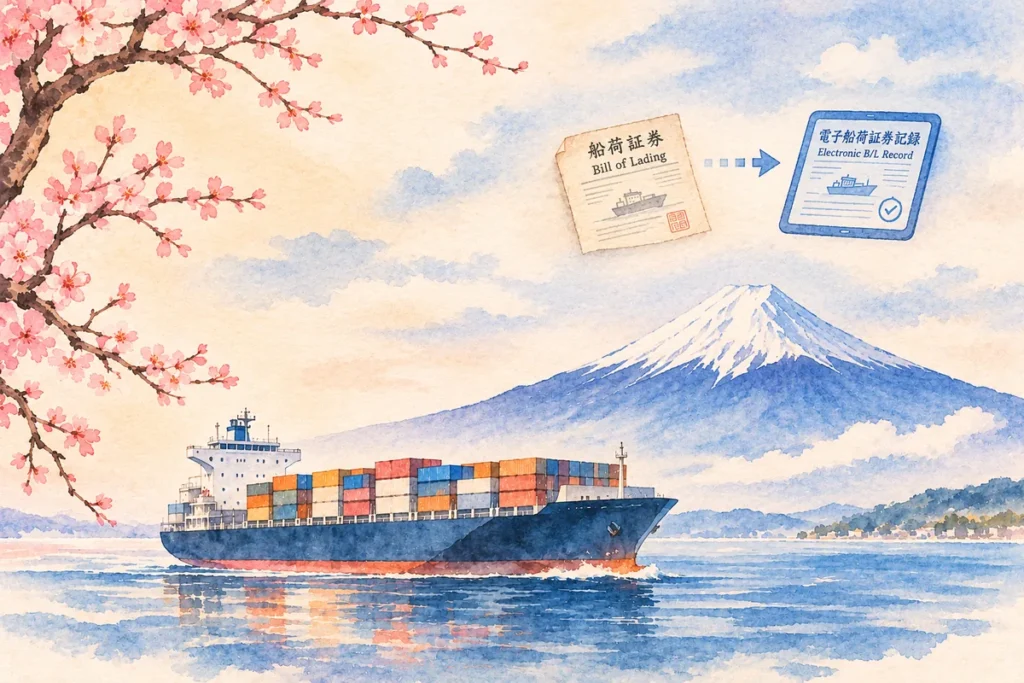

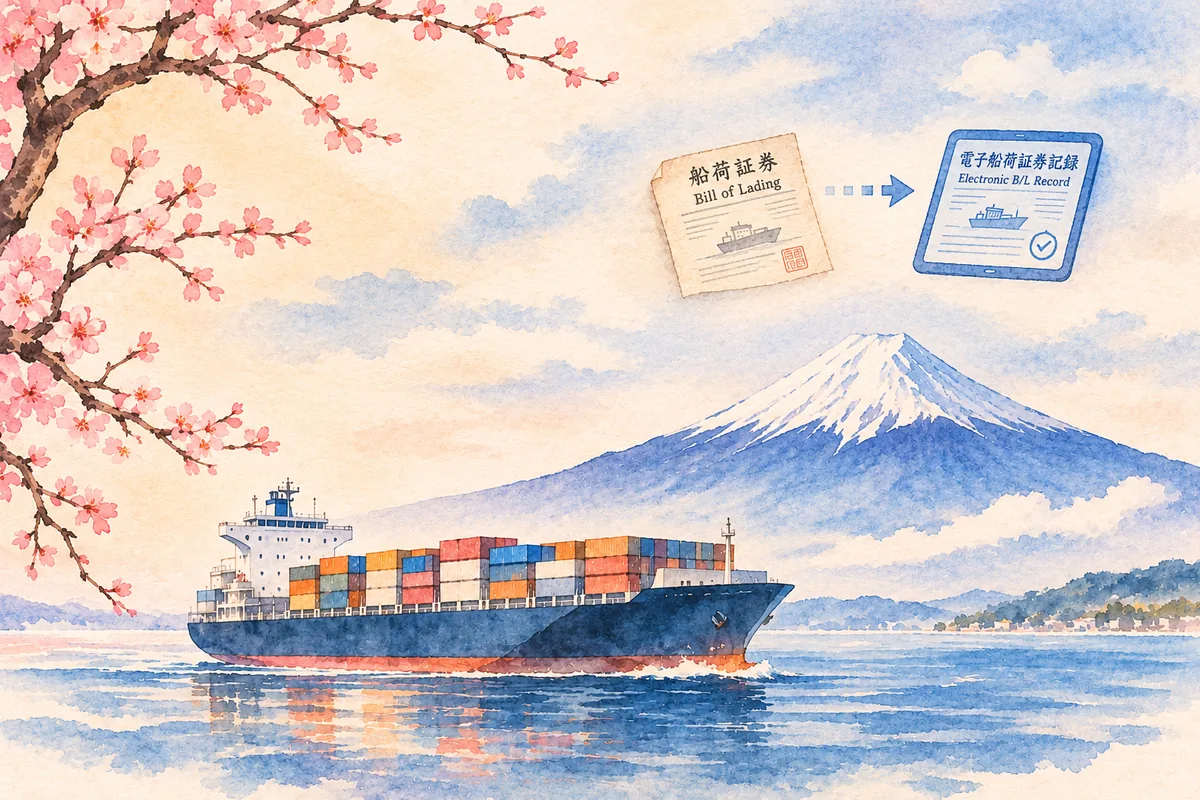
Electronic bills of lading will be legally valid in Japan from 2027.. On 25 November 2026, Japan’s House of Councillors unanimously passed an amended Commercial Code that gives an electronic bill of lading record the same legal effect as a paper original, including the right to claim the cargo..
On 25 November 2026, Japan’s House of Councillors unanimously passed a revised Commercial Code that allows bills of lading to be issued and transferred as electronic records..
From the day the law comes into force, an electronic bill of lading in Japan will carry the same legal weight as the paper original, including the right to claim the cargo at destination..
The law takes effect in 2027, on a date the cabinet will set within one year of the law being promulgated..
Why paper has been a problem in Japan
Japan’s Commercial Code was first enacted in 1899 and has been amended many times since, but its bill of lading rules still assumed paper..
Many of Japan’s main trade lanes are short, and some services from China reach Tokyo in just 2 to 3 days.. Meanwhile, the original B/Ls may still be travelling by courier from the seller to the banks and then to the buyer..
When the cargo arrives before the documents, the buyer either waits and pays storage and demurrage, or the parties may arrange delivery against a letter of indemnity (LOI), which shifts the risk onto the carrier and sometimes the bank..
Electronic B/L platforms have been around for years, operating in Japan through contractual arrangements between participating parties..
However, those arrangements did not provide the same statutory recognition of electronic transferable records as paper bills of lading, particularly in relation to transfer of title and the rights of third parties..
What the new law actually says
Based on the Ministry of Justice’s official outline of the bill (salient points published in Japanese, translated to English by AI), here are the main points you need to know..
- A new legal document called the “electronic bill of lading record”.. This is an electronic record containing everything a paper B/L must contain.. It must be created and managed in a specific information system, and that system must have measures (to be set by Ministry of Justice ordinance) that allow verification of whether the record has been altered and reliably establish that it was created by the carrier or master..
- “Control” replaces possession.. A person has control when, within the system, only that one person can use the record as the person holding the rights to the cargo.. This is the electronic version of holding the original B/L in your hand..
- “Provision” replaces handing over.. Provision is the act of the carrier, master, or person authorised to control the record taking steps prescribed by Ministry of Justice ordinance in the system so that a person they designate becomes authorised to control it.. This is how the record moves from the shipper to the bank to the consignee..
- Rights can be transferred or pledged.. The law sets out when a transfer or pledge of rights under an electronic B/L is legally effective.. The pledge provisions are particularly relevant for banks using transport documents as security in trade finance transactions.. A person holding the rights under an electronic B/L can also demand that the person authorised to control it provide the record to them..
- It works by consent.. The carrier or master can provide an electronic B/L record only with the consent of the shipper or charterer.. Going electronic is a choice, and paper stays available..
- You can switch between paper and electronic.. The carrier or master can convert a paper B/L to electronic with the consent of its holder, and back to paper with the consent of the person authorised to control it.. This is useful when the next party in the chain, say a bank in another country, can only handle paper..
- The existing B/L rules still apply.. The law provides for relevant Civil Code and Commercial Code provisions governing paper bills of lading to apply to electronic B/L records, with the necessary adjustments..
- Warehouse receipts and multimodal transport documents are covered too.. The law establishes similar frameworks for electronic warehouse receipts and electronic multimodal transport documents.. This is relevant for freight forwarders and NVOCCs, particularly where they issue qualifying transport documents in their capacity as contractual carriers..
- Damage notices can be sent electronically.. The International Carriage of Goods by Sea Act will allow consignees and other relevant parties to notify carriers electronically about partial loss of or damage to cargo..
Japan joins a growing list of countries
With this law, Japan joins a growing list of countries that give electronic trade documents like the B/L the same legal standing as paper, keeping pace with other nations that have adopted this change..
Many of these laws are based on, or influenced by, UNCITRAL’s Model Law on Electronic Transferable Records (MLETR), which was adopted in 2017.. UNCITRAL keeps an official status list, and as of November 2026, it shows these 13 countries..
Bahrain, Belize, China, France, Kiribati, Marshall Islands, Mauritius, Papua New Guinea, Paraguay, Singapore, Timor-Leste, United Arab Emirates, and United Kingdom..
Some big trading nations are NOT on the UNCITRAL list, but they have their own laws that recognise electronic B/Ls..
These include Germany, the Netherlands, South Korea, and the United States, each with its own approach to how an electronic B/L is created and transferred..
What is yet to come for Japan
The law sets the legal base, but a few practical pieces are still missing..
- The technical rules.. The Ministry of Justice still has to publish the ordinance that sets out the measures an electronic B/L system must have..
- The exact start date.. The cabinet will set it, and it will be no later than one year after the law is promulgated, so sometime in 2027..
- The banks.. For banks, accepting an electronic B/L involves more than agreeing to electronic presentation.. The letter of credit must allow the electronic records required, with the ICC’s eUCP rules applying where the credit says it is subject to them.. Banks also need to work out how they will receive, examine, take control of and transfer an electronic B/L where their role in the deal needs it, especially when the goods are their security for the financing..
- Everyone else in the chain.. The shipper, the carrier, the bank, the consignee and sometimes the customs broker all need to be on the same platform or on interoperable platforms..
What should you be doing now..??
If you are a carrier or an NVOCC, check whether your current electronic B/L platform will meet the Ministry of Justice ordinance once it is published, and remember that your house bills and multimodal transport documents fall under this law too..
If you are an exporter or importer trading with Japan, talk to your carrier and forwarder about when they plan to offer electronic B/Ls, and start looking at your sales contracts and letter of credit terms to make sure they allow an electronic B/L..
If you are a bank financing trade with Japan, look at how the new transfer and pledge rules fit into your documentary credit processes..
Is your business ready to send or receive an electronic B/L for a Japan shipment in 2027..??
My Take
Japan has got the legal design right.. Building the law around control and provision, with consent and a route back to paper, follows MLETR thinking without forcing anyone off paper overnight.. The real test now is the Ministry of Justice ordinance.. If it stays technology neutral, any approved platform can compete.. If it quietly favours one system, Japan risks ending up with a closed registry like South Korea’s Article 862 model, which has seen limited use.. And none of this works until Japanese banks are ready to take control of an electronic record instead of a courier envelope..
Article FAQ
What is the difference between an electronic bill of lading and a sea waybill..??
An electronic bill of lading is a document of title, and a sea waybill is NOT.. With a sea waybill, the named consignee collects the cargo without presenting any document.. Under Japan’s amended Commercial Code, the person who has control of the electronic bill of lading record is the one who can claim the cargo..
Why can a PDF copy of a bill of lading not be used as an electronic bill of lading..??
A PDF copy of a bill of lading cannot show who is the one rightful holder, because anyone can copy and forward it.. Japan’s amended Commercial Code requires an information system where only one person has control of the record, with tamper-checking measures set by Ministry of Justice ordinance..
How do I check whether an electronic bill of lading platform is accepted by P&I clubs..??
Check whether the platform appears on the International Group of P&I Clubs list of approved electronic bill of lading systems.. International Group approval matters for carriers, because P&I club cover for liabilities under electronic bills of lading depends on using an approved system.. Japan’s Ministry of Justice ordinance will set separate legal requirements..
Critical Note: Does Japan’s new law cover electronic bills of lading issued before 2027..??
The answer depends on transitional rules that Japan has not yet published in detail.. The Ministry of Justice outline of October 2026 only says that necessary transitional measures will be set.. Until those rules are out, treat electronic bills issued before the start date as contractual platform arrangements..
*** END OF ARTICLE ***