
When hazardous and noxious substances (HNS) carried by sea cause damage, the cost can fall on public authorities, coastal communities, fisheries, ports, clean-up teams, and businesses with no direct contract with the shipowner, charterer, carrier, or cargo receiver..
More importantly, people who suffer damage from HNS cargoes carried on board ships did not have access to a comprehensive and international liability and compensation regime..
Let’s take the real-life example of the chemical tanker Ievoli Sun which sank in the English Channel on 31 October 2000.. The ship was carrying around 4,000 tonnes of styrene monomer, 1,000 tonnes of isopropyl alcohol, and 1,000 tonnes of methyl ethyl ketone, along with fuel oil and diesel..
The crew was rescued, but the cargo problem stayed behind.. UK, French, and Channel Island authorities had to deal with a wreck at around 70 metres, possible chemical releases, fuel oil leakage, salvage decisions, environmental monitoring, and response costs.
The UK Maritime and Coastguard Agency incurred £129,358.52 in response costs.. According to an Interspill paper on the Ievoli Sun claim, its expected recovery was about £33,000, or 25.5% of its loss, after more than 2.5 years and more than £75,000 in legal expenses..
The same paper said that, if the HNS Convention had applied, it would have resulted in a 100% payout for all claimants..
That is the gap that the IMO’s HNS Convention aims to close. After almost 3 decades, that regime is finally close..
What is the HNS Convention..??
HNS means hazardous and noxious substances.. The 2010 HNS Convention establishes an international liability and compensation system when these substances cause damage during carriage by sea.
HNS cargoes include chemicals, oils, acids, fertilisers, alcohols, refined petroleum products, liquefied gases such as LNG and LPG, packaged dangerous goods, and solid bulk cargoes with chemical hazards.. These cargoes move in everyday trade.. They feed manufacturing, agriculture, healthcare, energy, construction, and industrial production..
Based on IMO and IOPC Funds stats, more than 2,000 types of HNS are regularly transported by sea with more than 200 million tonnes of chemicals traded annually by tankers.. This is a mainstream shipping issue..
Why was it needed..??
International shipping already has compensation regimes for oil pollution from tankers, bunker fuel pollution, passenger claims, and wreck removal, but HNS was the gap.
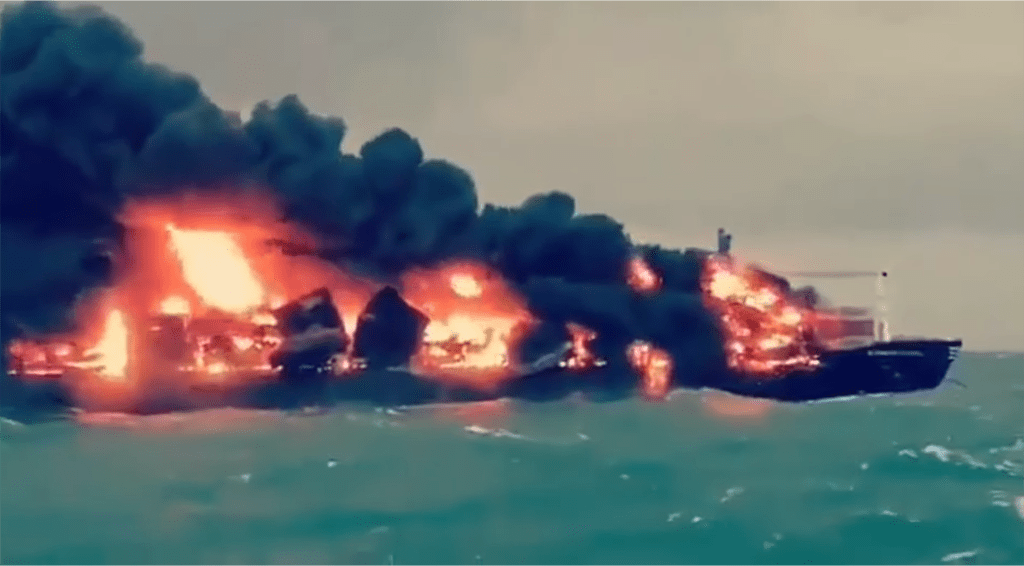
An HNS incident can affect people and organisations far outside the shipping contract.. A toxic release can affect emergency responders.. A fire can shut port operations.. A chemical spill can damage fisheries.. A sinking (like the X-Press Pearl) can leave governments and coastal authorities managing the risk long after the ship has gone down..
Many affected parties will have no direct contract with the shipowner, carrier, charterer, shipper, or cargo receiver.. The HNS Convention gives them a recognised compensation structure..
That matters because ordinary legal routes can be slow, expensive, and uncertain.. They can also leave claimants facing limitation funds, insurance arguments, proof requirements, and recovery costs..
The Ievoli Sun case and X-Press Pearl showed this clearly.. The issue was not whether anyone cared about the response costs.. The issue was whether the system in force gave the affected authority an effective route to recover them..
Why 2010 matters if the Convention was adopted in 1996
The original HNS Convention was adopted in 1996.. But it did not enter into force..
States struggled with practical issues, especially how to report contributing HNS cargo and how to set up the contribution system for the HNS Fund..
The 2010 Protocol amended the 1996 Convention to make the regime more workable.. That is why the instrument is now called the 2010 HNS Convention, meaning the 1996 Convention as amended by the 2010 Protocol..
The conditions for the treaty’s entry into force were met on 29 May 2026, paving the way for the 2010 HNS Convention (the 1996 Convention as amended by the 2010 Protocol) to enter into force 18 months later.
“The fulfilment of the conditions for the entry into force of the HNS Protocol is a long-awaited milestone that closes an important gap in the international liability and compensation regime for shipping,” said IMO Secretary-General Arsenio Dominguez.
“This treaty will ensure that those affected by hazardous cargo incidents involving ships can access fair and timely compensation, while providing legal certainty for industry and governments.”
So the regime that was discussed for years is now moving from treaty text to operational reality..
What damage does it cover..??
The Convention covers damage caused by HNS carried by sea, including loss of life, personal injury, property damage, economic loss, clean-up costs, preventive measures, and environmental damage..
That matters because HNS incidents rarely sit inside one neat commercial relationship.. The affected party could be a government agency that paid for response work, a port authority dealing with disruption, a fishery affected by contamination, a coastal business that suffers economic loss, or a person injured by fire, explosion, or toxic exposure..
In each of these situations, the damage can fall on people and organisations that have no direct contract with the shipowner, carrier, charterer, shipper, or cargo receiver.. That is why the compensation system has to follow the damage..
How does compensation work..??
The Convention has 2 tiers..
The first tier is the shipowner.. IMO states that the Convention introduces strict liability for the shipowner, supported by compulsory insurance and insurance certificates.. In practice, this means the shipowner is the first source of compensation up to the Convention limit..
The second tier is the HNS Fund.. IMO states that the Fund becomes involved where no shipowner liability arises, where the owner is financially unable to meet the obligation in full, or where the damage exceeds the owner’s liability limits..
The Fund is financed by receivers of contributing HNS cargo in Contracting States.. This brings the cargo side into the compensation structure, which matters because HNS damage can go beyond the ship, the cargo, and the immediate commercial parties..
Total compensation is capped at 250 million Special Drawing Rights per incident, including compensation paid under the shipowner’s first tier..
What changes for shipping and trade..??
TShipowners will need HNS certificates of insurance or other financial security, as required under the Convention.. Cargo receivers in Contracting States will also need to understand whether they receive contributing HNS cargo and whether reporting duties apply..
The Convention’s funding model depends on identifying contributing HNS cargo received in Contracting States.. That means cargo classification, cargo descriptions, dangerous goods declarations, receiver information and reporting accuracy become more than administrative details..
Ports, terminals, ship agents, freight forwarders, and documentation teams may not all be direct contributors to the HNS Fund.. But they sit inside the chain of information that helps cargo move, get declared, get received, and get reported..
The practical takeaway..??
The HNS Convention will not prevent chemical spills, toxic releases, fires, explosions or sinkings.. That work still sits with safe packing, correct declaration, proper documentation, vessel safety, cargo handling, emergency response and operational discipline..
The Convention deals with the financial aftermath..
When hazardous cargo causes damage, affected people and organisations need a compensation route that does not depend only on the shipowner’s liability limit, one insurer’s policy position, or a direct contract with the parties involved in the shipment..
That is why the entry into force of the 2010 HNS Convention matters..