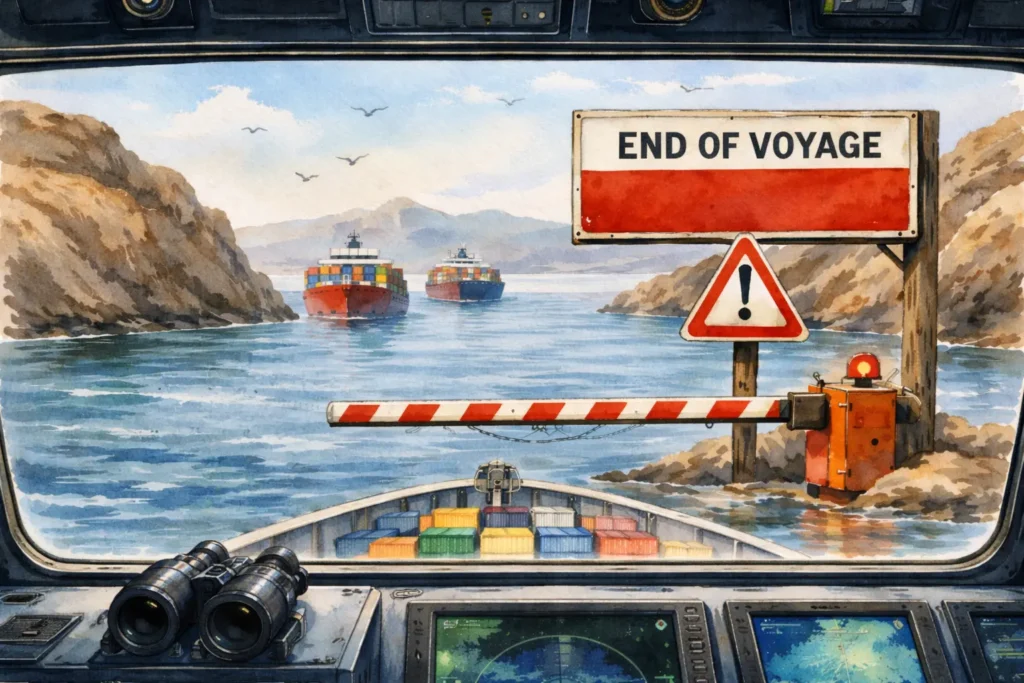


Your carrier has declared End of Voyage and your container is sitting at a port you never planned for.. The carrier has walked away, charges are ticking, and the buyer is waiting.. Here are 8 practical options to deal with stranded cargo and what you need to do NOW..
In the previous article, we discussed what “End of Voyage” means, where the authority for it comes from, and why the 2026 Gulf crisis is the first time we have seen this term applied at scale..
But understanding what happened is only half the problem.. The more pressing question for thousands of cargo owners right now is: what do I actually do next..??
- Your container was supposed to arrive at Jebel Ali, Dammam, or Hamad Port.. Instead, the carrier has discharged it in Salalah, Mundra, Colombo, or somewhere you have never done business before..
- The carrier has walked away..
- You have been charged an End of Voyage fee by the carrier, and on top of that, the Demurrage, Detention and Port Storage charges are ticking..
You should also be aware that this problem is bound to spread because carrier networks are interconnected and the disruption might not stay within the Gulf..
Containers will pile up at unplanned discharge ports, export yards in the Gulf backing up with no vessels to load, blank sailings across the region, sailing schedules in disarray..
The effects on vessel availability and on-time performance will hit multiple trade lanes in the weeks ahead..
So, what are the options if your shipment has reached End of Voyage..?? Here are some things you can do..
First, review your sales contract and Incoterms® chosen clearly to identify who bears this End of Voyage risk and costs – you as a seller or you as a buyer.. Once you know whether if the risk and costs lie with you, choose from the options below (click to expand)..
1
Arrange onward movement yourself
Try to get the cargo to its original destination by rebooking with another carrier that may still be servicing this route, using third-party feeder services, or arranging cross-border trucking.. As an example, cargo discharged in Oman could potentially move overland to the UAE.. You will have to find options that suit your contract and your pocket.. As holder of the document of title, you will bear the additional costs under most carriers’ conditions of carriage..
2
Unpack the cargo
3
Reroute via a different port for a different buyer
Find a different destination outside of the Arabian Gulf/Persian Gulf region where your cargo may have a market and redirect the container to that destination from where it has been discharged.. Example: Container discharged in Salalah instead of Jebel Ali, but you have found a customer in India..
4
Find a new buyer locally
If the cargo cannot move forward and the original buyer cannot wait, selling locally at the forced discharge port may be viable.. Contact your country’s embassy or consulate (commercial section), the local chamber of commerce, your national trade promotion agency, or your freight forwarder’s local office.. They may be able to assist with this.. Be aware, however, of different import duties, product standards, and labelling requirements at this location..
5
Check your cargo insurance
Notify your insurer immediately.. Under the Termination of Contract of Carriage clause in the Institute Cargo Clauses, if the carrier terminates the voyage at a port other than the named destination, your insurance also terminates by default.. However, the clause gives you the right to request continuation of cover, and if you do, the insurer cannot refuse, although they may charge an additional premium.. This gives you up to 60 days of continued cover from the date cargo arrives at the unplanned port.. Without this notification, you are uninsured.. Do this now..Check with your insurer or broker whether your cover includes war risks, either as part of the policy or as a separate add-on.. Without it, your options may be limited.. Standard cargo clauses and even war clauses exclude claims where the cargo is undamaged, but the voyage has been frustrated..
Check if you can claim forwarding charges or a constructive total loss.. Your broker can advise..
6
Abandon the cargo
7
Return the cargo to the origin
Ship the goods back home.. This makes sense if there is a domestic market for them and the commercial relationship with the original buyer cannot be fulfilled.. You are paying for a new shipment entirely.. Sometimes this may be the cheaper option..
8
Store and wait
For high-value goods with a committed buyer, it may make sense to wait it out to see how the situation evolves.. Probably the buyer also has a vested interest in getting the cargo once the situation has returned to normal.. But even if you wait, you must notify your insurer.. The 60-day clock is running (under the Termination of Contract of Carriage clause in the Institute Cargo Clauses, your cover continues for only 60 days from the date cargo arrives at the unplanned port, subject to an additional premium, after which it lapses)..
What you should do RIGHT NOW..
While you are considering which option to choose, if your cargo has been affected, DO THIS NOW:
- Check your Incoterms rule to understand who bears the risk..
- Call your insurer and check for continuation of cover under the Termination of Contract of Carriage clause..
- Contact your freight forwarder for the latest port conditions at the port where container was discharged and alternative ports you may be interested in..
- Contact your trade partner (seller if you are buyer and vice versa) to update the situation and understand their position..
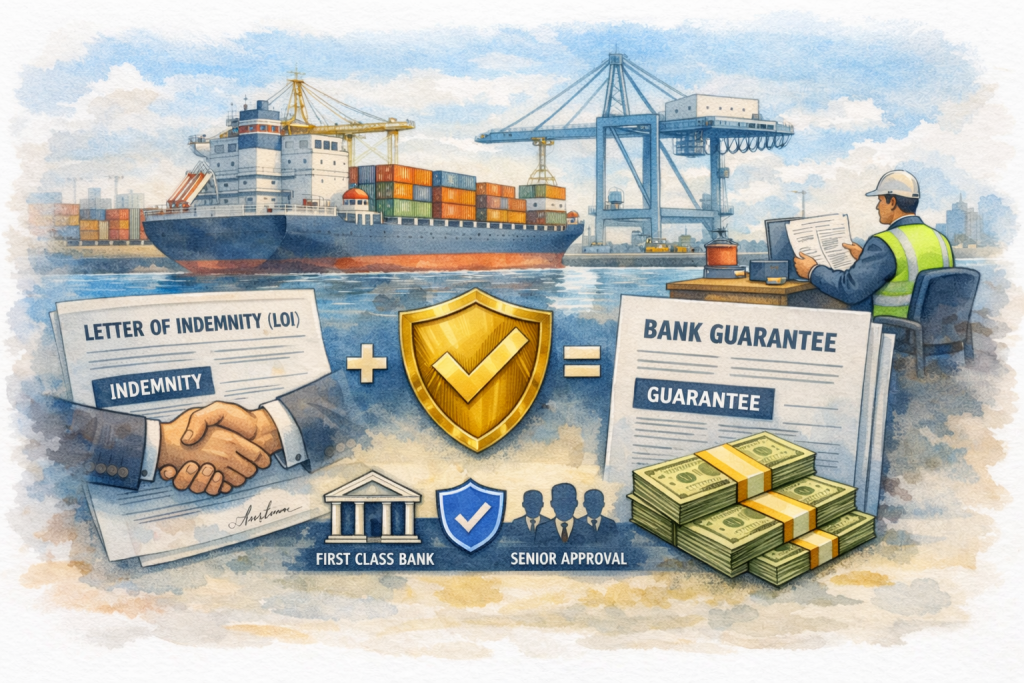
- Contact your bank if the shipment is operating under an LC..
- Document everything: carrier advisories, storage receipts, correspondence, photographs..
The carriers have exercised their contractual right.. Whether it was exercised fairly may be tested in court one day.. But right now, what helps is action, not waiting..
My Take
The 2026 Gulf crisis will likely be the event that forces courts to define the boundaries of the contract of carriage clauses that carriers rely on to terminate voyages.. Until now, these clauses existed quietly in the fine print.. No one tested them at scale because no situation required it..
Now they have been applied across an entire trade lane, affecting hundreds of thousands of containers simultaneously, and the legal, insurance, and commercial consequences are playing out in real time.. If there is one takeaway from this situation, it is that every cargo owner needs to read their bill of lading terms before they need to, and discuss their options in the future with their insurer..
Article FAQ
What is End of Voyage, and what does it mean for my cargo..??
End of Voyage is an operational declaration by a carrier to terminate a voyage before reaching the contractual port of discharge.. The carrier discharges your cargo at the nearest safe port and walks away.. You are left to arrange onward movement at your own cost.. The authority comes from the carrier’s Conditions of Carriage on the bill of lading, not from any maritime law convention..
Why does my cargo insurance not automatically cover stranded cargo..??
The Institute Cargo Clauses exclude claims based on “frustration of the voyage or adventure”.. Undamaged cargo stuck at the wrong port is exactly that.. This exclusion also appears in the Institute War Clauses, so even war risks cover may not help for a pure frustration claim.. Your insurance also terminates by default when the carrier terminates the voyage unless you request continuation..
Who covers the freetime and storage costs at the alternate port where the container was discharged..??
This situation was neither created by you nor was the alternate port requested by you.. Therefore, you can request the carrier in writing to apply the same free time allowance and tariff conditions at the alternate port as those that applied at your original contracted port of discharge.. But of course, also be aware that the tariffs at the alternate port may also be less compared to the original port..
Where do I return the empty container if my voyage was terminated at an alternate port..??
The container belongs to the carrier and therefore as normal, the carrier should provide you with the nearest designated empty return depot to the port where the voyage was terminated.. You need not return it to the original port of discharge in this case.. Get written confirmation from the carrier of the return location before you do anything..
*** END OF ARTICLE ***