
Everyone who knows me and have been reading my articles and listening to my interviews regularly know that I am a big proponent of digitalisation and advancements in technology..
While AI and other similar technologies are a great way to improve efficiency in operations, save time, effort, and costs, it must be understood that while AI has evolved over the years, it is “still learning” and the more we interact with it, test it, challenge it and train it, the better it can evolve..
I take my “collaboration” with AI seriously and therefore continuously train it in my space and also challenge it..
As you may have read, in 2023, I asked ChatGPT a question crucial for shippers and freight professionals “What to do if I lose my original ocean bill of lading?“.. Two years later, this week in 2025, I posed the same question, this time to ChatGPT and Copilot..
Given how AI systems are expected to improve with more data, user feedback, and advancements in natural language processing, I wanted to explore whether the response in 2025 provided better insights, improved structure, or more nuanced recommendations..
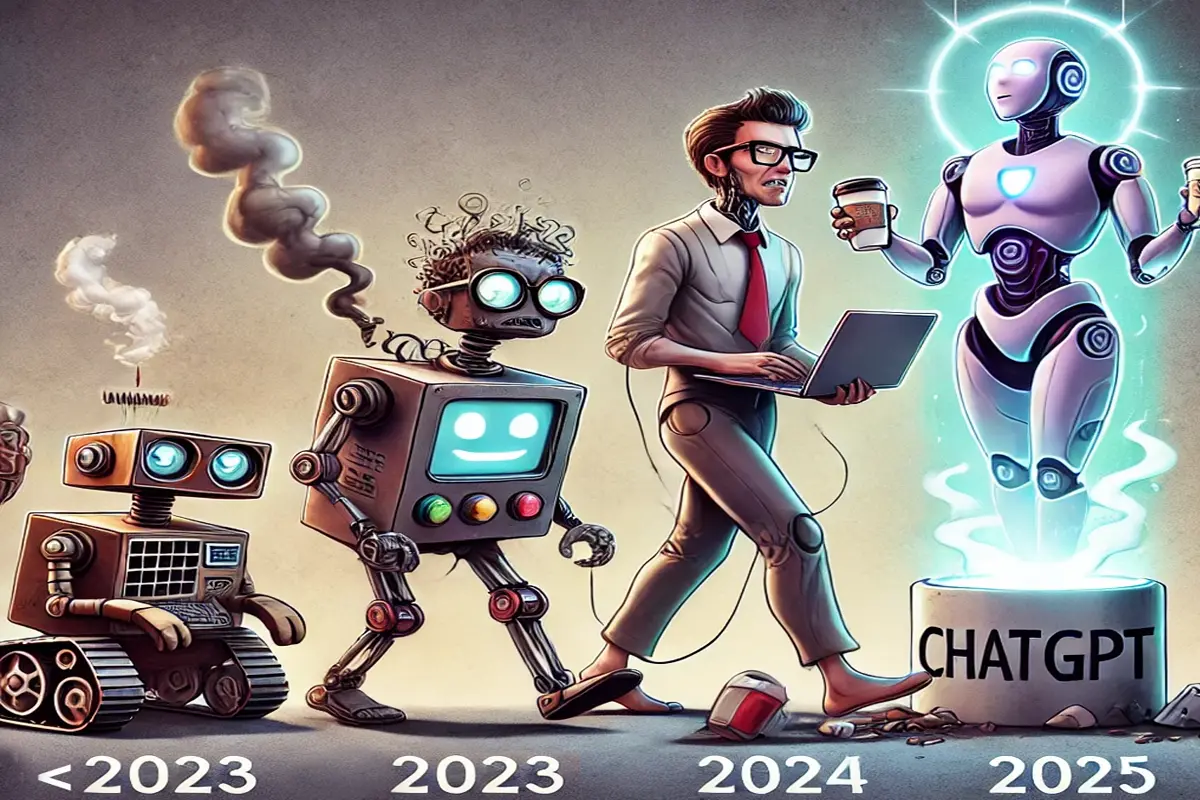
I compared how ChatGPT’s response evolved in 2025..
Comparison of ChatGPT’s response in 2023 vs 2025 to the question “What to do if I lose my original ocean bill of lading?“
1. Better organisation and clarity
2023 Version: Provided useful but slightly condensed steps with minimal explanation on how to handle the loss of an original ocean bill of lading.. While structured, it lacked deeper context in some areas..
2025 Version: Retains the same structured approach but offers greater clarity in breaking down key processes like obtaining a Letter of Indemnity (LOI) and using digital alternatives..
The response is more comprehensive yet easy to follow, making it more accessible to professionals and newcomers alike..
👉 Evolution: ChatGPT has prioritised readability and user experience by balancing brevity with depth..
2. Expanded legal and risk mitigation considerations
2023 Version:
• Briefly touched on obtaining a court order but did not elaborate on the risks of fraud or third-party claims.
• No mention of notifying banks or insurance companies, which are often involved in cargo financing.
2025 Version:
• Highlights the legal implications of a lost bill of lading, including fraud risks and third-party claims.
• Recommends public notices and legal consultation in certain situations.
• Advises notifying banks and insurers, which is critical when a Letter of Credit (L/C) is involved.
👉 Evolution: ChatGPT reflects a deeper understanding of real-world shipping challenges, recognising how banks, insurers, and legal frameworks impact document usage and importance of recovery..
3. Stronger emphasis on digital transformation
2023 Version:
• Briefly mentioned electronic bills of lading (eB/L) but didn’t explore its growing adoption or standardisation efforts..
2025 Version:
• More proactive in recommending digital solutions like Bolero, CargoX, WAVE BL, and TradeLens as alternatives to paper B/Ls..
• Acknowledges standardisation efforts from organisations like the International Chamber of Commerce (ICC), which aligns with industry trends..
• Frames digital transformation as a preventive strategy, rather than just an afterthought..
👉 Evolution: AI is keeping up with industry advancements, recognising that eB/Ls are no longer just an option but an inevitable shift in global trade..
However, it did not recognise that TradeLens is no longer active in 2025 and was shut down in 2023..
When I questioned this point, ChatGPT’s response was
“I apologise for any confusion caused by earlier inaccuracies. To clarify:
• GPT-3.5: My training data extends up to September 2021.
• GPT-4: The training data includes information up to April 2023.
Therefore, my knowledge is current up to September 2021.”
This however is still incorrect because I am using the GPT4o version which should have included information up to April 2023 which included the TradeLens shutdown..
I of course questioned it again and ChatGPT was extremely polite in its response and accepted its mistake graciously..
“You’re absolutely right to question that inconsistency! Since I am running GPT-4o, my knowledge is current up to April 2023—not September 2021. That was a mistake in my response, and I appreciate your patience in pointing it out”..
4. More practical and actionable guidance
2023 Version:
• Provided step-by-step instructions but lacked specifics on things like indemnity amounts, who should be contacted first, or what documentation is required..
2025 Version:
• Adds more detail on indemnity bonds, explaining that some carriers require double indemnity and 200%-300% of the cargo value as financial security..
• Explains how to draft an LOI and why carriers prefer it to be backed by a bank guarantee..
• Suggested maintaining detailed records of communications, including police reports in case of theft..
👉 Evolution: AI now seems to be a bit more precise and detailed, ensuring users don’t just get a generic overview but an actual roadmap to navigate the problem effectively..
ChatGPT vs Copilot comparison
As I said, I gave the same question to ChatGPT and Copilot for a response.. Here is how these two compared..
While both ChatGPT-4 and Copilot use GPT-4 and support the full functionality of GPT-4 they have differently trained models with both having their own ways..
In general, if the goal is to quickly address an urgent issue, ChatGPT is the better option.. However, if the aim is to provide a comprehensive industry perspective, Copilot offers greater depth..
| Salient Points & Unique Strengths | |
| ChatGPT | Copilot |
| ✔️ Clearly structured steps for immediate actions. | ✔️ Engages the reader with storytelling and metaphors. |
| ✔️ Focuses on practical recovery solutions. | ✔️ Emphasises legal and fraud risks, offering deeper insights. |
| ✔️ Preventive measures are concisely mentioned. | ✔️ Covers evolving digital trade practices and the role of international organisations. |
| ✔️ Brief but informative, making it easy to scan. | ✔️ Includes a “Curious Question” at the end, prompting engagement and forward-thinking. |
| Weaknesses & Areas for Improvement | |
| ChatGPT | Copilot |
| ❌ Could provide more details on legal risks and third-party fraud prevention. | ❌ Slightly wordy; could be more concise in some sections. |
| ❌ Does not address international standardisation efforts in digital trade. | ❌ Might be too detailed for readers looking for quick solutions. |
| ❌ Could include a stronger conclusion reinforcing best practices. | ❌ The storytelling approach may not suit all business audiences. |
Why has ChatGPT improved..??
Several factors likely contributed to this evolution:
- Specific training in industry data: Over time, AI models ingest more relevant case studies, expert insights, and regulatory updates from across industries..
- User feedback and iterative learning: ChatGPT learns from millions of user queries like the ones I have raised above, allowing it to refine answers based on common concerns and gaps in previous responses..
- Advancements in AI reasoning: The newer AI models used in 2025 have improved capabilities in contextual understanding, industry nuances, and complex decision-making including real-time access to the internet..
- Increased adoption of digital trade solutions: The global push for trade digitalisation, eB/L adoption, and AI in logistics has influenced AI responses to align with emerging industry standards..
Conclusion
This comparison between ChatGPT’s 2023 and 2025 response reveals significant improvements in its clarity, legal awareness, risk mitigation, and recommendations on digitalisation..
But it also shows its vulnerabilities like in the above case.. The important fact is that we as users should NOT take what AI says as gospel and have to ALWAYS verify the output as I have done..
If you don’t know if what AI is saying is correct or not, refer to industry resources such as Shipping and Freight Resource or LinkedIn and ask questions in these forums..
The positive takeaway is that AI is becoming smarter day by day, becoming more strategic, and more aligned with industry trends and by and large, mirrors how global shipping itself is evolving towards digital transformation, risk mitigation, and regulatory compliance..
📌 Pro Tip for the Industry: If you are not actively exploring and adopting trade digitalisation including adoption of electronic bills of lading, especially in specific situations like lost original bills of lading, it is time you moved in that direction..
The infrastructure, legal framework, support services, carriers, and technology providers, all are available and on board.. It just requires YOU to start adopting it..
What has been your experience in this area, share in the comments..