
Have you always wanted to switch from paper trade documents to digital originals in trade, but didn’t know how? You are not alone..!!
Walk into any bank’s trade finance department today, and you will notice something interesting.
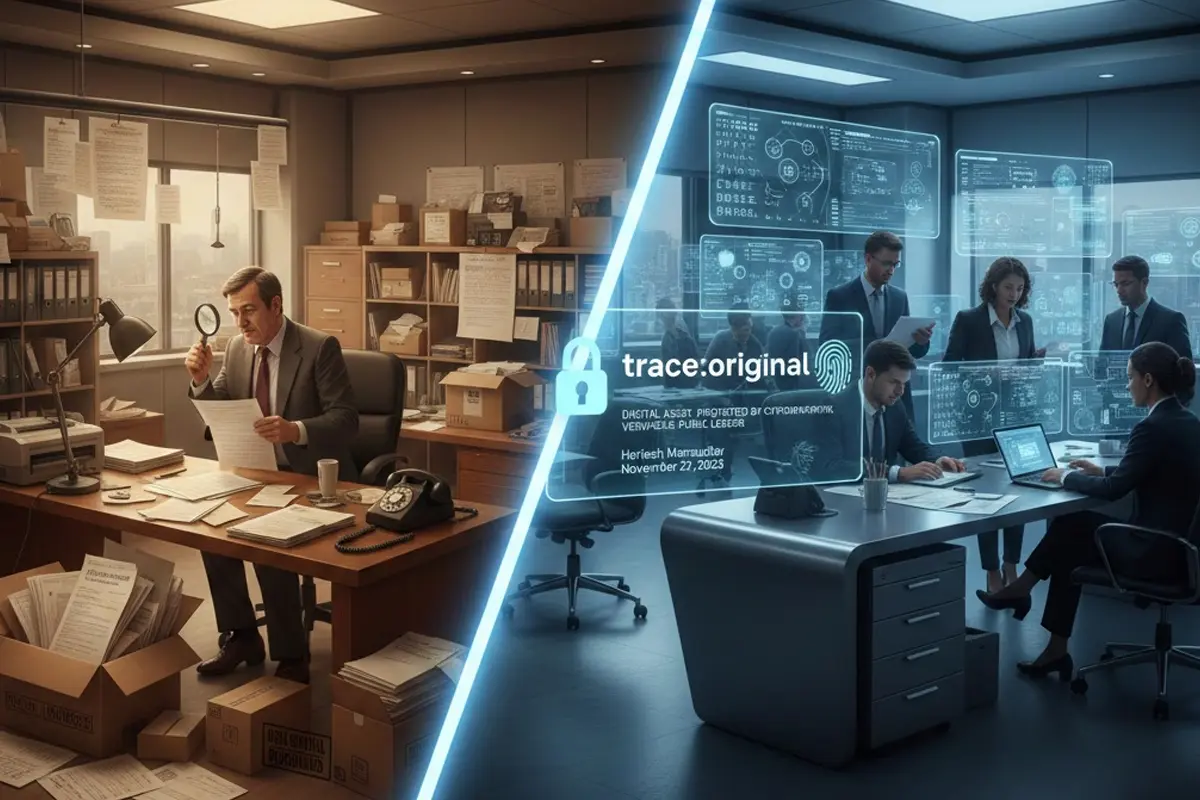
Everything feels digital, screens glowing, emails flowing, documents compared and reviewed online, yet the moment someone asks for an original, the room goes back to 1985.
Out come the paper bundles, courier envelopes, wet signatures, and stamped bills of lading. This dependence on paper has always been the final barrier stopping trade from becoming fully digital.
Almost every process around it has modernised, but the core legal function of an original document has remained stuck in the physical world.
trace:original was created by Enigio to close that gap. It offers a way to keep the legal integrity of paper while finally pulling original documents into the digital age.
The problem with “digital documents” as we know them
For years, the industry tried using PDFs, scans, and portal uploads as “digital versions”, but none of these solved the key issue.
- A PDF can be copied
- An email attachment can be edited
- A scan can be duplicated endlessly
There is no such thing as the original digital copy. And in trade, original means everything, ownership, risk, payment, release of goods, and security.
So, the question became :
How do we create a digital document that behaves like an original piece of paper?. One that only one person can control, that cannot be forged, and that everyone can trust?
trace:original is the answer to that question.
A new kind of digital document, not just a PDF
When people first hear about trace:original, they often imagine it is simply a specialised PDF. But that could not be further from the truth.
The PDF format is only the packaging, a convenient, globally accepted shape for the document. The real magic sits inside.
A trace:original document is:
- A unique digital asset
- Protected by cryptography
- Verifiable through a public ledger
- Controlled only by whoever holds the matching private key
- Append-only, meaning nothing inside can be erased or quietly rewritten
In other words, it looks familiar on the outside, but functions like digital paper with superpowers, something a normal PDF could never do.
How it maintains trust – the “digital fingerprint”
Every time a trace:original document is created, it gets a unique identity number, and every version is referenced by multiple digital fingerprints, cryptographic hashes using the SHA-256 algorithm. Each version and change is also digitally signed by the current holder.
These fingerprints are:
- Completely unique
- Impossible to guess or fake
- Each new version is cryptographically linked to the previous
- Published on a publicly distributed ledger
- Authenticity verifiable by mathematics and correct signatures
But, and this is important, the content of the document is never made public. Only the current controlling public key, fingerprints, and signatures are recorded on the ledger. The business information stays private with the document holder.
This means anyone in the world can check whether their copy is the true original simply by verifying document structure and fingerprints towards the ledger.
Ownership built into the document
A physical paper original is controlled by whoever physically holds it.
trace:original achieves the same effect digitally. Each document is tied to a public–private key pair. While the public key is visible in the document and on the ledger, the private key is kept secret by the holder and proves possession.
If the private key matches the public key, the holder can:
- Update the document (by adding, never overwriting)
- Transfer it to someone else
- Invalidate it if necessary
Lose the private key, and you lose control, just as you would with a misplaced physical original.
Transferring a digital original, as real as handing over a paper one
One of the most powerful aspects of trace:original is how transfer works. Just like handing over a paper original, with the previous holder relinquishing control through encrypted transfer, making the new holder the legally recognised controller, backed by a verifiable entry appearing on the ledger showing the new holder’s public key.
Transfers can be made:
- By email
- Directly to the receiver’s public key
- Directly to the receiver’s Fullnode
The new holder must receive the latest version of the file and hold the private key to control it.
It feels remarkably similar to handing over a physical document, but with clearer proof and no risk of loss, delay, or tampering.
Endorsements and amendments, the digital equivalent of scribbling on paper
In the paper world, endorsements and notes are written physically on the document. trace:original mimics this exactly because the document or data cannot be overwritten or rewritten, and can only append new information, creating a perfect audit trail, locked permanently into the document’s history.
This is essential for negotiable instruments and documents of title.
How trace:original is created
A trace:original document is created using a Fullnode, which works like a digital printing press that turns any document into a secure digital original.
JSON Schemas (following different information standards) can specify the required structure of data in a document and make the document machine-readable, allowing banks, logistics providers, customs authorities, and other organisations to add structured data, embed electronic signatures, and manage transfers seamlessly within their own systems.
Smaller users can simply receive and verify trace:original documents using the free online tool at traceoriginal.com, making the document interoperable like paper, without requirements on the recipient to be a customer or having a certain application available.
A practical path toward global digital trade
Digitalisation will not happen evenly around the world. Some countries and banks will move quickly; others will need time.
That is why trace:original was designed to be:
- Infrastructure-agnostic
- Platform-independent
- Legally and functionally equivalent to paper
- Usable by anyone with a computer and internet
- Built so that paper and digital can coexist during the transition
It is a realistic, scalable solution, not a closed system, not a walled garden, and not another platform demanding universal adoption.
Instead, it brings the best qualities of paper into a trusted digital format, giving trade the ability to modernise without forcing every participant to change at the same time.
Download the free and easy-to-understand guide to switch from paper to digital originals here.
You will full understanding of trace:original, including how it works, how cryptographic hashing works, how transfers are recorded on the ledger, and how JSON Schemas support interoperability. All details are explained clearly in the trace:original guide.