
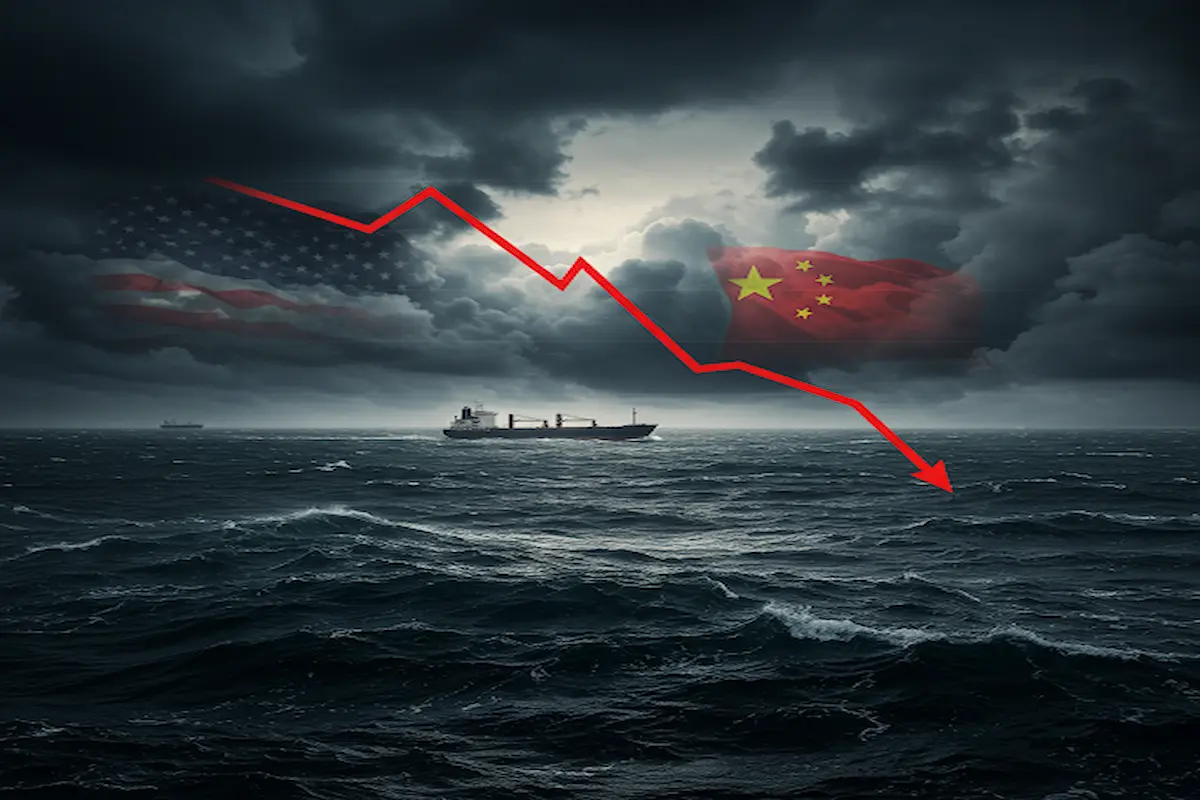
The ocean freight industry is navigating rough waters as container pricing continues to plummet amid intensifying trade tensions between the United States and China.
The recent decision by President Donald Trump to increase tariffs on Chinese imports from 10% to 20% has re-ignited a fierce exchange between the world’s two largest economies.
China swiftly responded with a bold message from its U.S. embassy, declaring, “If war is what the U.S. wants, be it a tariff war, a trade war or any other type of war, we’re ready to fight till the end.”
China has also backed up its words with action. China retaliated with an additional 15% tax on key American exports of chicken, pork, soybeans, and beef.
What’s happening with the freight rates
Amid these heightened geopolitical tensions, the Drewry World Container Index (WCI) has further declined, dropping another 3% to $2,541 per 40-foot container as of March 6, 2025.
This latest decrease marks a significant milestone, falling 76% from the record-setting pandemic peak of $10,377 per container in September 2021.
While this reflects a stark normalization from previously inflated rates, current prices still stand notably above the pre-pandemic average of approximately $1,420 per container in 2019, emphasizing ongoing volatility within the freight market.
Year-to-date, the average composite index is $3,289 per 40-foot container, which remains $405 higher than the 10-year average of $2,883, demonstrating that, despite recent declines, container pricing has not entirely returned to historical norms.
Regional impact and route-specific developments
Transpacific trade routes were hit hardest this past week:
- Rates from Shanghai to Los Angeles fell sharply by 9%, or $311, bringing the rate to $3,166 per 40-foot container.
- The Shanghai-New York route similarly experienced a considerable drop of 6%, declining by $273 to reach $4,320 per container.
On the transatlantic front:
- Rates from Rotterdam to Shanghai decreased by 4%, losing $20 to reach just $483.
- Rotterdam to New York rates saw a slight decline of 1%, down $15 to $2,359.
However, some routes displayed marginal resilience amid the broader downturn:
- Shanghai to Rotterdam experienced a modest 2% increase, climbing by $50 to $2,636 per container.
- The New York to Rotterdam route also registered a slight uptick of 1%, adding $10 to reach $845 per container.
- Routes from Shanghai to Genoa and Los Angeles to Shanghai maintained stability, indicating selective strength in certain trade lanes.
Market outlook & implications
Experts at Drewry predict that freight rates will continue to trend downward in the coming weeks, driven by persistent overcapacity in the shipping market and subdued global demand. The ongoing trade war uncertainty between the US and China is expected to further dampen market sentiment, potentially pressuring rates to new lows in 2025.
Carriers, shippers, and logistics providers must remain vigilant and prepare for ongoing volatility. Strategic flexibility and operational efficiency will be crucial for stakeholders aiming to maintain profitability and competitiveness.
Companies may need to reassess their supply chain strategies, renegotiate contracts, and explore alternative routes or shipping options to mitigate the impacts of fluctuating container pricing.
The era of elevated container rates and abundant profits appears to be coming to a close. As prices approach their lowest levels since early 2024, stakeholders must brace for ongoing volatility in a market increasingly influenced by geopolitical forces beyond their control.