
By now, we all know what a bill of lading is, the types of bills of lading, and the functions of a bill of lading.. If not, please do read the linked articles..
In the early 16th century, the term “bill of lading” entered formal English usage, with Merriam-Webster citing its first known use in 1532..
This coincides with a period when English merchants and ship captains began issuing signed cargo receipts as separate documents..
Surviving records from the 1530s, including a 1538 Admiralty Court case referencing a “bill of lading,” confirm that by Henry VIII’s reign, the bill of lading was already an established document in English trade and law..
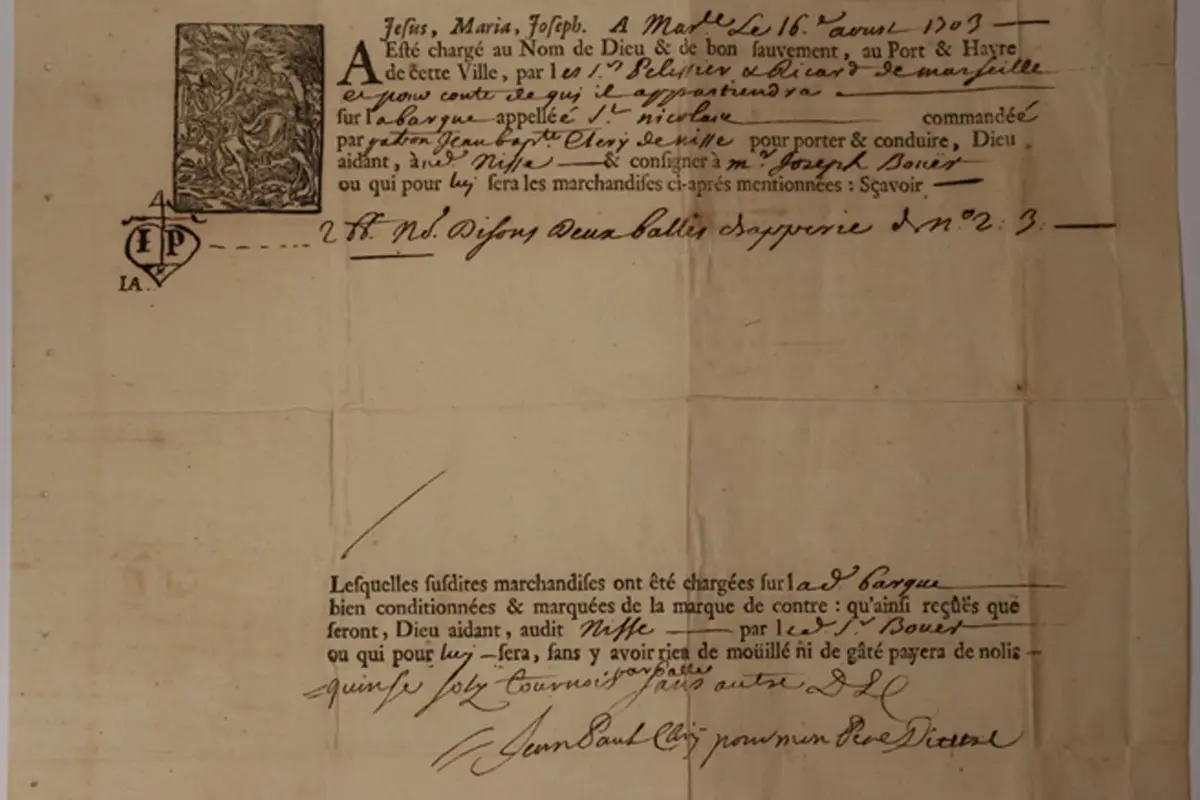
In this article, Ahmet Aytoğan showcases one of the vintage bills of lading he has from the year 1703..
Document Type: Bill of Lading
🔹 Document Language: French
🔹 Date: 16 August 1703
🔹 Port of Loading: Marseille
🔹 Port of Discharge: Nice
🔹 Carrying Vessel: Barque Saint Nicolas
🔹 Master: Jean-Baptiste Cléry of Sète
🔹 Shippers: Messrs. Pélissier & Ricard of Marseille
🔹 Consignee: Mr. Joseph Bouis
🔹 Cargo: Two bales of draperies (marked No. 2.3)
🔹 Freight: Not specified (however, the phrase “qu’il payera de nolis quinze sols couronne par autre…” indicates a partial freight payment)
Original Bill of Lading text (translated from French)
Jesus, Mary, Joseph.
In Marseille, on the 16th of April 1703
Has been loaded in the Name of God and for good delivery, at the Port and Harbor of this City, by Messrs. Pélissier & Ricard of Marseille, and for account of whom it may concern, on the barque named St Nicolas, commanded by captain Jean Baptiste Clercy of Cette, to be carried and delivered, God willing, to Messina, and consigned to Mr. Joseph Bouis or whomever acts on his behalf, the merchandise herein mentioned:
Namely: 2 bales marked N.D. Dijon, draperies, numbers 2 and 3
The above-mentioned goods have been loaded on said Barque, well conditioned and marked with the countermark: and being thus received, God willing, at said Messina by the said Mr. Bouis, or whomever for him shall act, without anything wet or damaged, freight to be paid at fifteen sols crown, without any other deceit.
Jean Paul Clerc, for my father Pistou
Academic Analysis
This bill of lading, dated April 16, 1703, issued in Marseille, is a valuable document from the Ancien Régime’s maritime commerce. It reveals many foundational aspects of pre-modern commercial shipping practice.
Firstly, the invocation of “Jesus, Mary, Joseph” at the top signals the deeply religious character of commercial activities in the 17th and 18th centuries. This religious reference not only reflects societal norms but also served as a symbolic mechanism to shift part of the risk or responsibility to divine will in case of maritime perils.
The document clearly identifies the vessel (barque called St. Nicolas) and its captain, Jean-Baptiste Clery of Siette, which confirms the need for accountability in shipping operations. The named shippers (Messrs. Pélissier & Ricard) and consignee (Mr. Joseph Bousset) show that this bill of lading fulfilled all three traditional functions: receipt of goods, evidence of contract of carriage, and document of title.
The legal tone of the document is evident, particularly in the clause “without anything being wet or damaged,” indicating the shipowner’s responsibility for proper care of cargo — although still within a pre-modern legal framework lacking codified international conventions such as Hague-Visby.
The freight rate – fifteen sols tournois – reveals the monetary context and cost structure of the time, because in the past it was common for the bill of lading to reflect the freight amounts paid for the carriage.
The signature Jean Paul Clary for my father Victor is a strong indication of a familial commercial representation, common in Mediterranean trade networks.
Use of this image and text is prohibited without written permission from the author Ahmet AYTOĞAN.
About the Author: Ahmet Aytoğan, born in 1963, is a veteran of the industry living in Türkiye and an avid collector of bills of lading, especially old ones.. He became involved in foreign trade and container shipping in 1985.. His bill of lading collection includes approximately 1,200 bills of lading in various languages and from various countries, the oldest of which dates back to 1680.. He held the first-ever bill of lading exhibition at the Maritime Museum in Beşiktaş, Istanbul, for four days..