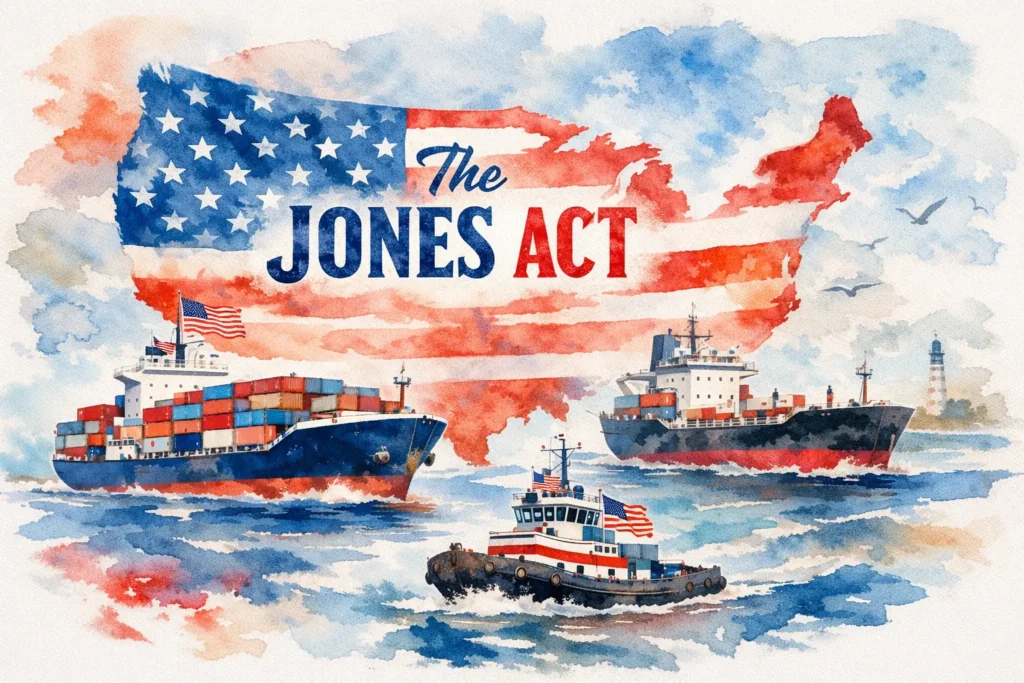

The US Maritime Action Plan proposes a fee on virtually every commercial ship entering American ports.. With US-built vessels accounting for less than 1% of global commercial shipping, the impact could ripple across the entire supply chain..
On Friday, the 13th, 2026, the United States Government released The Maritime Action Plan (MAP) based on Executive Order 14269, signed April 9, 2025, which directed the development of the Plan..
While the MAP talks about several recommended policy actions, mainly to fund the initiatives, the one that caught my eye was the recommendation to “Establish a Universal Fee on Foreign-Built Vessels from any Nation Entering U.S. Ports“..
In simple terms, it says that a fee should be levied on ANY foreign-built vessels, which at this stage is 99% of commercial ships calling at US ports since the USA accounts for less than 1% of new commercial ships globally..
The Plan models two illustrative fee levels assessed on the weight of the imported tonnage arriving on the vessel..
- A fee of 1 cent per kilogram on foreign-built ships as the lowest bracket, which would account for a projected revenue of approximately $66 billion over ten years, and
- A fee of 25 cents per kilogram at the highest bracket, which would account for a projected revenue of $1.5 trillion over the same period..
These figures define the potential funding envelope for shipyard expansion and maritime industrial capacity programs, with the revenue flowing into a proposed Maritime Security Trust Fund..
Who is likely to pay these costs..??
If we look at how container shipping works, these fees are unlikely to be absorbed by carriers and are typically recovered through rate adjustments or surcharges.. So the cost may effectively shift to cargo owners and importers..
Impact on the customer
At the lower illustrative rate of $0.01 per kilogram, a 40ft container carrying approximately 14 metric tons would attract an additional charge of about $140..
On a Shanghai to Los Angeles freight rate of roughly $2,200 per 40ft (as per Drewry’s World Container Index), this represents an increase of approximately 6.3% on the freight line..
At the higher illustrative rate of $0.25 per kilogram, the same container would attract an additional charge of about $3,500, which exceeds the underlying ocean freight rate..
For an individual importer, this becomes a direct landed cost increase per container, depending on how the carrier structures these costs in the freight contract..
Importers working on thin margins, especially in heavy cargo categories, will feel this more.. Weight-based assessment affects commodities, industrial goods, and dense cargo differently from lightweight consumer products..
Impact on the carrier
At the vessel level, the numbers scale quickly.. A carrier discharging 1,000 TEU, equivalent to roughly 500 forty-foot containers, each averaging 14 metric tons, would face an aggregate fee of approximately $70,000 at $0.01 per kilogram.. At $0.25 per kilogram, the aggregate exposure rises to approximately $1.75 million for that single port call..
Vessel fee does not sit in isolation
When reviewing the broader MAP, there are additional recommendations that could also influence the landed cost of goods into the United States..
The Plan also proposes a Land Port Maintenance Tax of 0.125 percent on merchandise entering through land borders.. Unlike the vessel fee, which is weight-based, this levy is value-based..
This makes it harder for importers to simply reroute cargo via Canada or Mexico to dodge the maritime fee.. Sea imports get hit on weight, land imports get hit on value, and either way, your landed cost calculation changes..
Another recommendation is the gradual introduction of a United States Maritime Preference Requirement, under which certain U.S.-bound cargo may be required to move on qualifying U.S. vessels..
This isn’t a direct tax, but over time it could change how freight is priced on affected trade lanes by shifting capacity allocation and cost dynamics.. For importers, the impact would likely appear as long-term freight base adjustments rather than a visible surcharge..
The MAP also proposes establishing a Strategic Commercial Fleet supported through dedicated funding mechanisms.. If vessel-based fees contribute to a Maritime Security Trust Fund that finances fleet expansion and industrial programs, part of the cost of rebuilding US maritime capacity may end up being embedded within trade flows..
My take
While these are definitely lofty plans to revitalise the US maritime ambitions, at this stage, these are proposals.. But they have the potential to affect US trade, consumers, and the carriers that serve the nation..
But whether through a weight-based vessel fee, a value-based land port tax, or evolving maritime preference rules, IF implemented in its current state, the direction of travel is clear.. Trade policy is moving closer to directly affecting how freight costs work..
For importers, the issue is no longer just freight rates.. It is structural exposure.. Because when policy starts influencing weight, routing, and vessel allocation, landed cost is no longer a static number..