
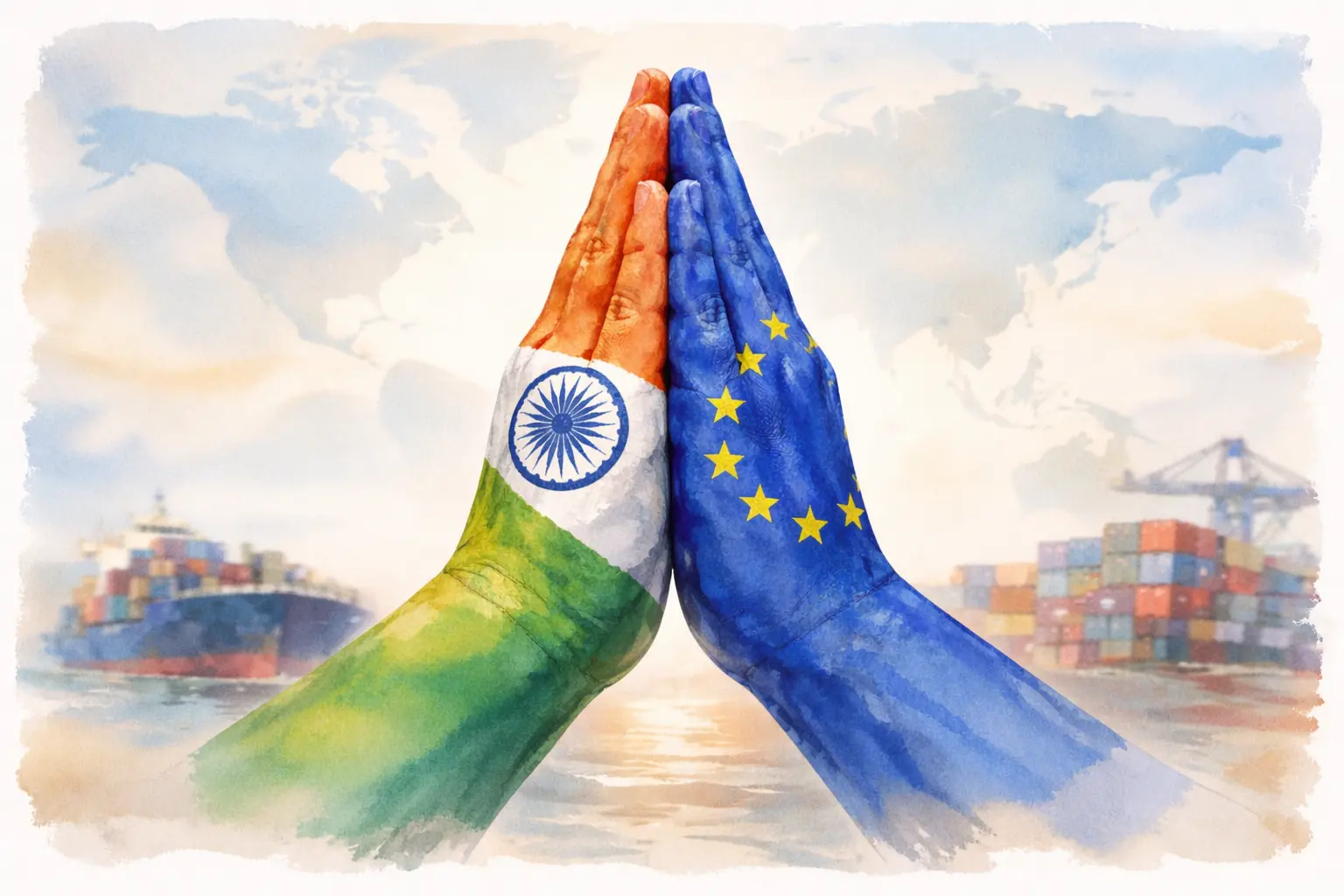
After nearly two decades of negotiations, India and the European Union have politically concluded what leaders are calling the “mother of all deals”, a landmark Free Trade Agreement that signals a new phase in bilateral economic cooperation.
The agreement comes at a time of global trade uncertainty, rising protectionist signals in key markets, and supply chain realignments. Against this backdrop, the India-EU FTA represents a deliberate move toward stability, diversification, and long-term economic integration.
What the deal aims to achieve
The FTA is designed to improve market access across a broad range of sectors, including manufacturing, services, industrial goods, and selected consumer products.
- For India, this could mean stronger export momentum in areas such as engineering goods, textiles, pharmaceuticals, and auto components.
- For the EU, it opens deeper access to one of the world’s fastest-growing large markets..
As per India Today, the agreement is expected to “boost manufacturing competitiveness and strengthen long-term investor confidence,” underlining that this is not merely a tariff exercise but a structural economic partnership.
Importantly, the agreement also reinforces services trade and investment cooperation, areas where India’s IT, consulting, and business services sectors are already deeply engaged with European markets.
When does it come into effect?
Although negotiations have been politically concluded, the agreement does not enter into force immediately. It must now undergo legal scrubbing, translation into EU languages, and formal ratification processes.
On the European side, approval by the European Parliament is required, and depending on the final structure, member state procedures may also apply. India must complete its own domestic approval processes.
In practical terms, businesses should expect a phased implementation timeline once ratification is complete, with tariff reductions introduced progressively rather than overnight.
Strategic implications in a changing global trade environment
The FTA also carries geopolitical and economic weight. With the United States signalling a firmer stance on tariffs and trade measures in certain sectors, both India and the EU are seeking to diversify their economic partnerships. A structured agreement between two major economic blocs reduces reliance on any single market and strengthens resilience across supply chains.
For exporters, manufacturers and logistics providers, this diversification could help stabilise trade flows between India and Europe, partially offsetting volatility linked to shifting US trade policies and geopolitical tensions.
What this could mean for shipping
Over time, deeper India-EU integration could support stronger containerised flows between Indian and European ports, particularly in manufacturing-led sectors.
Greater trade predictability often translates into more stable freight contracts and clearer demand visibility for carriers and forwarders.
While shipping volumes will not shift immediately, the agreement has the potential to reinforce the India-Europe corridor as a more structured and strategically important trade lane in the medium term.
A measured but meaningful step forward
The India-EU Free Trade Agreement is not an overnight transformation. It is a framework for gradual integration, investment confidence, and diversified growth.
If implemented smoothly, it could strengthen manufacturing competitiveness, deepen services cooperation, and enhance supply chain resilience for both regions. In an era of global trade fragmentation, that stability alone makes this agreement significant.
For industry leaders, the focus now shifts from negotiation headlines to practical preparation, understanding tariff schedules, compliance requirements, and sector opportunities as the agreement moves toward formal implementation.