
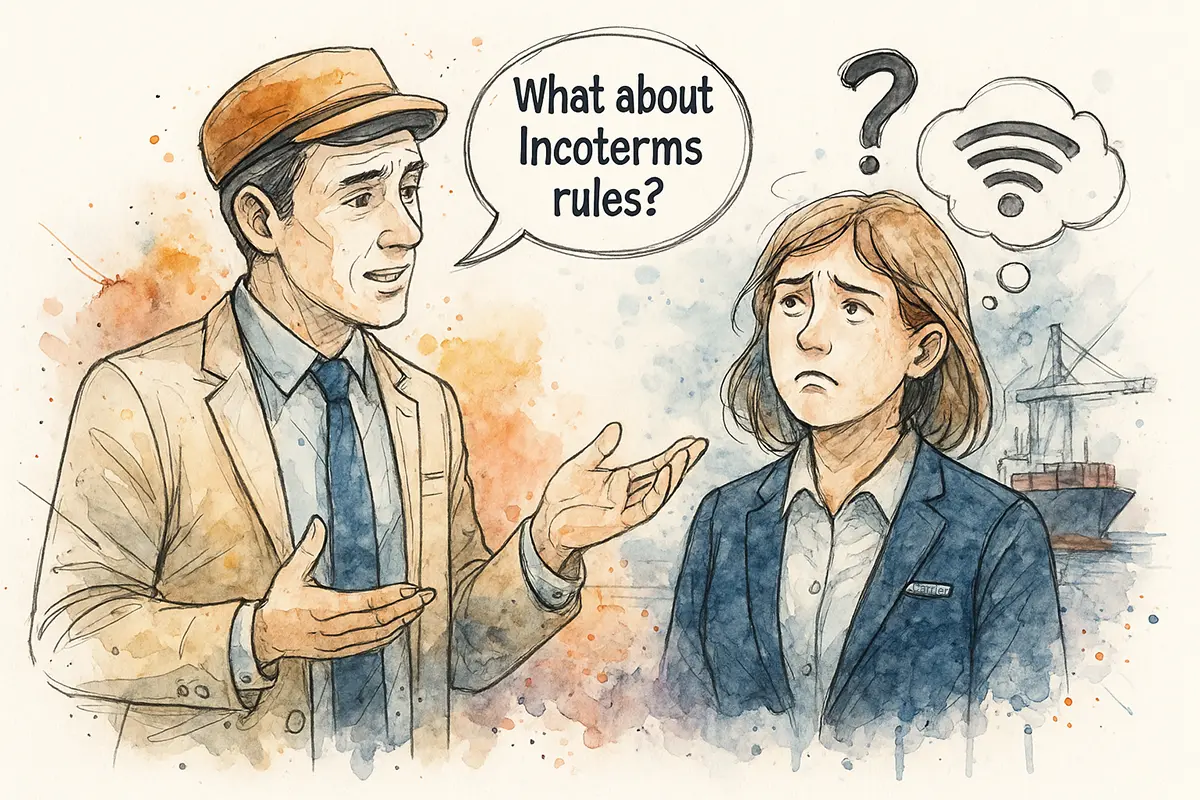
- Is there a connection between Incoterms® and the shipping line..??
- Should Shipping Lines be concerned with Incoterms®..??
- How does Incoterms® affect the shipping line..??
These are a few of the questions raised by readers who have complained that their booking with the carrier was on FCA, FOB, CIF, etc, but the carrier refuses to show this commercial information on the bill of lading..
Let’s analyse the questions starting with the definition of Incoterms®.. The ICC (International Chamber of Commerce), defines Incoterms® as below :
Incoterms®
The Incoterms® rules are an internationally recognized standard used worldwide in international and domestic contracts for the sale of goods. First published in 1936, Incoterms® rules provide internationally accepted definitions and rules of interpretation for most common commercial terms.
The rules have been developed and maintained by experts and practitioners brought together by ICC and have become the standard in international business rules setting. They help traders avoid costly misunderstandings by clarifying the tasks, costs and risks involved in the delivery of goods from sellers to buyers. Incoterms® rules are recognized by UNCITRAL as the global standard for the interpretation of the most common terms in foreign trade.
As you can see from the explanation above, Incoterms® are an integral part (although not mandatory) of the sales contract between the seller and buyer..
So, technically and legally, there is no connection between Incoterms® rules and the shipping line, as these terms do not form part of any contract between a customer and the shipping line..
Remember that a sales contract and contract of carriage are two different things..
The sales contract incorporating Incoterms® is between a buyer and seller, whereas the contract of carriage is between the customer (either the buyer or the seller) and the shipping line.
However, in practical life, I have seen cases where clients ask a shipping line to quote “FOB Durban to CFR Shanghai” or to quote “DDP Shanghai”..
Although the carrier or contract of carriage has nothing to do with the Incoterms®, due to perceived obligations or in their enthusiasm to assist the client, some staff at the shipping line’s office may quote the client based on their request..
They do this without being aware of the implications of these terms and what they need to include/exclude in the quote, exposing themselves or the line to the possibility of submitting a wrong quotation, with a potential for disputes at a later stage over it..
For a container carrier, making reference to or quoting based on FOB Incoterms® rules could get complicated because the term FOB itself is not the right term to use for containerised shipments..
But the buyer/consignee are using it and requesting a quote on that basis because for them it relates to the fact that their costs start from the time the goods are on board in Durban..
FOB seems to have become an integral part of the container shipping industry who are still unwilling to forget FOB.. It has become like a part of the furniture, like a boilerplate, because it was an established term in the industry for a very long time, and continues to be used incorrectly for containerised shipments instead of the correct term, which is FCA (Free Carrier)..
The term Free Carrier (previously FRC, now FCA) was introduced in the 1980 version order to deal with this frequent case, but since people are creatures of habit, the usage of the term FOB continued..
FOB vs FOB
There is also a disconnect in what “customers” refer to as FOB and what “carriers” refer to as FOB..
Customers understand and refer to FOB as an Incoterms® rule where FOB = Free On Board, because in reality, for them, this is what it is..
The buyer bought the goods on FOB basis, meaning in simple terms, they agreed with the seller that they (the buyer) will only be responsible for costs from the time the goods are on board and not before..
For Carriers, FOB is more of a “business” term used in practice to classify cargo that is commercially controlled by consignees at a destination port (FOB) as opposed to cargo that is commercially controlled by shippers at the same location port (CIF)..
For a carrier, FOB = freight collect at the POD as opposed to CIF = freight prepaid at the POL..
Totally different meanings..
In the other example “DDP Shanghai”, if the carrier indicates in their quote that it is DDP Shanghai, then they would be expected to include all the charges up to DDP Shanghai, which includes customs clearance, duty, VAT, etc, which are generally beyond the scope of a carrier’s activity..
Therefore, carriers are very reluctant or even pedantic about showing commercial information on their bill of lading, especially if it includes references to Incoterms® and cargo value, as these are not under the control of the carriers..
The carrier doesn’t want to undertake the liabilities and risks that come with the commercial and Incoterms® information when it is not a part of their contract..
Here, “commercially controlled” refers to whoever agrees on the freight rate negotiations/payments with the shipping lines..
Have you come across any instances where the shipping line has been involved with Incoterms®..??
Article republished with some critical updates..