
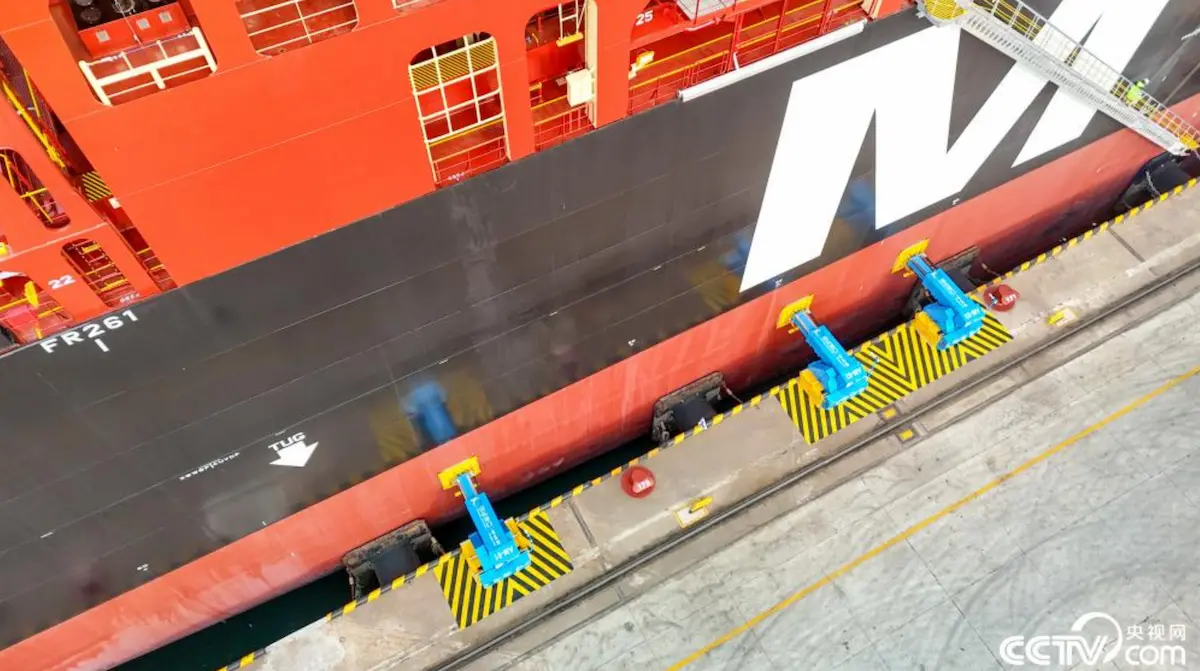
On 1 January 2026, Qingdao Port, operated by Shandong Port Group, placed China’s first vacuum-based automatic mooring system into live commercial operation at the Qingdao Automated Container Terminal.
The deployment marks a significant development in berth-side automation and vessel handling within China’s port sector.
The system entered service during the berthing of the 366-metre container vessel MSC Saudi Arabia, which was secured alongside the quay without the use of conventional mooring lines or quay-side line-handling crews.
Vessel positioning and securing were carried out automatically using high-vacuum suction technology, completing the mooring process in under 30 seconds. Conventional mooring operations for vessels of this size typically take between 20 and 30 minutes.
Commenting on the system’s commissioning, a Qingdao Port representative was quoted in Chinese state media as stating,
“This system enables fully automated mooring and unmooring of large container vessels through intelligent perception and control, significantly reducing berthing time while improving operational safety.”
System configuration and capabilities
As per reporting by CCTV and China News Service, the automated mooring installation comprises 13 vacuum mooring units distributed along the quay line.
When operating simultaneously, the system is capable of generating a combined holding force of approximately 2,600 kN, enabling it to accommodate container vessels exceeding 200 metres in length, including ultra-large container ships currently in operation.
According to the same sources, the system is built around a three-layer control architecture, described as a combination of a remote centralised control centre, mobile terminals, and local control units. This architecture allows for coordinated control and real-time operational oversight across the berth.
China News Service further reports that the system integrates multi-sensor fusion and intelligent decision-making algorithms, combining hydraulic drive technology, high-vacuum suction units, real-time vessel motion tracking, and continuous monitoring of wind, wave, and current conditions.
This enables active station-keeping and automated adjustment to environmental changes during berthing operations.
Safety and operational impact
By eliminating the need for quay-side personnel during mooring and unmooring, the system removes workers from the mooring line danger zone, which is widely recognised as one of the higher-risk areas in terminal operations.
This materially reduces exposure to line-handling incidents and enhances overall operational safety.
From an efficiency perspective, Qingdao Port estimates that the automated mooring system can save more than 200 hours of berthing time per berth annually. This time saving is equivalent to enabling more than ten additional vessel calls per berth each year, without requiring physical expansion of quay infrastructure.
In a statement reported by China News Service, port officials noted,
“By integrating real-time environmental monitoring with intelligent control algorithms, the automated mooring system can dynamically respond to changes in wind, waves, and currents, ensuring stable and reliable vessel positioning during operations.”
Implications for port automation
The deployment extends automation beyond cranes, yard equipment, and gate systems into core berth-side processes. Mooring has historically remained a manual and labour-intensive activity despite advances in other areas of terminal operations.
Qingdao’s implementation demonstrates the feasibility of integrating automated mooring into high-throughput container terminals as part of a broader move toward end-to-end operational automation.
While vacuum-based mooring technologies have been deployed at selected ports internationally, this installation represents the first such system to enter live operation in China, positioning Qingdao Port as an early adopter of berth-side automation within the country’s port network.