
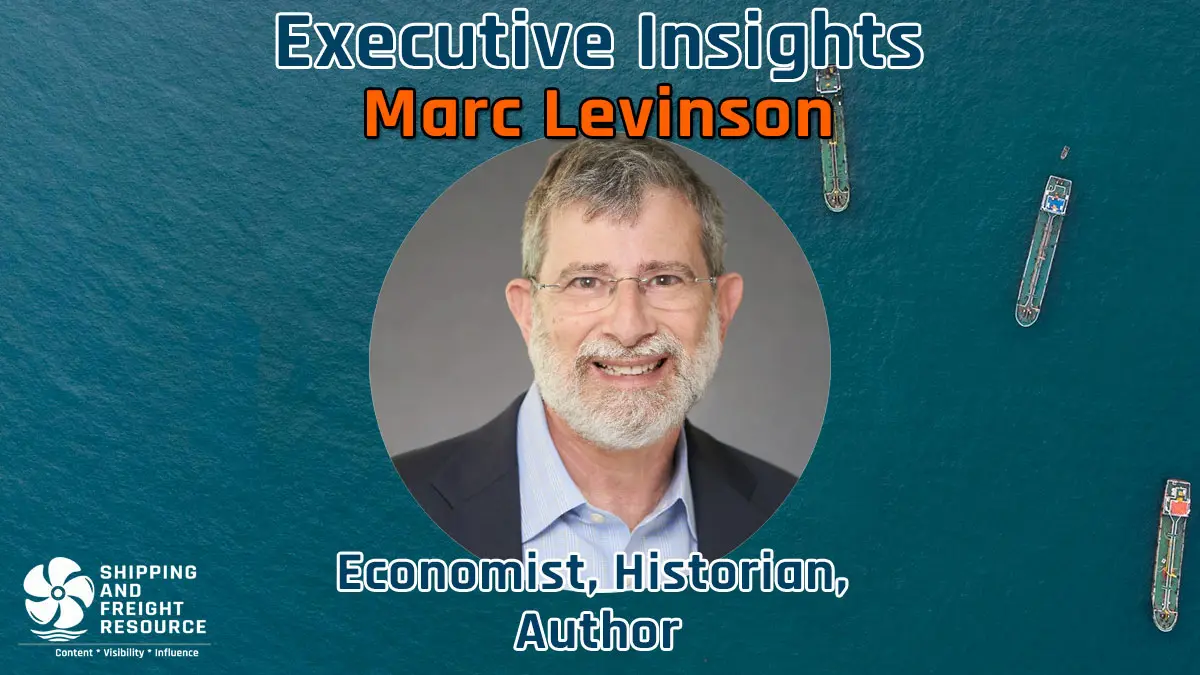
An economist, historian, former journalist, and author, Marc Levinson is known for his work spanning global trade, productivity, transportation policy, the shifting forces behind globalisation, and, of course, his groundbreaking books The Box and Outside the Box related to our industry..
Levinson’s work has shaped how generations of professionals understand containerisation and its profound influence on the modern world economy..
In this edition of Executive Insights, I chatted to Levinson on demographic shifts, megaships, digitalisation, and the structural pressures shaping the freight industry’s future..
SFR: Marc, for the few who may be new to your work, could you start with a brief introduction about yourself..
ML: I describe myself as an independent historian and economist based in Washington, D.C. My early career was in journalism, writing for publications like Newsweek and The Economist.
After that, I worked as an economist and spent several years advising the U.S. Congress on transportation and industrial issues.
Over the years, I have written books related to distribution, transport, and the broader economic forces that shape global trade. I continue to follow this industry closely because it has enormous consequences for how we live and work.
SFR: Your book The Box remains one of the most influential works on containerisation.. How has the industry evolved since you first published it in 2006..??
ML: When I wrote the book, a 6,000 TEU ship was considered large. Many vessels were in the 1,200–2,000 TEU range.
The industry changed dramatically soon after, especially with the rise of megaships. That shift prompted me to revise the book in 2016, mostly to reflect how these much larger vessels were reshaping ports, alliances, and shipping economics.
My perspective on containerisation is slightly different from traditional maritime analysis. I approach it from the angle of international trade and economics, looking at how containerisation transformed supply chains and the global economy, not just how the ships themselves evolved.
SFR: In your recent work, you argue that globalisation is shifting from goods to services, ideas, and intangibles.. What should freight professionals be preparing for..??
ML: For about 20 years, global goods trade grew twice as fast as global GDP. That was driven mainly by rising populations and rising consumption of physical goods.
Today, we are seeing structural reversals. Populations are ageing, fertility rates are below replacement in many countries, and demand for “stuff” declines as people age.
On the technological side, software-driven machinery lasts longer and requires fewer physical upgrades. Electric vehicles contain thousands fewer parts than internal-combustion vehicles, which suppresses a major component of containerised trade.
All these trends reduce the growth momentum of goods trade. Goods will remain important, but the rapid expansion we once took for granted is unlikely to return.
SFR: You have suggested that infrastructure expansion should be more calculated, and that ‘more is not always better..’ What should ports and investors be considering today..??
ML: Many ports are politically driven and naturally optimistic about growth. Local communities want expansion because ports bring jobs and economic activity.
But when everyone expands at once, we end up with far more capacity than we need. Some ports around the world have seen traffic decline, not because of poor management, but simply because there is less physical stuff moving internationally.
Ports also compete more intensely than many governments realise. In the United States, for instance, Los Angeles competes directly with New York–New Jersey, as shippers can choose multiple routes. Excess capacity becomes a real risk.
This is why private capital plays an important role. Private investors are more sceptical and more focused on returns. They force harder questions about whether a new terminal or berth will actually pay for itself, and on what timeline.
SFR: You have written extensively about productivity challenges.. Where do you see the most pressing issues in shipping and logistics..??
ML: Excess capacity in ocean shipping is a major drag on productivity. When vessels move half full, resources are wasted. The orderbook suggests we may be entering another period of overcapacity.
Within ports, productivity issues range from crane lifts per hour to the speed at which boxes are evacuated inland. Digitalisation should help, but progress has been slower than hoped. Every stakeholder agrees, in theory, that more digital interoperability is needed. But many are reluctant to give up data control or customer relationships.
Digitalising the supply chain has proven much harder than anticipated. There has been progress, and the industry deserves credit, but much work remains.
SFR: You have seen global trade from several vantage points, including finance and policy.. Are there regulatory or structural trends that industry players underestimate..??
ML: One important trend was the unintended rise of contract transportation after deregulation in the 1980s and 1990s. No one expected trucking, rail, barging, and even ocean shipping to shift so heavily toward long-term contracts.
Yet today, most freight moves under contractual arrangements; the spot market is much smaller than it once was. That shift has reshaped global trade.
Another trend is the increasing vertical integration of logistics companies. Firms that once operated ships, or were railroads, or were freight forwarders, now offer end-to-end logistics solutions.
But I am not convinced shippers actually want one company to handle everything. With rising geopolitical risk and supply chain uncertainty, many shippers want optionality, not dependency. Whether this integration trend will endure is still unclear.
SFR: Finally, Marc, any closing thoughts on where the industry should focus its attention over the coming years?
ML: Global trade is being reshaped by slow, structural forces – demographics, technology, investment patterns, and the evolving nature of consumption. Freight professionals need to look beyond short-term shocks and recognise these deeper trends.
Goods trade is not disappearing, but its growth engine is no longer what it once was. Understanding these shifts will be essential for planning the next generation of supply chains.
View the full interview here https://youtu.be/ZPOJU5xf8O8