
The term Non-Vessel Operating Common Carrier was formally defined under the US Shipping Act of 1984 (46 U.S.C. § 40102).. This Act codified the NVOCC as an operator that issues its own bills of lading and accepts carrier liability without owning or operating vessels..The NVOCC has evolved into one of the most commercially versatile roles in container shipping worldwide..
How does the NVOCC model work in practice..??
You book a small export shipment.. You receive a bill of lading signed as the carrier from a company that does not own a single ship.. You then learn the ocean leg is moving on a liner you never contracted with..
If that feels like a plot twist, you’ve met the logic behind the Non-Vessel Operating Common Carrier (NVOCC).. It is an intermediary that sells ocean carriage in its own name, assumes the responsibility of a carrier to the shipper, and performs the sea leg through an underlying vessel operating carrier..
In this article, we look at the evolution of an NVOCC..
How did the NVOCC concept evolve..??
The concept of the NVOCC evolved out of regulatory attempts to make sense of what intermediaries were already doing in practice..
In the early days of ocean freight, particularly in the United States, freight forwarders were primarily seen as agents acting on behalf of shippers..
The 1946 Supreme Court case United States v. American Union Transport Co. reinforced this position.. It treated forwarders as representatives of the cargo owner rather than as carriers in their own right..
At the same time, similar intermediary roles developed across Europe and Asia.. Consolidators combined cargo and issued their own documents, even if the regulatory treatment differed..
As trade volumes grew and shipment sizes varied, intermediaries began consolidating cargo and issuing their own documents.. They stepped into a role that looked increasingly like that of a carrier, even though they did not own or operate ships..
This gap between legal definition and operational reality triggered the regulatory evolution of the term NVOCC..
The introduction of the term NVOCC and how its structure works
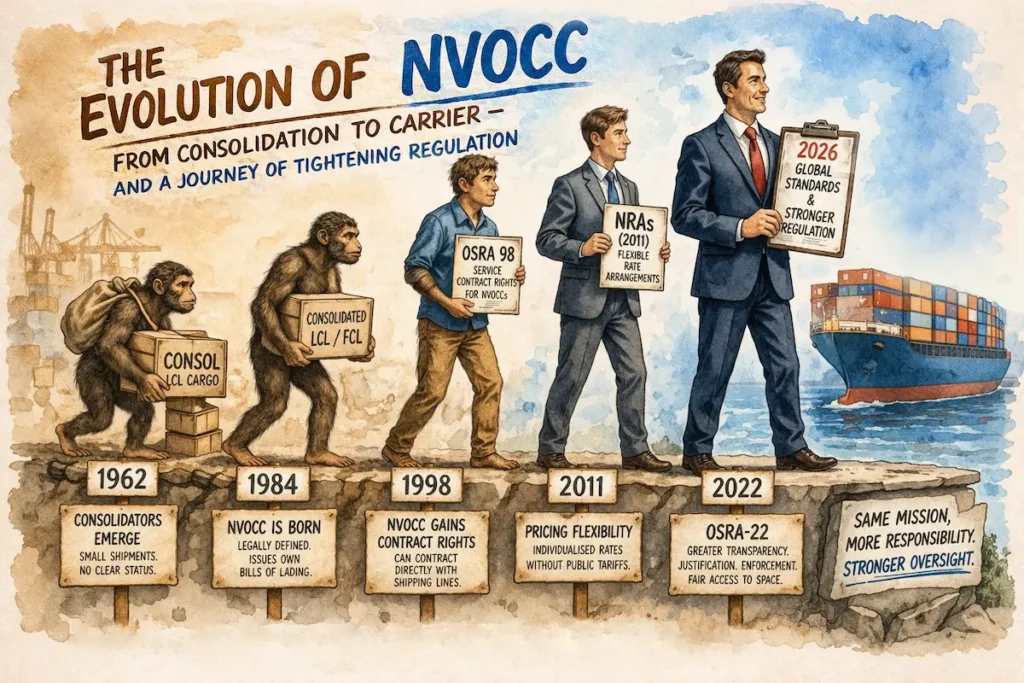
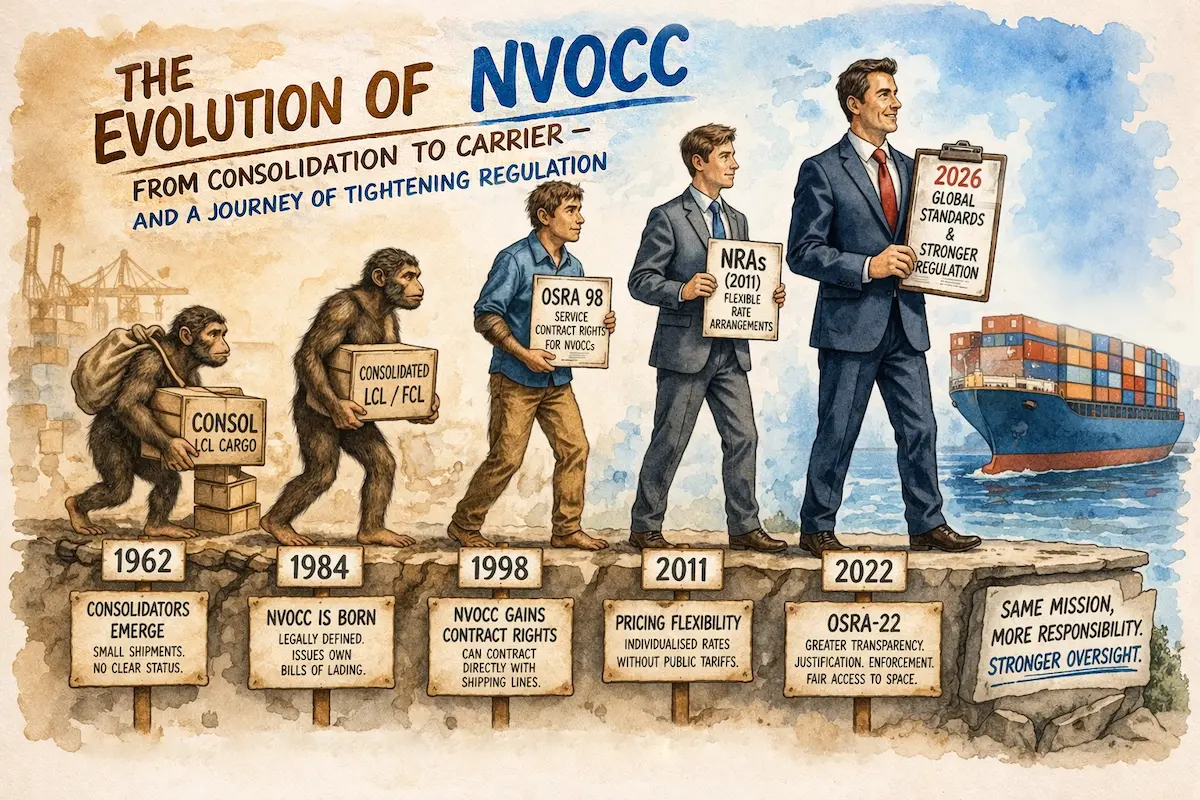
The term NVOCC can be traced back to 1962.. The Federal Maritime Commission introduced and defined the concept through rulemaking published in the Federal Register..
More than two decades later, the Shipping Act of 1984 (46 U.S.C. § 40102) codified this concept into law.. It gave the Non-Vessel Operating Common Carrier a clear statutory identity..
The Federal Maritime Commission (FMC) licenses and oversees NVOCCs operating in the US trades.. FMC defines NVOCC as:
- a common carrier that holds itself out to the public to provide ocean transportation, issues its own house bill of lading or equivalent document, and does not operate the vessels by which ocean transportation is provided
- a shipper in its relationship with the vessel-operating common carrier involved in the movement of cargo
While this definition comes from US regulation, the operating model is global.. NVOCC-type operators function under different licensing regimes and commercial practices across trades..
The commercial structure that makes the NVOCC model work is what is often called the dual role..
An NVOCC books space on a vessel and presents itself as a shipper to the Vessel-Operating Common Carrier (VOCC).. The VOCC issues a master bill of lading to the NVOCC..
The NVOCC then issues its own house bill of lading to the cargo owner..
This creates a two-tier documentation structure.. The NVOCC sits in the middle and carries liability in both directions.. The cargo owner has no direct contractual relationship with the vessel operator..
How did NVOCC standards evolve..??
Before 1984, many intermediaries issued house bills of lading and consolidated cargo without any clear classification governing their liability..
The 1984 Shipping Act changed this in the USA.. It placed NVOCCs within the definition of a common carrier, with all the regulatory responsibility that comes with it..
As per FMC regulations, US-based NVOCCs must post surety bonds.. These act as financial recourse if the NVOCC fails to deliver or becomes insolvent.. Outside the United States, though, requirements vary and many markets do not have a single global regulator governing NVOCC activity..
This lack of global standardisation creates challenges around documentation integrity.. It is most visible in the issuance of bills of lading, leading to inconsistencies and risks across the trade chain..
The International Maritime Bureau responded by establishing NVOCC registers and standards.. It also introduced a code of conduct to improve issuance standards and reduce fraud risks in trade finance..
How has NVOCC regulation evolved from the Shipping Act 1984 to OSRA 2022..??
The Shipping Act of 1984 created the regulatory framework.. It also kept NVOCCs out of service contracts, which only beneficial cargo owners could negotiate directly with shipping lines..
The Ocean Shipping Reform Act of 1998 (OSRA 98) changed this.. It allowed NVOCCs to enter into service contracts with VOCCs for the first time..
For serious NVOCC operators, this was the most commercially significant shift since 1984..
In 2011, the FMC introduced NVOCC Negotiated Rate Arrangements (NRAs)..
Before NRAs, every rate had to be filed publicly in a tariff.. NRAs allowed NVOCCs to offer individualised pricing through written agreements without publishing those rates..
The most recent structural change came with the Ocean Shipping Reform Act of 2022 (OSRA-22), signed into law on 16 June 2022..
While OSRA-22 applies to US trades, similar concerns exist globally.. These include space allocation, pricing transparency, and carrier accountability..
OSRA-22 requires VOCCs to provide written justification when declining to negotiate or enter into service contracts with NVOCCs..
It strengthens FMC enforcement over unreasonable refusals to carry and detention and demurrage practices..
It also gives smaller NVOCCs a channel to challenge discriminatory space allocation during high-demand periods..
Whether enforcement catches up with the intent of the law is a separate matter.. The regulatory standing is now in place..
What does the modern NVOCC actually operate and offer..??
Today, the NVOCC can look very similar to a freight forwarder unless you look closely at the contractual structure..
The defining feature remains the same..
If an entity issues its own bill of lading and takes responsibility for the carriage, it acts as a carrier, regardless of asset ownership..
What has not changed, despite decades of evolution, is the core value proposition..
The NVOCC brings together cargo from different shippers.. It secures space with carriers and moves that cargo under its own contract..
It assumes this responsibility because most of the shippers it serves do not have the volume or leverage to deal directly with carriers on workable terms.. The NVOCC aggregates that demand and makes the movement viable.
That is really why the model has endured..
The NVOCC did not start as a concept.. It came out of practice, was recognised by regulators, and scaled with containerisation and technology..
It exists because the market needed someone to take responsibility even when the ship belongs to someone else..