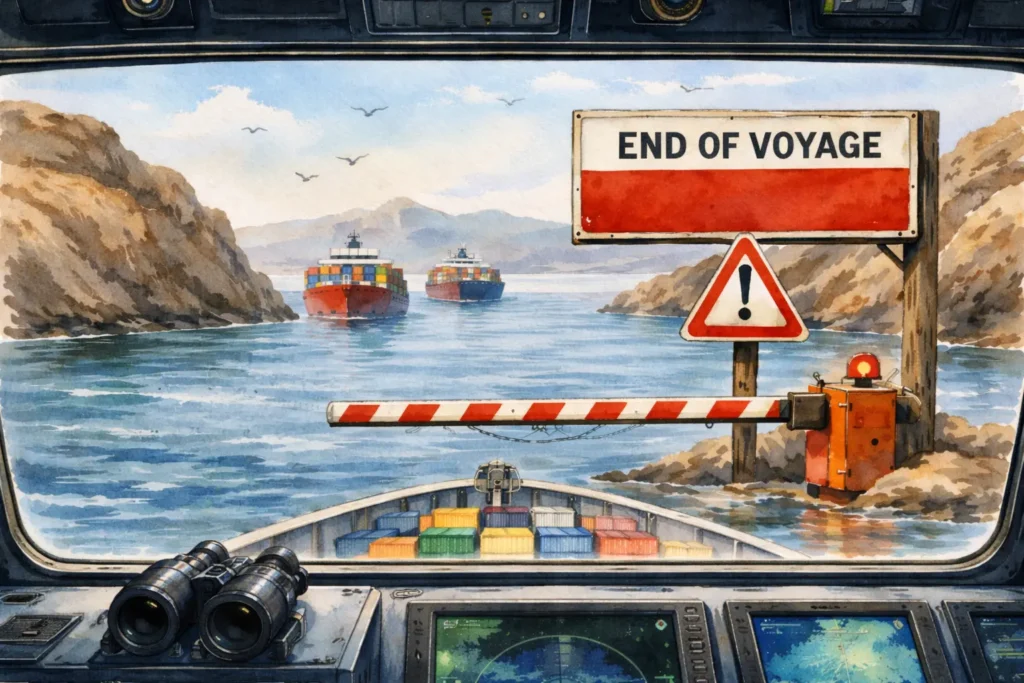

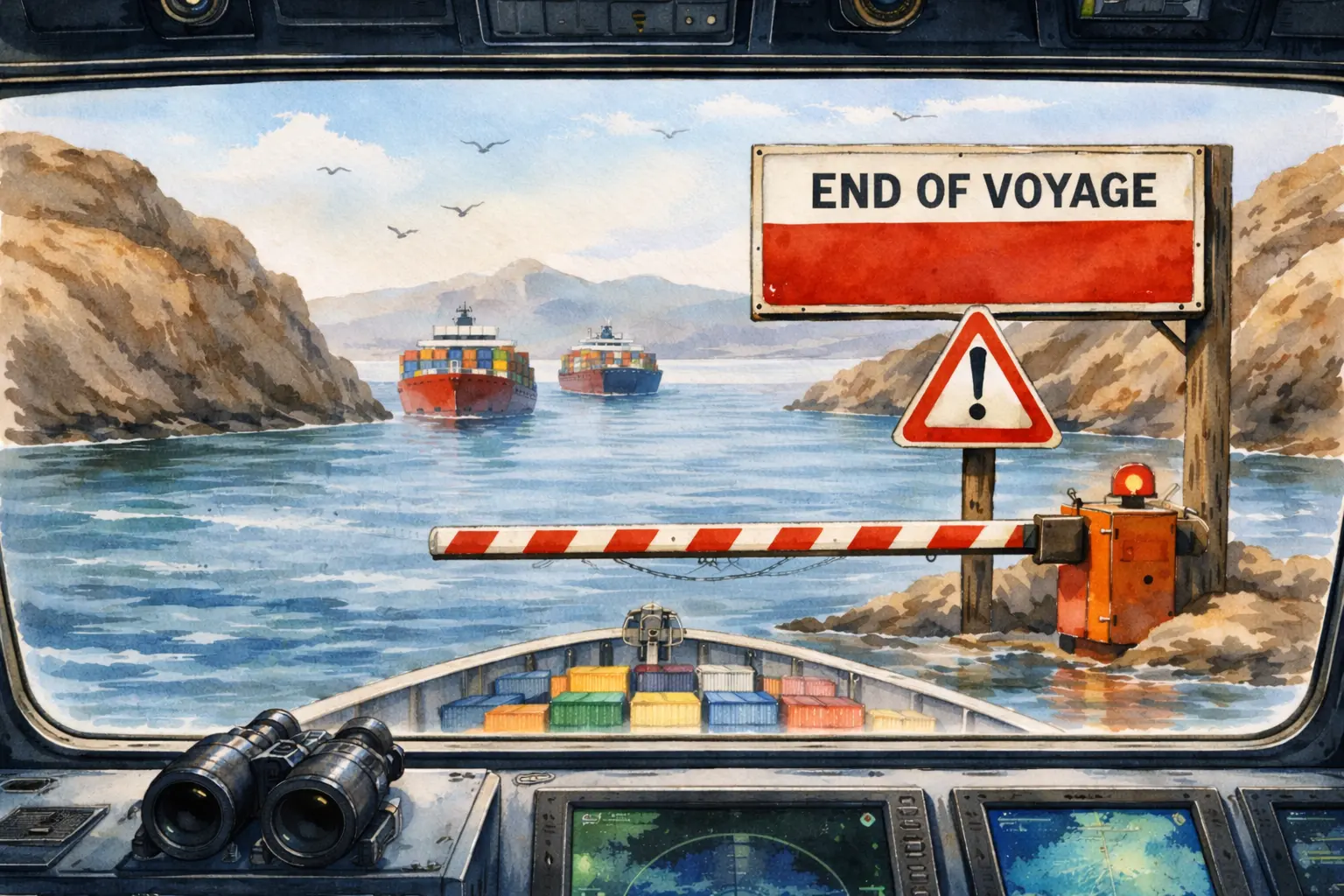
The term “End of Voyage” is an operational declaration by a carrier to terminate a voyage short of the contractual port of discharge.. It is not a legal doctrine in Maritime law, but relies on the authority carriers have under their standard Conditions of Carriage..
What is “End of Voyage” and where does it appear in law..??
As you might have seen, a few container carriers issued advisories in the last few days/weeks advising that vessels bound for the Arabian Gulf or Persian Gulf covering UAE, Qatar, Iran, Saudi Arabia, Bahrain, Kuwait, Iraq, and Oman have reached “End of Voyage“..
End of Voyage refers to the operational fact that the declared ship(s) which are currently en route to the Arabian Gulf or Persian Gulf will be diverted to the next safe port of discharge, where the cargo will be discharged and placed at the disposal of the cargo interest for its further movement..
In short, it means that the carrier will have no further involvement with the movement of this cargo, and the shipper is left to their own devices to take delivery of their cargo from wherever the cargo is discharged..
If you, however, search for the term “End of Voyage” in any maritime legal framework or convention of carriage like the Hague Rules, the Hague-Visby Rules, the Hamburg Rules, or the Rotterdam Rules, you will find nothing..
It has no definition in maritime statutes, does not appear in the standard legal tests applied by admiralty courts when examining cargo disputes..
So where does this term and its authority come from, and what are the carriers relying on..
The authority comes from the Bill of Lading, not from maritime law
Although the term “End of Voyage” may be new to many, the concept has been around for years as part of the terms and conditions of the bill of lading..
The legal basis for stopping a voyage short of the contractual port of discharge and not proceeding further, falls under clauses like “METHODS AND ROUTES OF CARRIAGE ” and “MATTERS ADVERSELY AFFECTING CARRIER’S PERFORMANCE ” which are incorporated into contracts of carriage through the booking confirmation and the Bill of Lading terms..
The clauses read like below, for example (only relevant portions quoted and highlighted)
9. METHODS AND ROUTES OF CARRIAGE
9.1 The Carrier may at any time and without notice to the Merchant:
(d) load and unload the Goods at any place or port (whether or not any such port is named on the front hereof as the Port of Loading or Port of Discharge) and store the Goods at any such port or place, including but not limited to the use of off-dock storage at any port;
9.2 The liberties set out in clause 9.1 may be invoked by the Carrier for any purpose whatsoever whether or not connected with the carriage of the Goods, including but not limited to loading or unloading other goods, bunkering or embarking or disembarking any Person(s), undergoing repairs and/or drydocking, towing or being towed, assisting other vessels, making trial trips and adjusting instruments. Anything done or not done in accordance with clause 9.1 or any delay arising therefrom shall be deemed to be within the contractual carriage and shall not be a deviation.
19. MATTERS ADVERSELY AFFECTING CARRIER’S PERFORMANCE
19.1 If at any time the carriage is or is likely to be affected by any hindrance, risk, danger, delay, difficulty or disadvantage of whatsoever kind and howsoever arising which cannot be avoided by the Carrier by the exercise of reasonable endeavours, (even though the circumstances giving rise to such hindrance, risk, danger, delay, difficulty or disadvantage existed at the time this contract was entered into or the Goods were received for the carriage) the Carrier may at its sole discretion and without notice to the Merchant and whether or not the carriage is commenced either:
(c) abandon the carriage of the Goods and place them at the Merchant’s disposal at any place or port which the Carrier may deem safe and convenient, or from which the Carrier is unable by the exercise of reasonable endeavours to continue the carriage, whereupon the responsibility of the Carrier in respect of such Goods shall cease. The Carrier shall nevertheless be entitled to full Freight on the Goods received for the carriage, and the Merchant shall pay any additional costs incurred by reason of the abandonment of the Goods. If the Carrier elects to use an alternative route under clause 19.1 (a) or to suspend the carriage under clause 19.1 (b) this shall not prejudice its right subsequently to abandon the carriage. 19.2 If the Carrier elects to invoke the terms of this clause 19, then notwithstanding the provisions of clause 9, the Carrier shall be entitled to such additional Freight and costs as the Carrier may determine.
* Disclaimer: The above numbers and wordings are from MSC’s contract of carriage terms and conditions and differ from those of other carriers.. Refer to your actual bill of lading to see which clauses and wordings are used..
Has “End of Voyage” ever been declared before in maritime history..??
While the contractual rights mentioned above have always existed, the use of the phrase “End of Voyage” applied simultaneously across an entire trade lane, at scale, with mass public communications, appears to be specific to the current situation..
Previous conflicts in the Middle East, Gulf, or other wars did not produce the same response, and the reason is pretty straightforward.. The Strait of Hormuz was never fully closed to commercial traffic..
During the Gulf War of 1990-91, Saudi Arabian ports including Al Jubail and Ad Dammam remained operational and accessible throughout the conflict.. Commercial vessels continued to complete contractual voyages to the destination..
There was no situation requiring carriers to declare, at scale, that voyages to an entire region were terminated..
During the Iran-Iraq Tanker War of the 1980s, commercial container volumes through the Gulf were a fraction of today’s levels..
Carriers managed disruption voyage by voyage, without the mass digital advisory communications that now notify thousands of cargo owners simultaneously..
The operational scale and the communications infrastructure that makes a public declaration necessary simply did not exist..
What is different in 2026 is not the contractual right, which has always been there..
What is different is the effective closure of the Strait of Hormuz to commercial traffic, the scale of modern containerised trade through the Gulf, the real-time digital visibility that carrier decisions now carry globally, and the commercial necessity of communicating voyage termination to a worldwide customer base at once..
The phrase “End of Voyage” is new language for an old contractual mechanism, applied in a new operational environment..
Whether a cargo owner can challenge an “End of Voyage” declaration is genuinely uncharted territory.. Because the term does not exist in any Bill of Lading or maritime convention, there is no established legal precedent specifically addressing it..
That question has not been tested in court.. The 2026 Gulf crisis may well be the event that eventually forces it into litigation and creates the precedent that does not yet exist..
My Take
Thirty-seven years in this industry and I have never seen a carrier phrase cause this much confusion.. “End of Voyage” is not a legal term, but the contractual mechanism behind it is very real and has existed in the Bill of Lading for decades.. What is new is the scale, the simultaneity, and the public branding of it as a named event.. Cargo owners with goods destined for the Arabian Gulf need to understand one thing clearly — the carrier’s responsibility for your cargo ends the moment it invokes that clause and discharges at an alternative port.. What happens next is entirely your problem to solve.. Read your Bill of Lading, read the specific clauses, and speak to your Maritime Lawyer about what options you have for onward movement and any potential claims..
Article FAQ
Is “End of Voyage” a legal term in shipping..??
No.. “End of Voyage” is an operational declaration by a carrier.. It does not appear in any maritime legal framework or international convention including the Hague Rules, Hague-Visby Rules, Hamburg Rules, or Rotterdam Rules.. It is not a term defined in maritime statutes or recognised by admiralty courts..
Does a carrier have the right to stop my shipment short of destination..??
Yes.. The authority comes from two clauses in the carrier’s Conditions of Carriage incorporated into the Bill of Lading — one covering Methods and Routes of Carriage and one covering Matters Adversely Affecting Carrier’s Performance.. These clauses allow the carrier to discharge the carriage at any port it deems safe and convenient, retain full freight, and cease all responsibility for the cargo.. These are not new clauses.. They have been standard features of carrier Bills of Lading for decades..
Has a carrier ever stopped an entire trade lane before..??
Not like this.. During the Gulf War of 1990-91 and the Iran-Iraq Tanker War of the 1980s, carriers continued completing voyages or managed disruption voyage by voyage.. Neither conflict produced the combination of factors that exist in 2026 — effective closure of the Strait of Hormuz, the scale of modern containerised trade, and the need to notify a worldwide customer base simultaneously..
Can I challenge my carrier’s End of Voyage declaration..??
This is genuinely uncharted territory.. Because the term does not exist in any Bill of Lading or maritime convention, there is no established legal precedent specifically addressing it.. The 2026 Gulf crisis may be the first event to force this question into litigation..
*** END OF ARTICLE ***