
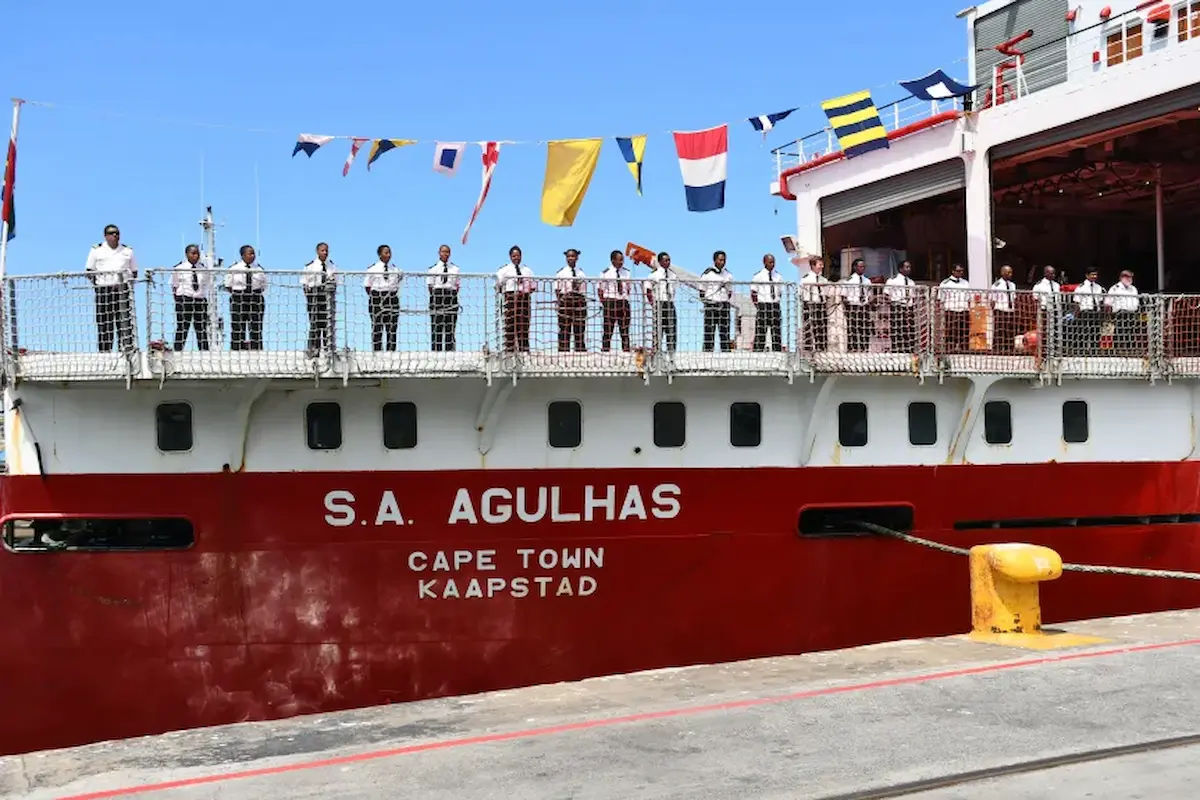
What does it say about an industry when a vessel that once trained seafarers, supported research, and carried South Africa’s maritime ambitions now sits under arrest, with no clear future for its crew or its mission..??
I was dismayed to read the interview published by Maritime Review Africa, not because what is happening to the SA Agulhas deserves pity, but because a vessel that still had a meaningful role to play has been allowed to slip into limbo..
The SA Agulhas is no ordinary ship.. Built as an ice-strengthened, polar-capable vessel, she was not merely a piece of steel afloat; she was a national asset that bridged education and opportunity..
After serving South Africa’s scientific and Antarctic efforts, she evolved into something even more vital, a hands-on training platform where young seafarers logged sea time, gained practical experience, and entered a global industry that constantly claims it needs more skills..
When the vessel was sold through a competitive tender, it was not framed as a disposal.. The conditions required the new owners to retain the crew and continue the ship’s training mandate, confirming there was recognised value still attached to her purpose.. The SA Agulhas was meant to continue serving the maritime ecosystem, not fade from it..
That responsibility was taken up by Captain Stefan Bülow, a maritime professional with extensive experience aboard research and polar-capable vessels.. His ambition was to refit the ship, diversify her operations, and expand her training and charter potential, an ambition that aligned perfectly with what the sector repeatedly claims to prioritise..
According to Maritime Review Africa, the vessel’s current predicament stems from a series of commercial and financial setbacks under private ownership, culminating in its arrest and an uncertain future for the crew..
And that is where the disappointment sharpens.. The maritime industry speaks boldly about unlocking youth potential, expanding participation in the ocean economy, and building world-class capability..
But here sits a ready-made instrument designed to do exactly that, abandoned not because it could not perform, but because the ecosystem around it could not protect or sustain it..
In the interview, Captain Bülow describes the situation as “horrible” and admitted that he could not “get this over the finish line.”
The real tragedy is not that a ship ran out of time.. It is that a maritime pathway ran out of support.. The SA Agulhas was not obsolete.. She was functional, relevant, and irreplaceable in her role, a working bridge between maritime education and real industry participation.. Bridges, once lost, are not easily rebuilt..
South Africa still has the S.A. Agulhas II, a globally respected Antarctic research and supply platform, but she was never designed as a training vessel.. She does not plug the developmental gap that the original Agulhas left.. Without a practical training ship, the industry’s ambitions remain rhetorical, not operational..
If the SA Agulhas disappears, she will not be remembered for her proud history, but for what she was prevented from doing, carrying a new generation of South African seafarers into a world that keeps telling them there is space at the helm, yet keeps removing the gangway that leads to it..
Is the SA Agulhas going to be frozen in time, a symbol of maritime mismanagement….?? Unless governance, funding models, and stewardship frameworks evolve beyond aspiration and into action, that question may already be answered, not in the water, but in the silence where opportunity once lived..