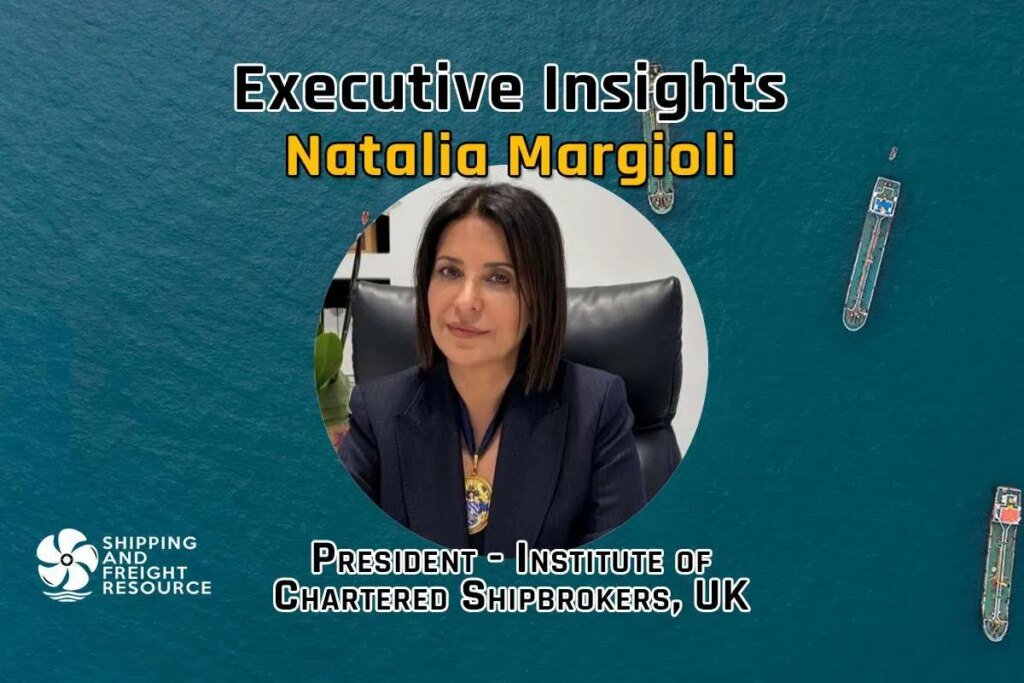

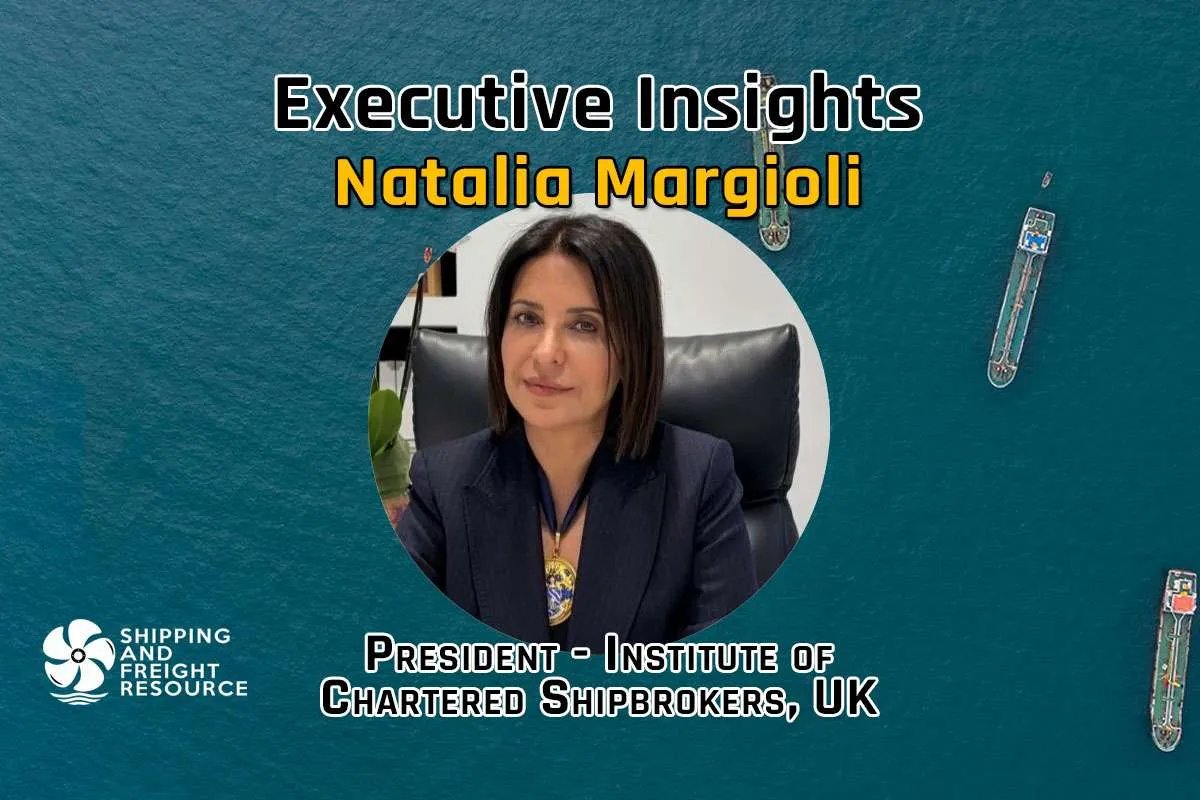
To be selected as the First Female President of a 115 year old global institution, incorporated by Royal Charter in the UK long before containerisation and trade developed to what it is now, is truly a great honor..
That honor belongs to Natalia Margioli..
Natalia took over as the First Female President of the Institute of Chartered Shipbrokers, in October 2026 incidentally, in South Africa.. In this exclusive interview with Shipping and Freight Resource as part of the Executive Insights series, Natalia speaks about education, technology and AI, the reach of the Institute across commercial shipping, the gap between qualifications and practical capability, and the opportunities to strengthen maritime skills across Africa..
The first female President of the Institute
Natalia describes her appointment as an honour and a privilege, and she is understandably proud of becoming the first woman to hold the position.. Her focus, however, is on what can be achieved during her presidency and the example her appointment can give younger professionals across shipping..
Leadership is about knowledge, ability, integrity and bringing people together.
She hopes her appointment encourages more women to pursue their ambitions in shipping, while also encouraging young professionals to invest in education and have the confidence to take on leadership roles..
I would like to be remembered not simply as the first female president, but for what we achieved together during my presidency.
Education, branches, and industry relationships
Natalia wants to build on the Institute’s existing foundation while keeping its qualifications relevant to the changing needs of shipping.. Education remains central, with greater use of technology and more opportunities for continuing professional development among her priorities..
She also wants closer cooperation across the Institute’s 27 branches, with more sharing of ideas, experience, and practices between them.. The third area is the Institute’s international presence and its relationships with maritime organisations, universities, and shipping companies..
Her objective is a more connected and accessible Institute that remains relevant to maritime professionals throughout their careers..
AI and electronic trade documents in shipping education
Technology is already changing daily work across shipping, and Natalia believes professional education has to keep pace.. The Institute has introduced digital examinations and is examining how AI tools can make learning more interactive and practical..
I would like our students to become familiar with artificial intelligence, data analytics and electronic trade documents, not just in theory but through real life examples.
That practical connection matters.. AI, data analytics, and electronic trade documents are increasingly part of the working environment that students will encounter after qualification.. Familiarity with the tools needs to sit alongside sound commercial shipping knowledge..
Natalia’s view is that shipping will remain a people-driven industry, with technology supporting professional knowledge and decision-making..
A professional home for commercial shipping
The Institute’s name can still create the impression that it is principally for shipbrokers.. Natalia says its role today is considerably wider than its historical origins in the shipbroking community..
I see the Institute of Chartered Shipbrokers as a professional home for everyone working in commercial shipping.
Its qualifications cover chartering, shipping operations, maritime law, logistics, port management, finance, insurance, and other areas.. For Natalia, understanding how these parts connect makes people better shipping professionals, regardless of their individual role..
Qualification is the beginning
The discussion also turned to a question I consider important in professional education: what happens between passing an examination and being able to apply that knowledge when a real commercial or operational decision has to be made..??
Natalia says the Institute’s syllabi are developed by industry professionals, while tutors bring practical experience and real examples into the classroom.. Students therefore learn how shipping works, the problems professionals encounter, and how decisions are made..
Learning doesn’t stop when you qualify.. It continues throughout your career.
Seminars, webinars, industry events, and professional networks form part of that continuing development.. In an industry where markets, regulations, technology, documentation, and operating practices keep changing, professional competence needs regular renewal..
Strengthening maritime skills across Africa
Natalia begins her presidential journey in Cape Town, making Africa a natural part of the discussion.. She sees the continent’s strategic location and growing trade connections as an opportunity for the Institute, while recognising that individual regions have different needs..
She would like African branches to work more closely through joint training programmes, webinars, regional events, and stronger links with industry.. She also wants the Institute to examine ways of making its qualifications more accessible through sponsorships, mentoring, and online learning..
The priority is to turn these opportunities into practical action and help Africa become an even stronger part of our global ICS community.
For the Institute, that combination of education, professional networks, practical capability, and access will determine how useful it remains to the next generation of shipping professionals..
You can view the full interview below..
Executive Insights is a series by Shipping and Freight Resource featuring industry leaders sharing their perspectives on the issues shaping global shipping, freight, logistics, and trade..