
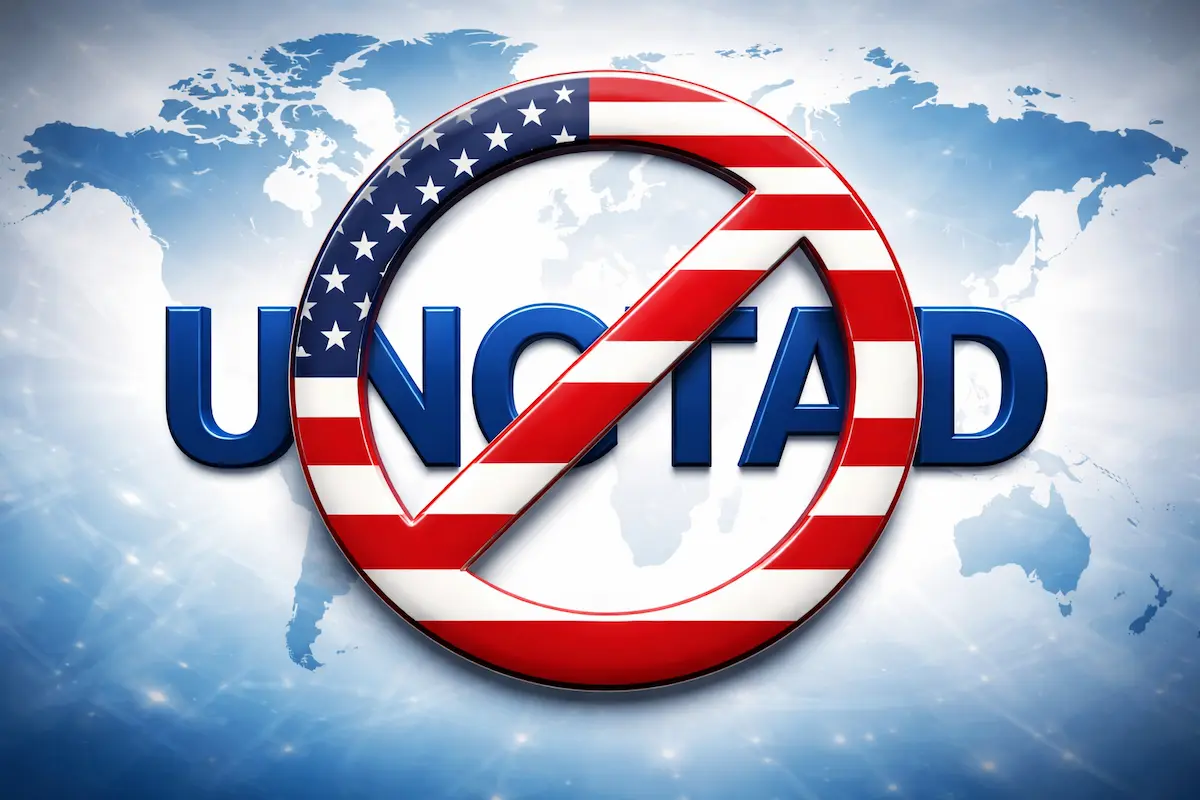
The United States’ withdrawal from the United Nations Conference on Trade and Development (UNCTAD), announced on 7 January 2026 as part of a broader exit from 66 international organisations, marks a dramatic shift in the architecture of global trade governance..
Effective immediately in terms of participation and funding, the decision reflects a reassessment of how the United States engages with multilateral institutions.. While the practical consequences will unfold over time, the structural direction is already clear..
This is not an event that disrupts supply chains overnight.. However, it is a signal that trade professionals, policymakers, and business leaders should not overlook, particularly in an environment already shaped by geopolitical uncertainty, regulatory divergence, and evolving trade priorities..
UNCTAD’s role in a changing trade landscape
UNCTAD has traditionally played a stabilising role at the intersection of trade, investment, and development..
Its influence has not come through binding rules or enforcement mechanisms, but through research, analytical frameworks, policy guidance, and technical support that inform how governments and institutions approach trade and investment decisions..
For developing and emerging economies in particular, UNCTAD’s work has helped shape export strategies, investment frameworks, and capacity-building initiatives that support integration into global value chains..
Although businesses may not interact with UNCTAD directly, many operate within policy environments influenced by its analysis and recommendations..
The United States has historically been an active contributor to this ecosystem, providing funding, expertise, and strategic input..
Its withdrawal reinforces a broader shift away from consensus-driven multilateral coordination toward bilateral and selective engagement, where national policy tools and direct partnerships take precedence over shared frameworks..
Implications from a trade-risk perspective
First, it increases the likelihood of fragmented policy signals across regions.. Multilateral institutions help establish common analytical baselines for trade trends, investment flows, and development priorities..
When participation by major economies diminishes, those shared reference points weaken, giving way to divergent interpretations of trade priorities..
For businesses operating across multiple markets, this translates into greater compliance complexity, planning uncertainty, and exposure to regulatory misalignment..
Second, reduced participation and funding may constrain UNCTAD’s capacity to deliver research, advisory support, and technical assistance, particularly in smaller and developing economies..
Over time, this can limit the effectiveness of trade facilitation initiatives and investment reforms, increasing systemic vulnerability within global value chains that rely on emerging markets for sourcing, manufacturing, and growth..
Third, the balance of influence within global trade and development discussions will continue to evolve.. As one major actor steps back, other economies and regional blocs will play a more prominent role in shaping policy narratives and strategic priorities..
This shift does not inherently favour or disadvantage any single group, but it reinforces the need for businesses to pay attention to who is shaping trade frameworks, not just who is setting formal rules..
Importantly, the US withdrawal from UNCTAD does not dismantle the global trading system, nor does it signal an immediate breakdown of multilateral trade..
It does, however, contribute to a gradual decentralisation of trade governance, where alignment cannot be assumed, and responsibility for managing trade risk increasingly sits with individual governments and firms..
Looking ahead
For businesses, the implications are clear.. Trade risk today extends well beyond freight rates, port congestion, or documentation delays.. It is increasingly embedded in policy direction, institutional alignment, and the pace at which global norms fragment or realign..
In global trade, structural signals often matter more than headlines.. The United States’ withdrawal from UNCTAD is one such signal, and its effects will be felt not in days or weeks, but over the years that follow..