
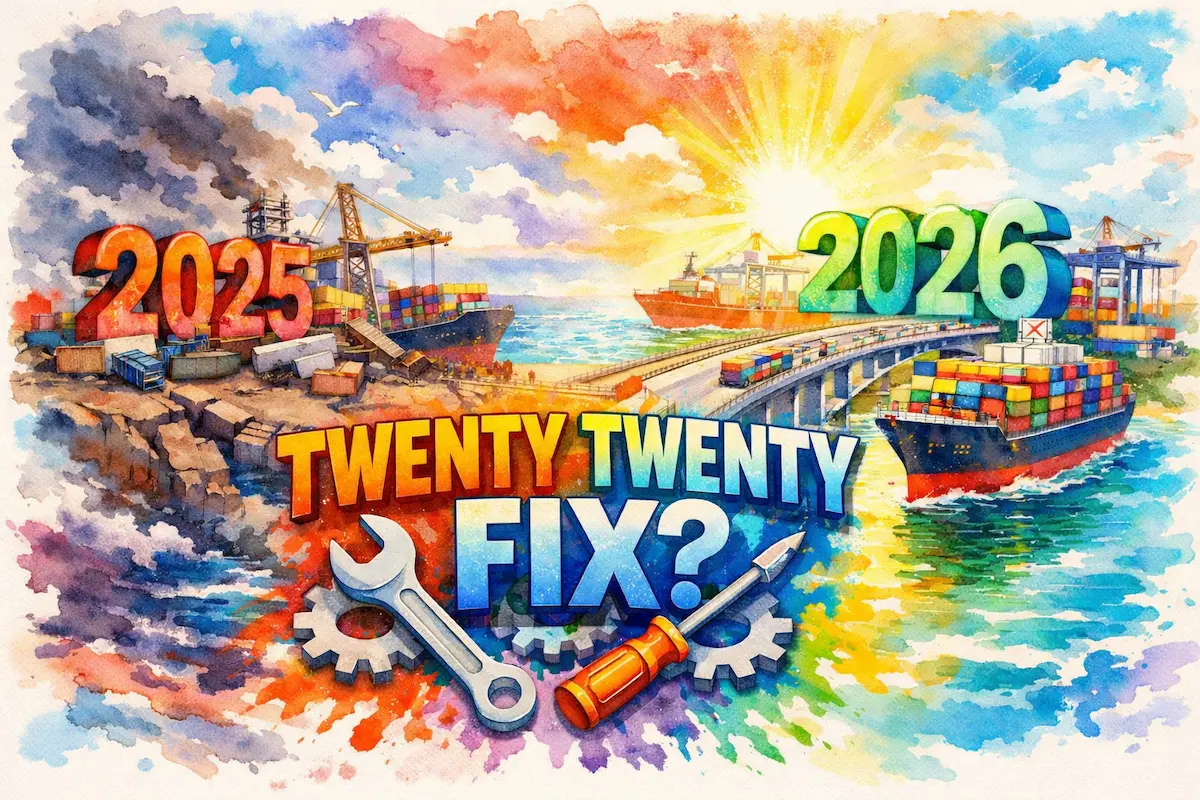
2025 (Twenty Twenty Thrive) did thrive indeed with global trade on course to surpass US$35 trillion with trade flows in goods and services representing a 7% increase over 2024, despite slowing momentum..

But it also brought along with it several challenges..
Across safety incidents, documentation disputes, sanctions exposure, technology debates, and trade disruption, the same fault lines surfaced repeatedly throughout the year..
It demonstrated how familiar problems continue to resurface when conditions tighten, volumes shift, or complexity increases, and by the end of 2025, it had become increasingly difficult to describe them as isolated or unexpected..
So while Twenty Twenty Fix (2026), is being spoken about as a year to “fix” things, it is worth pausing to reflect on what 2025 actually exposed, without rushing to prescribe solutions..
What were the recurring fault lines in 2025..??
- Safety incidents were rarely “accidents”, they were information failures
One of the most visible patterns of 2025 was that major safety incidents almost always traced back to decisions and assumptions made long before a vessel sailed..
Fires at sea continued to occur with disturbing regularity, involving lithium batteries, chemicals, and other high-risk cargoes..
Investigations consistently pointed towards misdeclaration, misunderstood cargo behaviour, inadequate packaging, temperature sensitivity, and delayed escalation rather than unforeseeable events at sea..
The YM Mobility explosion followed a familiar progression.. Early warning signs, leakage, smoke, escalation, and then loss of control.. It highlighted how quickly risk compounds when cargo information degrades as responsibility passes across commercial and operational boundaries..
Container losses overboard told a similar story.. Parametric rolling, stack collapse, lashing stress, and overweight containers are not new phenomena..
Their continued occurrence suggests that awareness does not always translate into discipline, particularly when commercial pressure intervenes..
The sinking of Morning Midas and the broader discussion around EV shipments exposed another pressure point..
New cargo types are entering supply chains faster than shared, enforceable handling protocols are being agreed, leaving gaps that only become visible when something goes wrong..
By the end of 2025, it was difficult to avoid the conclusion that cargo information is still too often treated as administrative input, even though its failure manifests as physical damage, environmental harm, and human risk..
- Documentation friction remained a silent but powerful risk multiplier
Away from physical incidents, 2025 also exposed how fragile trade becomes when documentation, finance, and shipping realities drift apart..
Paper documents continued to slow transactions, introduce errors, and increase disputes, even as cargo movements became faster and more complex.. The issue was not paper itself, but the absence of universally trusted, interoperable digital alternatives across borders and counterparties..
Documentary credit disputes illustrated how easily transactions can unravel over wording that does not reflect operational reality..
Minor misalignments between banking requirements and shipping execution led to delayed payments, rejected presentations, and avoidable commercial tension..
Discussions around bills of lading, documents of title, and consol box structures highlighted a deeper issue.. Operational convenience is still frequently mistaken for legal certainty, with risks only becoming visible when transactions are stressed by delay, dispute, or insolvency..
2025 reinforced an uncomfortable truth.. Documentation may appear secondary to physical movement, but it ultimately determines control, payment, and liability, often long after the vessel has sailed..
- Geopolitics shifted from background risk to operational reality
Trade disruption in 2025 extended far beyond freight rates and capacity management..
Sanctions regimes increasingly influenced contract drafting, cargo acceptance decisions, routing choices, and payment flows.. Compliance was no longer a downstream check, it shaped whether trade could proceed at all..
At the same time, disruption emerged from less visible forces.. Regulatory divergence, shifting alliances, compliance costs, and politically driven interventions that reshaped trade lanes without appearing directly on invoices or rate sheets..
By the end of the year, it became difficult to separate commercial decision-making from geopolitical exposure.. The two had effectively merged into a single operational reality..
- Technology progressed but governance struggled to keep pace
2025 was not without progress..
Standards-based interoperable electronic bills of lading began moving from concept into early execution, signalling that years of discussion were finally translating into practical frameworks..
AI tools also showed rapid improvement in their ability to analyse, summarise, and support decision-making.. At the same time, their limitations became clearer, particularly their dependence on structured data, context, and human oversight..
The recurring tension throughout the year was not whether technology was capable, but whether organisations and ecosystems were ready to use it consistently, responsibly, and across fragmented supply chains..
What 2026 is quietly asking us to reflect on
These questions are not theoretical.. Each one surfaced repeatedly, in different forms, across the events of 2025..
1) Is cargo information still being treated as administration rather than safety input..??
When misdeclared cargo leads to fires, when inaccurate weights contribute to container losses, and when new cargo types move faster than agreed protocols, it raises a simple but uncomfortable question..
At what point does poor information become an accepted risk rather than an exception..??
2) Are contracts, trade finance, and shipping execution genuinely aligned..??
When documentary credits fail over wording, when bills of lading are misunderstood as documents of title, and when operational shortcuts clash with legal expectations, it prompts reflection..
Is alignment between commercial intent and operational reality still assumed rather than deliberately designed..??
3) Has disruption and sanctions risk been structurally absorbed, or merely reacted to..??
As sanctions, regulatory shifts, and geopolitical interventions increasingly shape trade flows, the question is no longer whether these risks exist..
It is whether they are embedded into deal structures and daily decision-making, or left to surface only once cargo is already in motion..
4) Are digital tools being governed, or simply adopted..??
With interoperable eBLs and AI tools gaining traction, another tension becomes visible..
Is digitalisation being approached as a controlled transition, or as a collection of isolated implementations hoping to scale themselves..??
5) Is accountability becoming too diluted to be effective..??
Across safety incidents, documentation disputes, and compliance failures, responsibility in global trade often appears spread across too many parties..
At what point does shared responsibility quietly become no responsibility..??
6) Is risk still being managed in silos, despite repeatedly materialising end-to-end..??
- Weight errors become stability issues..
- Document mismatches become payment disputes..
- Compliance oversights become operational delays..
If risk travels across the entire supply chain, why is it still analysed and managed in fragments..??
7) Has speed quietly taken precedence over resilience..??
Faster bookings.. faster documentation.. faster adoption of tools.. Yet 2025 repeatedly showed that speed without alignment carries a cost that surfaces later, and often publicly..
Is velocity still being optimised at the expense of robustness in an increasingly volatile environment..??
And perhaps that is the real legacy of 2025
Looking back, the most striking realisation is not how much the industry learned in 2025..
It is how little of what went wrong was genuinely surprising..
The fires, the losses, the disputes, the delays, the sanctions shocks, the documentation failures, none of these emerged from unknown territory.. They emerged from areas the industry already understood, often discussed, and frequently postponed..
So the question heading into 2026 may not be whether the industry knows what needs attention.. It may be whether it is willing to disturb what has quietly become normal..
Because if the same patterns reappear under new vessel names, new cargo types, new technologies, and new regulations, it will become increasingly difficult to attribute them to complexity alone..
And that may be the quiet challenge that 2025 leaves behind.. Not demanding answers.. Just making it harder to claim that the questions were never asked..