
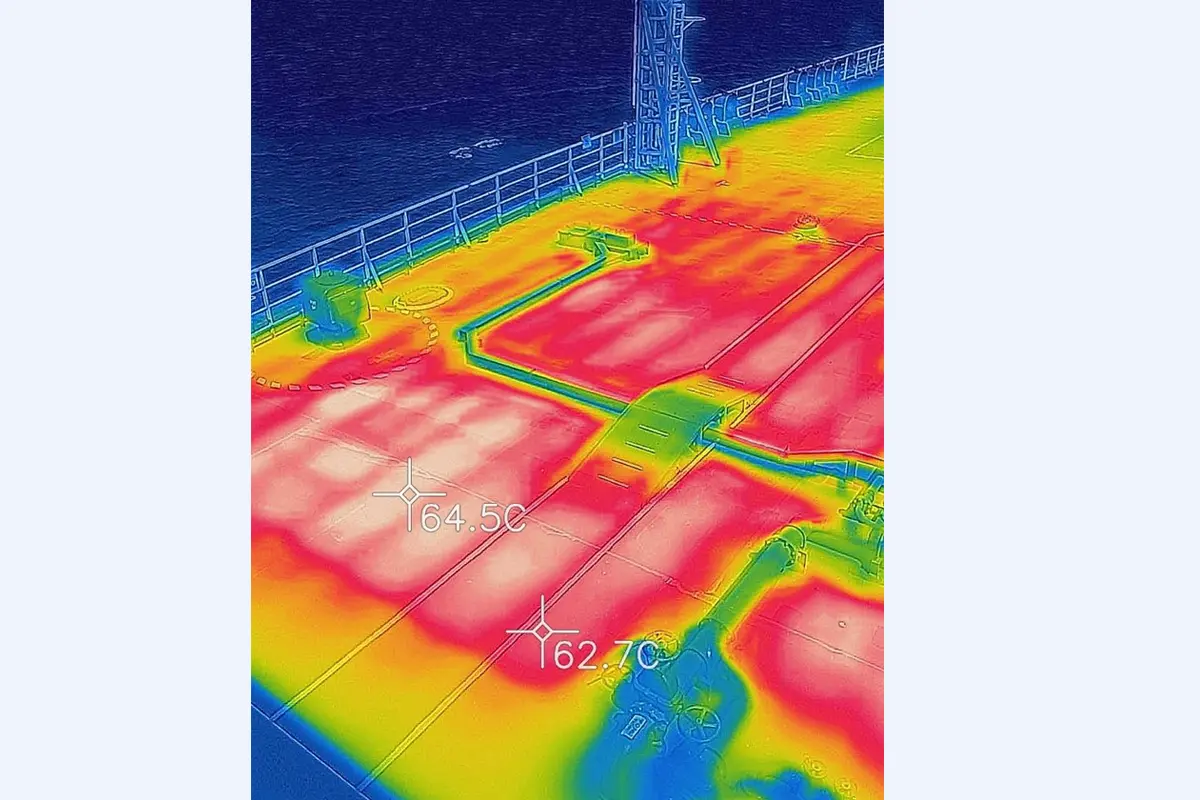
If you stand on the deck of any ship on a hot summer afternoon, you can almost fry an egg on the steel plating.. That heat is not just uncomfortable for the crew, it may also be cooking the cargo below..
It turns out that a surprising amount of this heat problem comes down to something most crude tanker operators barely think about – “deck paint” and “deck temperatures”..
According to a very interesting LinkedIn post by Michail Kvasnikov, a Marine Engineer, this “simple” layer can be the difference between retaining millions of dollars’ worth of crude oil or watching it evaporate into thin air.. Literally..
The paint on your ship’s deck might be costing you cargo
As he explains, “Many vessels are still running with deck paint systems that are decades out of date.”
This legacy approach carries an unexpected price tag.. Michail notes that a VLCC can lose 200–300 cubic metres of crude oil on a long voyage purely due to evaporation through the venting system..
That loss, he emphasises, is linked to how much heat transfers through the deck into the cargo tanks..
In other words, the paint is not merely cosmetic.. It affects cargo mass, temperature, vapour pressure, and the frequency of venting events..
How colour changes everything
Michail highlights something the industry rarely talks about: “The colour and quality of your deck paint has a huge impact on evaporation losses.”
Different colours absorb different levels of heat, and once that heat reaches the tank-tops, vapour pressure rises, and the tanks vent..
No alarms, no drama, just crude oil quietly disappearing..
Here is how Michail summarises the real-world behaviour of common deck colours:
Dark Green – The traditional choice, but also the worst offender.. He points out that it “absorbs a lot of heat,” often pushing deck temperatures to 70–80°C in strong sunlight..
Red Oxide / Brown – A minor improvement, but, in Michail’s words, it “doesn’t move the needle much operationally.” It still absorbs significant heat..
Light Grey – This is where results become measurable.. Operators can typically expect deck temperatures 10–15°C cooler than darker coatings..
Off-White / Very Light Shades – Michail notes that these “make a big difference,” often keeping decks 20–25°C cooler and offering ideal performance for routes or cargoes sensitive to heat..
Modern Reflective / Ceramic Coatings – The standout performer.. These coatings can reduce deck temperature by 25–30°C or more.. They cost more upfront, but, as he observes, “the savings in cargo losses can pay back fast, especially on VLCCs and ULCCs.”
The overlooked opportunity
Michail distils the issue into a single point:
“This isn’t just paint. It’s operational efficiency, safety, and sustainability all rolled into one simple decision that many operators overlook.”
Understanding the characteristics of the crude oil being carried, and matching the deck coating to it, allows operators to meaningfully reduce evaporation losses.. The result is not theoretical, it is measurable cargo retained instead of vapourised..
His conclusion is a quiet but powerful call to action:
“If you understand your crude oil characteristics and upgrade your deck coating accordingly, you can meaningfully reduce your evaporation losses.”