
A question was recently raised on Shipping and Freight Resource by an NVOCC agent in Port Sudan:
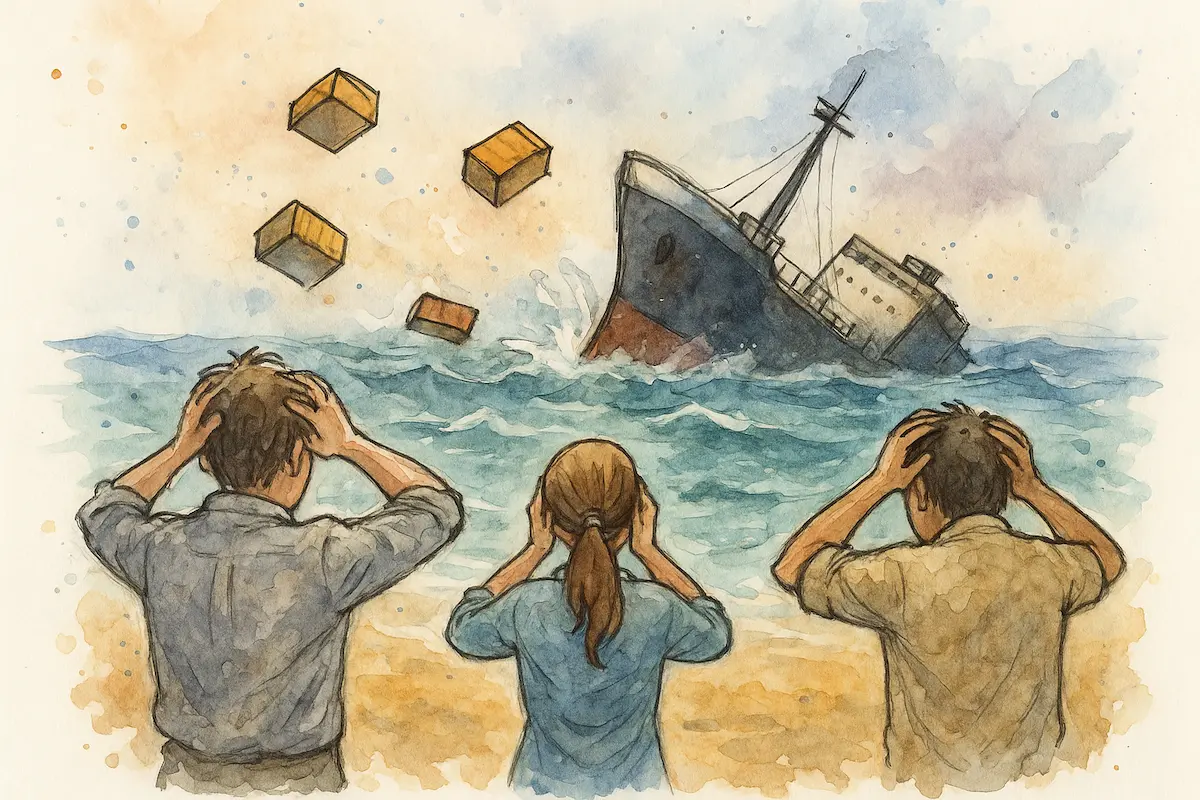
“We have a very critical case at our end in Port Sudan. The consignee has presented the original Bill of Lading to us, but the ship carrying his container sank in the Indian Ocean due to bad weather and did not arrive.
What advice would have benefited the owner of the goods, what action could he take, and what are our responsibilities as the agent of the NVOCC?”
This is a tragic and complex situation, but one that reflects the very essence of maritime risk management..
It raises important questions about liability, seaworthiness, insurance, and due diligence, all of which play a role when cargo is lost at sea..
Determining seaworthiness and cause of loss
The first issue to consider is how severe the weather was and whether the vessel was seaworthy at the time of sailing from its last port of loading..
Under international maritime conventions, the carrier has a duty to exercise due diligence to make the vessel seaworthy before and at the commencement of the voyage..
This includes ensuring the ship is properly manned, equipped, maintained, and supplied..
If the vessel was unseaworthy and the carrier (or charterer) failed to meet this obligation, liability for loss of cargo may attach..
However, if the loss was caused purely by perils of the sea, such as extraordinary and unforeseeable weather conditions, the carrier may be exempt from liability under the Hague or Hague-Visby Rules..
The cargo owner’s first action – contact the insurer immediately
The cargo owner (or the insured) must immediately notify their cargo insurer of the incident..
If the goods were insured under one of the Lloyd’s Institute Cargo Clauses (ICC A, B, or C), a claim may be recoverable provided that the cargo owner was not aware of any unseaworthiness of the vessel at the time of shipment..
- ICC (A) provides “All Risks” cover, excluding only general exceptions like delay or inherent vice..
- ICC (B) covers named perils such as heavy weather, collision, or sinking..
- ICC (C) offers the narrowest coverage, typically limited to total loss scenarios..
The insurance claim should be supported by:
- The original Bill of Lading
- The commercial invoice and packing list
- The insurance certificate
- Proof of loss (such as the carrier’s or maritime authority’s statement confirming the sinking)
If properly insured, the cargo owner would typically receive compensation based on the insured or CIF value of the goods, in accordance with the policy terms..
If the cargo was not insured
If the cargo owner did not have marine insurance, their recourse becomes more limited.. In such cases, the cargo owner may seek recovery directly from the NVOCC or the ocean carrier..
However, the burden of proof becomes much higher.. Under the Hague, Hague-Visby, and Hamburg Rules, carriers are not liable for losses arising from “perils of the sea,” unless it can be proven that they failed to exercise due diligence to make the ship seaworthy or properly care for the cargo..
The NVOCC’s liability, if any, will depend on the terms printed on its Bill of Lading, the governing law, and the applicable international convention..
Legal framework – applicable conventions and liability limits
Depending on the Bill of Lading issued, the carriage of goods would be subject to one of the following conventions:
| Convention | Carrier’s Duty | Liability Limit | Notes |
| Hague Rules (1924) | Properly and carefully carry and discharge cargo | GBP 100 per package | Oldest regime; limited liability. |
| Hague-Visby Rules (1968) | Same as above; adds seaworthiness obligation | SDR 2 per kg or SDR 666.67 per package (whichever is higher) | Most widely used |
| Hamburg Rules (1978) | Broader carrier responsibility; covers delay | SDR 2.5 per kg or SDR 835 per package (whichever is higher) | Favourable to cargo owners |
(SDR – Special Drawing Rights. Current exchange rates are available at www.imf.org. The latest rate applies, not the rate at the time of loss.)
In the case of Sudan, maritime matters are governed by several separate pieces of legislation rather than a single comprehensive act, including the Sudanese Maritime Act of 1961, the Law of the Sea Act No. 27 of 1992, and the Sudanese Marine Flags Act of 1994, which together regulate areas such as vessel registration, merchant shipping, and carrier liability..
For the carriage of goods by sea, Sudan’s framework is generally understood to align with the Hague or Hague-Visby Rules through domestic provisions similar to a Carriage of Goods by Sea Act (COGSA)..
However, as there is no conclusive public record confirming full incorporation, it is advisable to verify the governing law clause on the Bill of Lading and, where necessary, consult local legal counsel to confirm which convention applies to any shipment to or from Sudan..
Role and responsibilities of the NVOCC and its agent
The NVOCC (Non-Vessel Operating Common Carrier) acts as a contractual carrier to the shipper while contracting with the actual vessel operator..
When such a loss occurs, the local NVOCC agent plays an important role in coordinating communication and documentation, even though they are not directly responsible for the loss..
Their key responsibilities include:
- Official notification – Inform the shipper, consignee, insurer, and principal of the incident.
- Documentation support – Provide the NVOCC’s Bill of Lading, manifest, and shipment details for claim processing.
- Liaison with the ocean carrier – Obtain and share the official report or statement confirming the loss.
- Regulatory compliance – Notify port and maritime authorities as per local law.
- Assisting claimants – Facilitate documentation flow between the cargo owner, insurer, and NVOCC principal.
The agent’s role is representative and administrative, not operational.. Unless there is proven negligence or misrepresentation, the agent is not personally liable for the loss..
Claims process and limitation period
A cargo claim is normally calculated on the CIF value of the goods, though some Bills of Lading stipulate market value at destination..
Claims are time-barred after one year from the date of delivery or the date the goods should have been delivered..
If the prescription date is near, the claimant should request an extension in writing, and if it is refused, file a summons to preserve the claim..
It is always the duty of the claimant to prove the loss and the carrier or insurer to prove any exception under the applicable convention..
Lessons for shippers, forwarders, and NVOCCs
- Always insure cargo adequately.. Even the most reputable carriers and vessels face unpredictable risks at sea..
- Understand the fine print.. Know which legal regime governs your Bill of Lading and what liability limits apply..
- Act fast after an incident.. Notify insurers, request official confirmation from the carrier, and gather documentation immediately..
- Maintain clear communication.. Coordination between the NVOCC, its agent, shipper, and insurer is essential to resolve claims smoothly..
- Track claim timelines.. Missing the one-year prescription period can permanently extinguish a valid claim..
While the sea will always carry an element of unpredictability, being legally prepared and operationally alert ensures that when disaster strikes, the path from loss to recovery is as smooth and swift as possible..
With contributions from Alexander Robertson of Robertson’s Cargo Consultancy..