
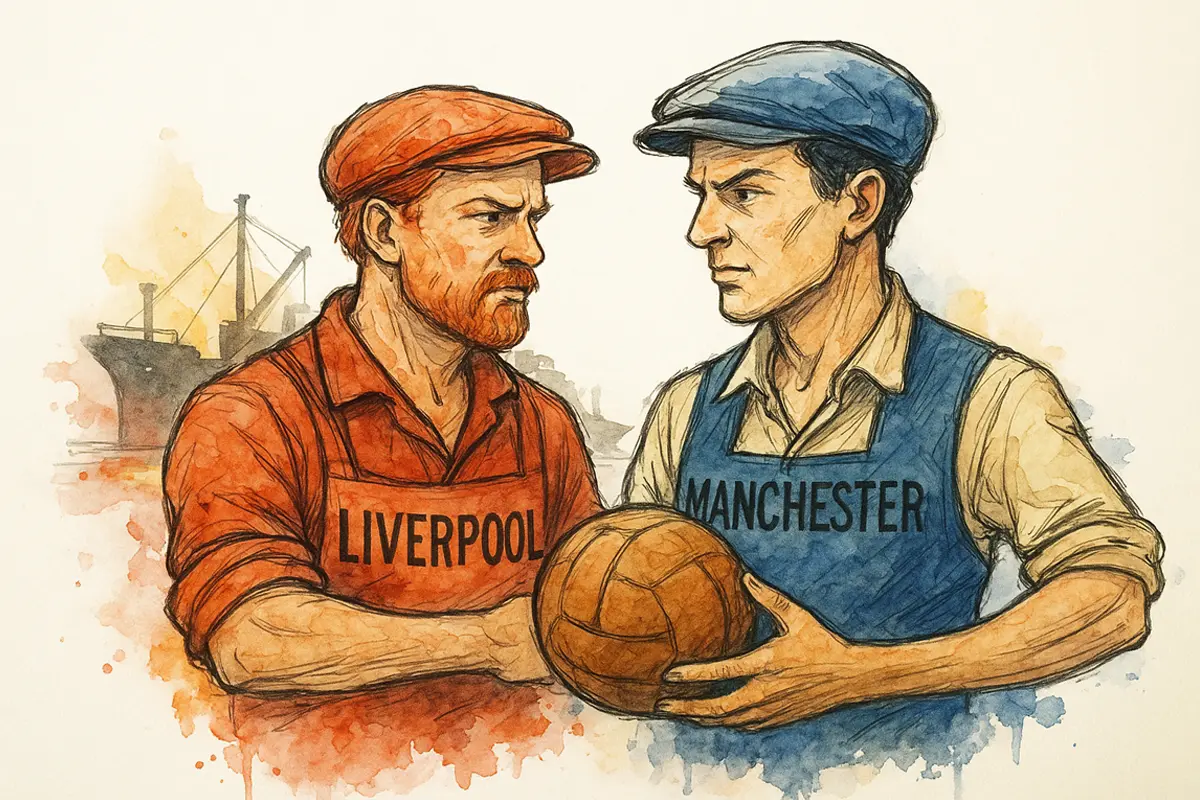
While I watch soccer for the beauty of the game, I would not call myself a hardcore fan like many of my friends.. What I really enjoy is the banter between my Manchester United and Liverpool friends, a rivalry that dominates conversations and defines English football for millions..
Yet, beneath the intense sporting competition lies a much older story.. Long before the first league match was played, Manchester and Liverpool were already competing fiercely, not on the pitch, but through trade, maritime access, and economic power..
This is the story of how shipping may have started a rivalry that would later find its loudest expression in football..
Liverpool: The gateway to the world
In the 18th and 19th centuries, Liverpool grew into one of Britain’s most important ports.. Cargoes from around the world flowed into the docks along the River Mersey, particularly raw cotton imported from the United States..
That cotton was then transported inland to Manchester, where it fed the mills that powered the Industrial Revolution..
This trade dynamic created a clear hierarchy.. Liverpool controlled the maritime access, customs processes, and port infrastructure that allowed Manchester’s industry to prosper.. As a result, Liverpool held a significant amount of economic influence in the region..
Manchester’s ambition to control its own trade
Manchester’s growth was extraordinary.. It became the global centre of textile manufacturing, but it remained dependent on its coastal neighbour to connect with international markets..
Leaders in Manchester were determined to take more control of their economic destiny.. The solution was bold, futuristic, and transformative..
In 1887, construction began on the Manchester Ship Canal: a deep-water route stretching approximately 58 kilometres from the Irish Sea to the heart of Manchester.. When it opened in 1894, the city effectively became an inland port capable of receiving ocean-going vessels..
The impact was immediate.. Cargo that once relied on Liverpool’s docks could now arrive directly in Manchester.. Warehouses, industrial sites, and new employment opportunities began emerging along the canal corridor.. The economic balance of the Northwest had shifted.
Symbols of commerce and conscience
There is often debate about the ship that appears atop the Manchester United and Manchester City crests, with some Mancunians linking it to the opening of the Ship Canal, though in truth, the emblem predates the canal by half a century..
The ship, drawn from Manchester’s coat of arms granted in 1842, symbolised the city’s trading spirit and aspiration for global reach long before the canal connected it directly to the sea..
Some historians note that this prosperity was built on the cotton trade, which in its early years depended on enslaved labour in the United States, while Liverpool’s own maritime wealth grew through the transatlantic routes that carried both cotton and enslaved people..
These intertwined histories are a reminder that the ships once sailing between these cities were more than symbols; they were vessels of commerce, ambition, and complexity..
And perhaps, without realising it, fans who proudly wear those crests today are also carrying traces of that past, the unspoken history of trade, toil, and human cost stitched into the very fabric of this rivalry..
Rivalry reinvented for a new era
Today, both cities continue to hold important places in global logistics.. Liverpool’s port remains a major gateway for international containerised trade, serving shipping lines and supply chains that reach far beyond the United Kingdom..
The Manchester Ship Canal corridor has evolved into a modern multimodal logistics hub, supporting warehousing, inland distribution, and interconnected transport networks..
The motivations remain surprisingly similar: attract business, build capabilities, and stay competitive in global trade.. The rivalry lives on, simply through different vessels..
The story of Manchester United and Liverpool is ultimately the story of two cities that helped build Britain’s industrial and maritime strength.. Their football rivalry stands on the shoulders of a much older contest for economic leadership, access to trade routes, and regional significance..
When these clubs meet, supporters witness far more than 90 minutes of sport.. They are watching a rivalry that was first forged on quaysides, in warehouses, and along a canal carved through the landscape to reshape the future of a city..
The football rivalry may be louder..
The shipping rivalry was there first..