
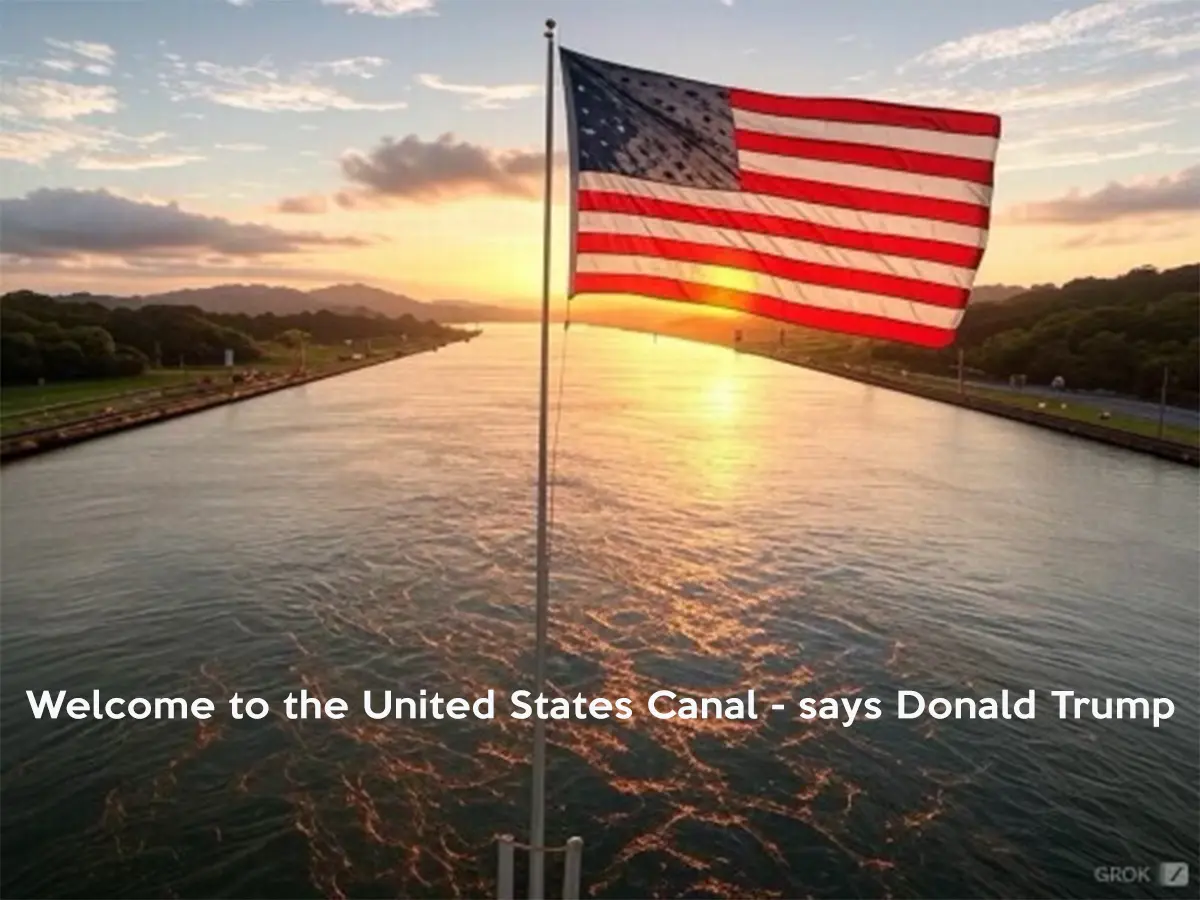
During a speech on 22nd December 2024, President-elect Donald Trump threatened that the United States might reclaim control of the canal, expressing concerns about Chinese influence over the waterway and criticizing Panama for its high transit fees.
“If the principles, both moral and legal, of this magnanimous gesture of giving are not followed, then we will demand that the Panama Canal be returned to the United States of America in full, quickly and without question,” Trump declared.
Trump followed this rhetoric posting image stating “Welcome to the United States Canal” on his TruthSocial account.
“Has anyone ever heard of the Panama Canal?” Trump said at AmericaFest, an annual event organized by Turning Point, an allied conservative group. “Because we’re being ripped off at the Panama Canal like we’re being ripped off everywhere else.” Reuters has reported.
The Current Geopolitical Debate
Trump’s comments highlight the canal’s enduring geopolitical significance. While the U.S. relinquished control over the canal decades ago, its strategic location and influence over global trade make it a focal point for international power dynamics.
Concerns over rising Chinese investments in Panama and other Latin American countries have added another layer of complexity to the debate.
Trump’s statement has drawn immediate responses from world leaders, including Mexican President Andrés Manuel López Obrador, who defended Panama’s sovereignty, stating that the canal “belongs to the Panamanians.”
Panama’s President José Raúl Mulino also rejected Trump’s comments, asserting that the canal is entirely under Panamanian control and free from foreign influence.
Panama, firmly asserting its sovereignty, emphasizes that the canal remains a symbol of national pride and economic independence. The country’s leadership has reassured the international community of its commitment to maintaining the canal’s neutrality and operational efficiency.
The Panama Canal – Historical Overview
The Panama Canal, completed in 1914, is one of the most significant engineering achievements of the 20th century. Stretching approximately 50 miles, the canal connects the Atlantic and Pacific Oceans, drastically reducing maritime transit times by avoiding the long and hazardous journey around South America’s Cape Horn.
The French initially attempted to construct the canal in the 1880s, led by Ferdinand de Lesseps, the mastermind behind the Suez Canal. However, tropical diseases, poor engineering, and financial mismanagement led to the project’s failure.
The United States resumed the effort in the early 1900s, employing innovative lock systems and significant health interventions to combat malaria and yellow fever. These measures, alongside robust engineering, culminated in the canal’s completion.
Under the Torrijos–Carter Treaties of 1977, the U.S. agreed to transfer control of the canal to Panama. This transition was finalized on December 31, 1999, marking a historic moment for Panama’s sovereignty.
The Canal’s Role in Global Trade
The Panama Canal is indispensable to global trade, facilitating approximately 14,000 vessels annually and handling nearly 5% of world trade.
It serves as a crucial link between the East Coast of the United States and Asia, significantly reducing shipping distances and costs. Goods such as electronics, automobiles, and agricultural products depend on this route for timely delivery.
In 2016, the canal underwent a major expansion to accommodate larger vessels, further solidifying its role in international commerce. However, it has faced challenges such as droughts affecting its water supply, necessitating transit restrictions, and new investments in water management infrastructure.
The Panama Canal is a great example of the intersection of engineering ingenuity, global commerce, and international diplomacy. As nations grapple with shifting economic power and trade dependencies, the canal’s governance will remain a topic of strategic interest.
The recent exchanges between Trump and global leaders underscore the need for multilateral dialogue to uphold the principles of sovereignty and cooperation that underpin global trade.